Leave Your Message
0%

Choosing a solar water pump isn't just about comparing motor wattage. Not even close. The right setup has to fit your well depth, how much water you need each day, the sunlight you actually get, pipe length, and how you plan to store water. A pump that works great on one farm can struggle in a remote borehole. Yep, the small details matter.

Dr. Amina Rahman, a renewable-water systems engineer, puts it like this: 'A reliable solar pump begins with accurate water-source data, not a low purchase price.' That's pretty much the mindset behind this guide. We're going to look at seven key selection points: flow rate, total dynamic head, controller quality, motor design, installation conditions, maintenance access, and long-term value. Together, they help buyers judge a Solar Pumps Water Pump with more confidence.

Search terms such as solar powered water pump solar bore pump price DC screw type solar bore pump brushless dc solar water pump solar dc submersible water pumps DC pump often describe very different products. And that difference? It can confuse first-time buyers. Honestly, it has confused experienced installers too. I've seen systems fail because the panels were oversized, the cables were undersized, or nobody thought about seasonal water levels. A lower price can look tempting at first. It can also lead to expensive replacement work later.

This intro won't promise one universal solution. There isn't one. Instead, it connects technical specs with real operating conditions. Expect clear comparisons, practical questions, and a few cautions. Measure carefully. Then choose confidently.
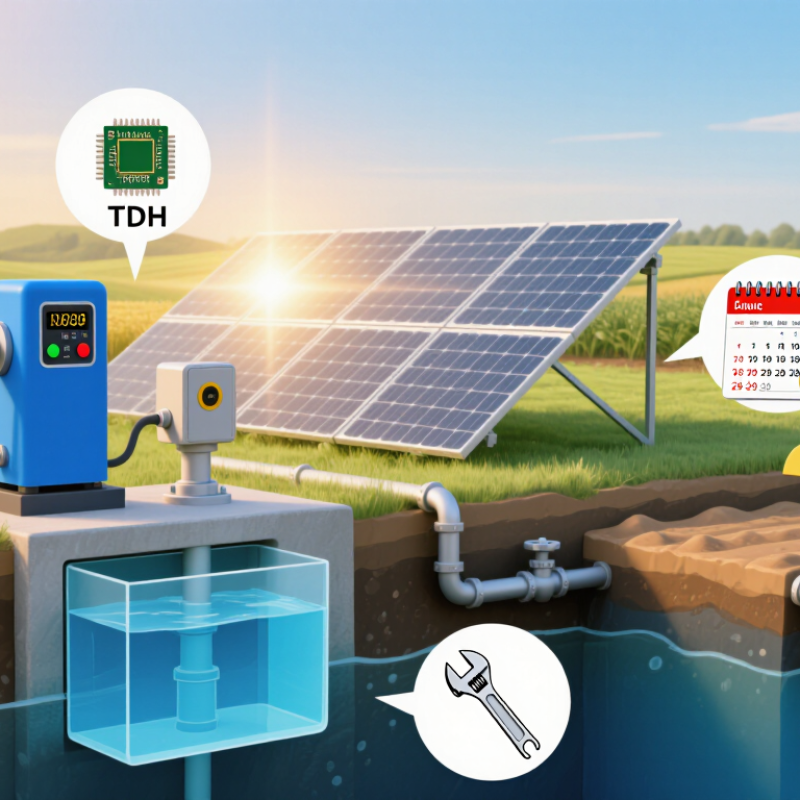
7 Tips to Choose the Best Solar Water Pump?

Define Your Water Needs and Pumping Conditions

Before choosing a solar water pump, define what the water must do. Measure daily volume, peak demand, source depth, and delivery height. A household may need 50 litres per person daily, while irrigation can require far more. The WHO/UNICEF Joint Monitoring Programme reported that 2.2 billion people lacked safely managed drinking water in 2022. Reliable design matters beyond convenience. Do not size the pump from well depth alone. Total dynamic head includes elevation, pipe friction, and changing water levels.

Tip 1: Record water demand across a full week. Note morning peaks, livestock use, seasonal irrigation, and dry-season drawdown. A 2,000-litre tank filled slowly may outperform a high-flow pump running briefly. Test the well during pumping, not only at rest. That distinction is easy to miss.

Tip 2: Match pump output to real sunlight and total head. Use measured litres per day at the required head, then check winter solar hours. FAO AQUASTAT identifies agriculture as responsible for roughly 70% of global freshwater withdrawals. Irrigation estimates deserve care. IRENA’s Renewable Power Generation Costs in 2023 reports a 90% fall in utility-scale solar PV costs since 2010. Cheaper panels cannot correct poor hydraulic assumptions. Include storage for cloudy periods and protection against dry running. My caution: “average sunshine” can hide several difficult weeks.

Assess Solar Resource and Select the Right Panel Capacity

Assess Solar Resource and Select the Right Panel Capacity

Choosing a Solar Pumps Water Pump begins with measuring the sunlight available at the installation site. Check monthly solar radiation, seasonal cloud cover, and shading from trees or nearby walls. A field test at different times can reveal problems that online maps miss. Morning shade matters.

Tip: Match panel capacity to the pump’s voltage, flow rate, and lifting height. A pump lifting water 30 meters needs more energy than one filling a shallow storage tank. Review the pump curve, not only the advertised wattage. In practice, adding 20–30% panel capacity can help during hazy weather and gradual panel aging. However, oversizing the array may increase cost without improving output.

Tip: Calculate daily water demand before selecting panels. Measure how many liters are needed, then compare that figure with expected sunlight hours. For example, a small farm requiring 8,000 liters daily may need stronger capacity during winter. Use conservative sunlight estimates. Real conditions are rarely perfect.

Tip: Leave room for maintenance and future changes. Dust on panels, loose wiring, and a partly blocked panel can reduce performance noticeably. Keep panels accessible for cleaning and inspect cables after heavy rain. I have seen systems underperform because the panel estimate was optimistic. Rechecking the calculation is worthwhile. A local solar technician can verify the design and confirm safe electrical installation.

7 Tips to Choose the Best Solar Water Pump: Assess Solar Resource and Select the Right Panel Capacity

The chart uses representative monthly average peak sun hours for a sunny subtropical location. The recommended photovoltaic array is estimated for 20 m³ of water per day at a 30 m total dynamic head, assuming 45% overall pumping efficiency, 75% solar-system derating, and a 25% design margin. Use local solar measurements and actual pump specifications before making a final selection.

Compare Pump Types for Wells, Irrigation, and Household Use

Choosing a solar water pump starts with the water source, not the panel size. For deep wells, select a submersible pump that handles the required total dynamic head. Surface pumps suit shallow wells, tanks, and open irrigation channels. Centrifugal models deliver strong flow for farms, while helical rotor pumps often perform better at higher heads. Household systems need steady pressure, low noise, and safe materials.

Measure daily water demand, well depth, pipe length, elevation, and dry-season yield. Then compare flow rate and head on the pump curve. A large pump may waste energy and empty a weak well. The FAO reports that agriculture uses about 70% of global freshwater withdrawals, so irrigation efficiency deserves close attention. Drip lines can reduce unnecessary pumping. Add a storage tank when sunlight changes during the day.

Check controller protection, dry-run shutdown, filtration, spare parts, and local service. Ask Solar Pumps Water Pump Manufacturers for measured performance data, not only peak wattage. The World Bank’s ESMAP research notes that solar pumping can reduce fuel costs, but poor sizing may increase groundwater stress. WHO and UNICEF reported that 2.2 billion people lacked safely managed drinking water in 2022, making reliability more important than appearance. My imperfect rule is simple: test the site before ordering. Dust, voltage loss, and seasonal water levels can change the decision. Even a promising specification can fail in the field.

7 Tips to Choose the Best Solar Water Pump? - Compare Pump Types for Wells, Irrigation, and Household Use

Tip Decision Factor Submersible Pump Surface Centrifugal Pump Helical-Rotor Pump Selection Guidance
1 Measure total dynamic head Well depth plus required delivery height and friction losses. Common solar well systems are designed for approximately 20–150 m of total head, depending on pump size. Best when the water level is within the pump’s suction limit. Practical suction lift is generally about 6–7 m at sea level, and less in hot or high-altitude conditions. Suitable for medium-to-high head applications, but flow usually decreases as head increases. For deep wells, choose a submersible design. For shallow tanks, canals, or cisterns, a surface pump may be simpler.
2 Match flow rate to water demand Typical small systems deliver roughly 0.5–5 m³/h, while larger systems can deliver more under suitable solar conditions. Often provides higher flow at low-to-medium head; approximately 2–20 m³/h is common for small agricultural and domestic installations. Often provides steady metered flow, commonly around 0.2–8 m³/h, depending on rotor size, speed, and head. Estimate daily demand first. One cubic metre equals 1,000 litres; irrigation demand can vary greatly with crop, soil, weather, and irrigation method.
3 Select the right application Well pumping, boreholes, storage tanks, livestock watering, and household water supply. Shallow wells, open reservoirs, rainwater tanks, canals, and surface irrigation. Deep wells, drip irrigation, livestock systems, and applications needing strong low-light performance. Use a pump designed for the water source. Never install a surface pump where the water level can fall below its safe suction range.
4 Check solar input and operating conditions Works well with a solar controller that adjusts motor speed as sunlight changes. Shading can substantially reduce output. May need more starting power because centrifugal pumps can draw higher current during startup. Usually performs well over a broad range of solar input because the positive-displacement action maintains useful pressure at lower speed. Size the array using the site’s worst-season solar resource, not only the annual average. Include allowance for cloudy days and panel temperature losses.
5 Consider water quality and filtration Many borehole models tolerate limited suspended particles, but sand can accelerate wear and should be controlled. Sensitive to debris and can lose prime if air enters the suction line. A strainer and foot valve are commonly required. More sensitive to abrasive sand because the rotor and stator operate with close clearances. Test for sand, silt, iron, salinity, and biological contamination. Use filtration appropriate to the pump and intended household or irrigation use.
6 Compare efficiency and storage options Generally efficient for lifting water from deep wells. Water storage is usually more economical than batteries for daily pumping. Efficient near its design point, but efficiency can fall when operated far from the rated head and flow. Often efficient at high head and variable sunlight, although replacement of the rotor or stator may eventually be needed. For irrigation, pump into an elevated tank where possible. Batteries are mainly justified when water is required after sunset or continuous pressure is essential.
7 Evaluate maintenance and protection Requires correct cable sizing, dry-run protection, overcurrent protection, and safe removal equipment for deep installations. Easy to access for inspection, but requires protection from rain, flooding, overheating, leaks, and loss of prime. Needs protection against dry running and excessive pressure. Periodic inspection of the rotor and stator is important. Choose a system with dry-run, overvoltage, overcurrent, and tank-level controls. Confirm that replacement parts and qualified service are available locally.
Important: Flow and head ranges are typical planning values, not guaranteed performance ratings. Actual output depends on pump curve, solar irradiance, panel orientation, controller efficiency, pipe diameter, elevation, water level, and seasonal conditions.
Quick rule: Use a submersible pump for deep wells, a surface centrifugal pump for shallow or open water sources, and a helical-rotor pump when high head, measured flow, and variable sunlight are key priorities.

Match Pump Flow Rate and Head to Your System

7 Tips to Choose the Best Solar Water Pump

Choosing a solar water pump starts with two numbers: flow rate and total head. Flow rate is the water needed per hour. Head is the vertical lift plus pipe resistance. A pump may lift water 30 meters, yet deliver far less than its advertised flow.

Measure the water source, tank height, pipe length, bends, and filters. Add friction losses before selecting the pump. For example, a farm requiring 2,000 liters daily may need only 250 liters per hour over eight sunny hours. However, cloudy weather changes the calculation. Sizing only for perfect sunlight is a weak decision.

Check the pump curve at your actual head, not at zero lift. A reliable Solar Pumps Water Pump Manufacturer should provide tested flow data, operating voltage, and controller details. Ask whether the figures reflect real conditions or laboratory testing. That difference matters.

Use a small safety margin, but avoid choosing an oversized pump. It can cost more and waste available solar power. I once underestimated pipe losses in a long irrigation line; the tank filled painfully slowly. That mistake taught me to verify flow at the outlet. Test the system with a container and timer after installation. Simple checks reveal problems early. Monitor seasonal performance, because winter sunlight may expose assumptions that looked reasonable in summer.

Check Power Storage, Controls, and Backup Options

Choosing the best solar water pump starts with power storage, not the pump label. IRENA’s Renewable Power Generation Costs report shows solar PV costs fell about 90% from 2010 to 2023. Yet a cheap panel system can still fail at sunset. Match daily water demand with peak sun hours, then size the battery for essential night-time use. For a small farm, this may mean storing enough energy for livestock drinking and one irrigation cycle, rather than powering every outlet.

Controls deserve close inspection. Choose a controller with maximum power point tracking, dry-run protection, overload protection, and automatic low-water shutdown. These features protect the motor when clouds pass or a well level drops. FAO reports that agriculture uses roughly 70% of global freshwater withdrawals, so flow sensors and timed irrigation are not optional extras. They help prevent both wasted water and silent groundwater depletion.

Keep a backup path. A hybrid inverter can connect batteries, grid power, or a compliant generator when several cloudy days arrive. Test the changeover before the dry season. I have seen systems with excellent panels stop because one untested battery connection failed. That mistake is easy to repeat. Review battery temperature limits, replacement cost, and controller compatibility before buying. The most powerful pump is not always the most reliable choice.

Evaluate Durability, Installation, Maintenance, and Total Cost

Choosing the best solar water pump requires more than comparing flow rates. Durability should match the water source and daily workload. Stainless steel parts, sealed motors, and dry-run protection help in dusty or remote locations. Ask for tested performance, not only advertised figures. A pump moving water uphill needs enough head pressure. Measure the well depth, pipe length, and storage tank height before buying.

Installation can decide whether the system performs well. Panels need clear sunlight, correct tilt, and secure mounting. Use suitable cable sizes and protect connections from rain and animals. A trained installer should check voltage, grounding, and controller settings. I have seen small wiring mistakes reduce output noticeably. They are easy to overlook.

Maintenance should remain practical. Clean panels monthly, inspect filters, and check unusual noise or reduced flow. Keep replacement seals and fuses available. Calculate the total cost over ten years, including panels, controllers, pipes, labor, batteries, and repairs. Batteries may increase convenience but often add replacement expense. The phrase High-Quality Solar Pumps Water Pump means little without test records, spare-part access, and clear warranty terms. User reviews can help, but local water conditions may differ. A cheaper pump can become expensive after repeated service calls.

FAQS

How should I assess sunlight before choosing a solar water pump?

Measure sunlight during morning, noon, and afternoon. Check seasonal clouds, wall shadows, and tree cover. Morning shade matters. Online maps may miss local problems. A short field test can reveal more.

How do I select the correct solar panel capacity?

Match panel capacity with voltage, flow rate, and lifting height. A pump lifting water 30 meters needs more energy. Review the pump curve, not only wattage. Adding 20–30% capacity can help in hazy weather. Oversizing still increases cost.

How much water should the system produce daily?

Measure actual demand in liters. Compare it with reliable sunlight hours. A small farm needing 8,000 liters daily may need stronger winter capacity. Use conservative estimates. Perfect sunlight is an unsafe assumption.

Which pump type suits a deep well?

A submersible pump usually suits a deep well. Check total dynamic head and dry-season water levels. Surface pumps fit shallow wells, tanks, and open channels. A large pump may empty a weak well. That can create trouble.

What information is needed before choosing pump flow and head?

Record well depth, tank height, pipe length, bends, filters, and elevation. Flow rate means water delivered per hour. Head includes vertical lift and pipe resistance. Compare performance at the actual head. Zero-lift figures can mislead.

How can I avoid wasting solar power?

Avoid choosing an oversized pump. It may cost more and waste available energy. Use storage tanks when sunlight changes during the day. Drip irrigation can reduce unnecessary pumping. Efficiency is not automatic.

What controller and protection features should I check?

Check dry-run shutdown, filtration, voltage protection, and cable quality. Confirm operating voltage and tested flow data. Ask for field measurements, not only peak wattage. Local spare parts and service also matter. Specifications can look better than reality.

How should I maintain the solar pumping system?

Keep panels accessible for cleaning. Remove dust and inspect cables after heavy rain. Check loose wiring and partly blocked panels. Test outlet flow with a container and timer. I once underestimated pipe losses, so I would recheck the calculation.

Conclusion

Choosing the right solar water pump begins with understanding your daily water demand, source depth, lifting distance, and intended application. Consider whether the system will serve a well, irrigation field, livestock area, or household, then select a pump type that suits these conditions. Compare the required flow rate and total head carefully, since a pump must deliver enough water at the necessary height without excessive energy use. Assess the available sunlight throughout the year and choose sufficient solar panel capacity to support reliable operation during peak demand and changing weather conditions.

A complete evaluation should also include battery storage, controllers, and backup power options for periods of limited sunlight. Pay attention to construction quality, weather resistance, installation requirements, maintenance access, and expected service life. Finally, compare the total cost, including equipment, installation, replacement parts, and long-term operating expenses. By balancing performance, reliability, and affordability, users can select Solar Pumps Water Pump systems that provide efficient and sustainable water delivery for their specific needs.
Isabelle

Isabelle

Isabelle is a dedicated marketing professional at Zhejiang Lanbo Intelligent Technology Co., Ltd., where her expertise in the field shines through her work. With a deep understanding of the company's innovative products, she plays a pivotal role in conveying the brand's message and values to a......
Previous How to Choose the Best Solar Water Pump?