
 DC SOLAR SUBMERSIBLE PUMP
 AC/DC Solar submersible Pump
 DC Solar Surface Pump
 AC/DC solar surface Pump
 Solar swimming Pool Pump
 Built-in Controller Solar Pump
 Solar Pump inverter
 Pump Accessories


 Mr Youkee Kong
80-Meter Deep Well: Submersible or Surface Pump?
80-Meter Deep Well: Submersible or Surface Pump?
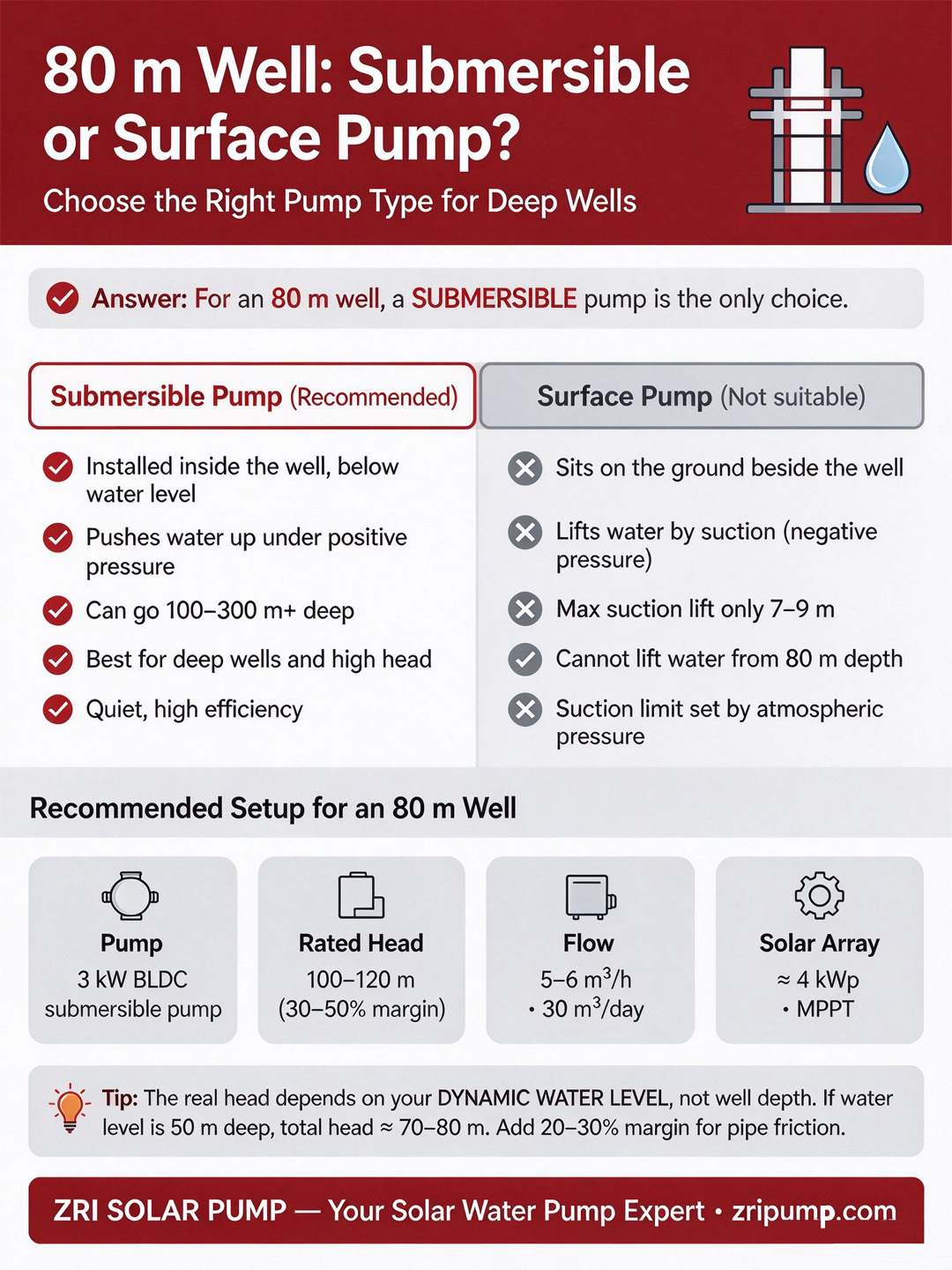
Quick Answer
Submersible pumps push water upward from underwater; surface pumps rely on atmospheric pressure to pull it up. At 80 m there is no "pull" option.
| Component | Specification |
|---|---|
| Pump type | Solar submersible (borehole) pump |
| Install depth | 30–70 m (below min water level) |
| Pump power | 1.5–3.0 kW (by flow & head) |
| Pump diameter | 4″ (100mm) or 6″ (150mm) to casing |
| Motor | Brushless DC permanent magnet |
| Construction | 304 or 316 stainless steel |
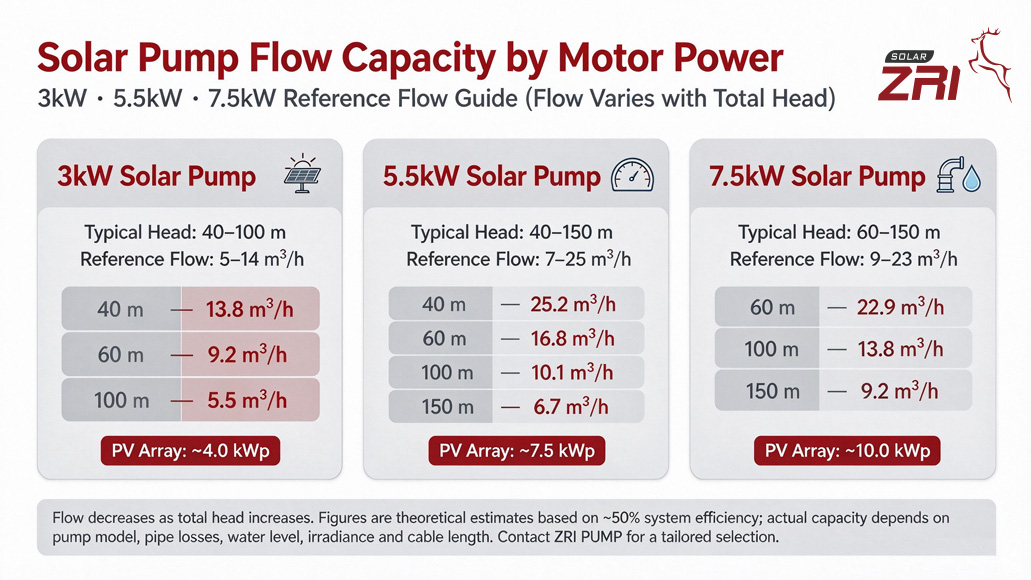
| Max head | 80–150 m |
| Flow rate | 50–120 L/min by TDH |
| Controller | MPPT solar controller + dry-run |
| Solar array | 2.5–4.5 kW by size & location |
| Cable / Pipe | 10–16 mm² submersible cable; 32–50 mm HDPE/PVC |
Understanding Pump Types & Principles
Surface Pump (centrifugal)
Installed above ground. Creates a vacuum in the suction pipe; atmospheric pressure pushes water up. Max theoretical suction 10.33 m at sea level; practical max 7–8 m, reduced by friction, vapor pressure, altitude, and warm water (≈6 m at 1,000 m, ≈5 m at 2,000 m).
Submersible Pump (borehole / deep well)
Installed underwater below the water level, pushing water up through the delivery pipe. No suction limit — operates at any practical depth up to 500+ m. Types: multi-stage centrifugal (most common, for wells), single-stage (drainage), helical rotor (solids/viscous).
Why Surface Pumps Cannot Work at 80 m
Scenario 1 — water at 10 m
Needed suction 10 m vs max 7–8 m → impossible (not enough vacuum).
Scenario 2 — water at 40 m
Needed 40 m vs physical law 10.33 m → completely impossible.
Scenario 3 — seasonal ±
Dry 50 m / wet 30 m — no surface pump handles either.
Deep well jet pumps
Ejector extends suction to ~20–25 m only; less efficient, more maintenance — still inadequate at 80 m.
Submersible vs Surface: Pros & Cons
Submersible — Advantages
- No suction limit (50–300+ m)
- No priming; no cavitation
- Higher efficiency, quiet, space-saving
- Freeze-safe (below frost line)
- Low theft/vandalism risk
Submersible — Disadvantages
- Hard to inspect (pull from well)
- Higher initial cost
- Cooling depends on water level
- Specialized install (torque arrestor)
- Cable vulnerability
Surface — Advantages
- Easy maintenance & install
- Lower initial cost
- Easy troubleshooting
- Air-cooled; good for shallow <7 m
Surface — Disadvantages
- 7–8 m suction limit (critical)
- Priming & cavitation risk
- Noisy; needs pump house
- Freeze risk; high theft risk
Comparison Table
| Feature | Submersible | Surface |
|---|---|---|
| Max depth | 50–500+ m | 7–8 m suction |
| For 80 m well | YES — required | NO — impossible |
| Priming | Not required | Required |
| Noise | Very quiet | Moderate–loud |
| Install complexity | High | Low |
| Maintenance access | Difficult | Easy |
| Initial cost | Higher | Lower |
| Efficiency | High | Lower (suction loss) |
| Cavitation | None | Moderate–high |
| Lifespan | 8–15 yr | 5–10 yr |
| Best for | Deep wells, boreholes | Shallow, ponds, tanks |
ZRI SOLAR PUMP Selection for 80 m Well
| Option | Power | Max head | Flow @ head | Build |
|---|---|---|---|---|
| Std (ground tank) | 2.2 kW | 90 m | 75–85 L/min @65m | 304 SS, 18-stage |
| High-head (+5m/2bar) | 2.8 kW | 120 m | 75–85 L/min @85m | 316 SS, 22-stage |
| Larger flow | 3.5 kW | 100 m | 120–140 L/min @65m | 304 SS |
Installation Guidelines (80 m)
Pre-install
- Video inspect, develop/clean well, yield & water-quality test, confirm depth & casing.
- Checklist: pump, MPPT controller, panels+mount, submersible cable, HDPE/PVC pipe, clamps, check valve (1–2 m above pump), torque arrestor, well seal, level sensor, lifting gear, safety gear.
Procedure
Solar System Design
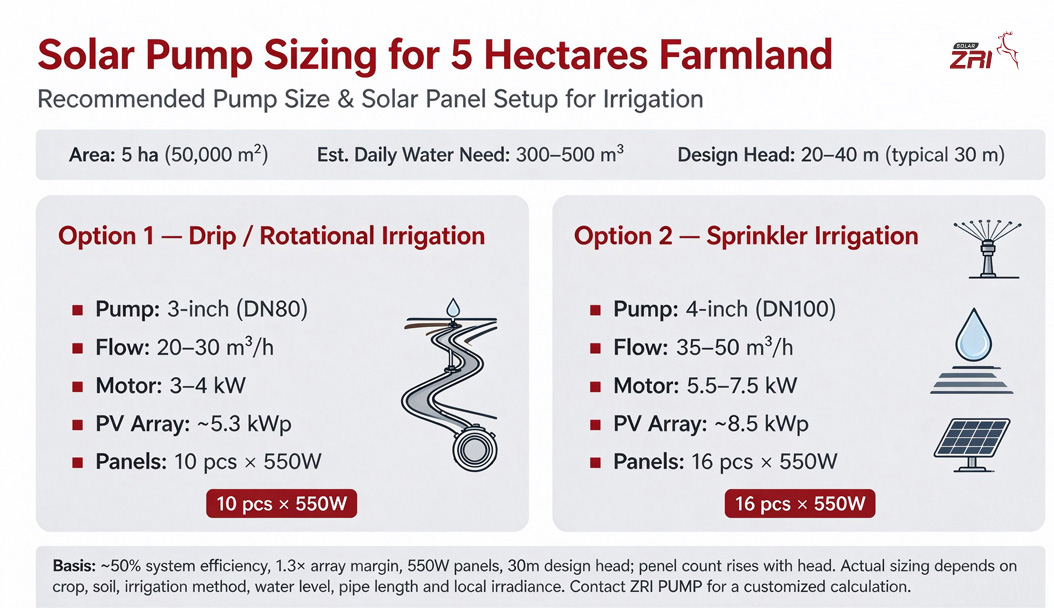
Array: 2.2 kW pump → ~3.2 kW panels. Prefer 8×400W ( ~152V/21A) for lower cable loss. Controller: input 100–400V DC ≥3.2 kW, output 300V DC ≥2.5 kW, with dry-run/over-voltage/over-temp/surge/soft-start. Advanced: Bluetooth/Wi-Fi/4G, logging, app, variable speed.
Mounting: ground mount (tilt = latitude ±15°, south/north-facing, ≥2 m height) or pole mount (≤8–10 panels). Roof only if load-verified and near wellhead.
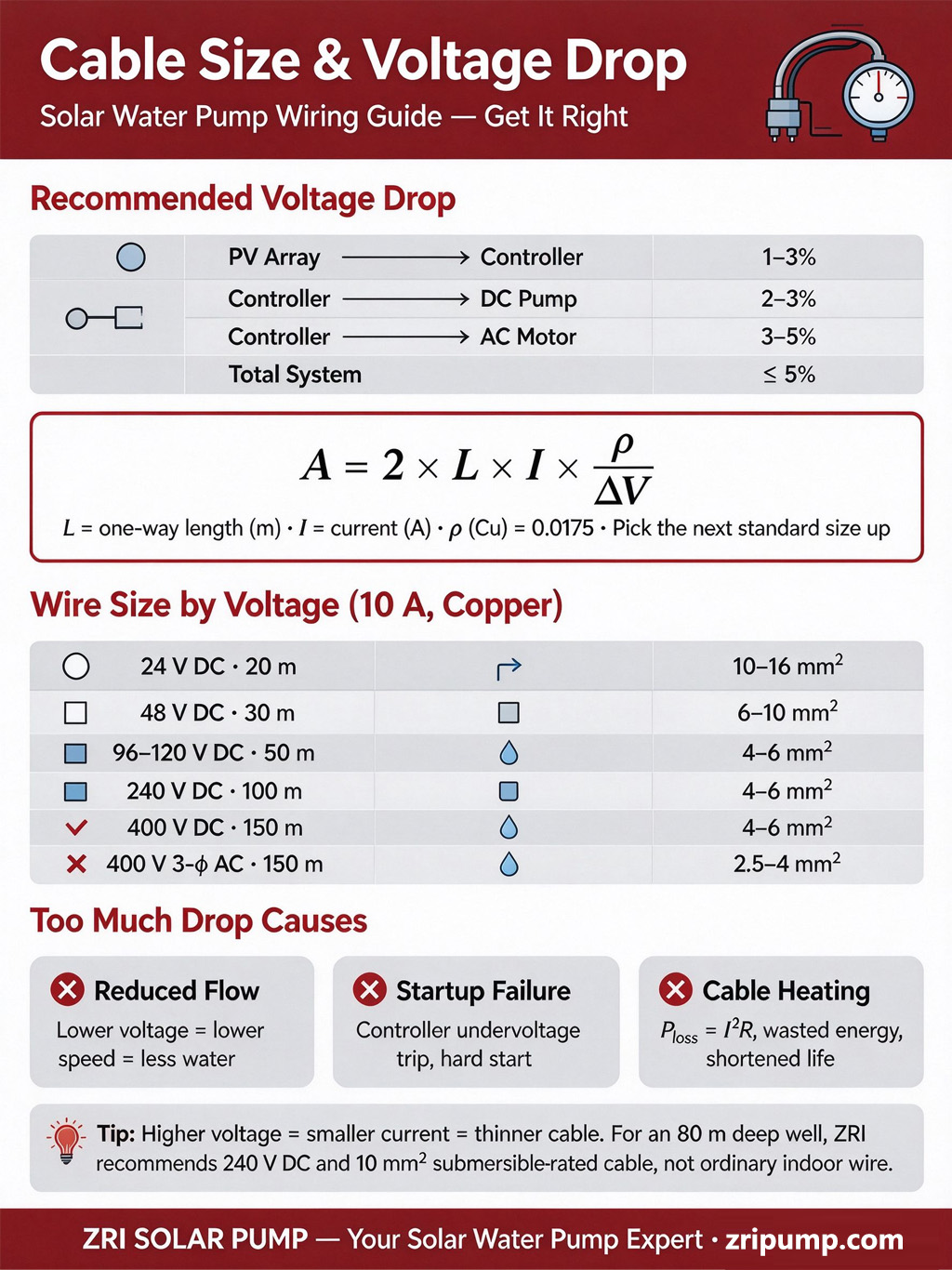
Cable: array→controller 30 m/152V/21A → 6 mm² solar cable (drop 2.4%). Controller→pump 55 m/96V/22.9A → 16 mm² submersible-rated cable (drop 2.9%).
8 Common Mistakes
- Surface pump for 80 m — impossible; always submersible >8 m.
- Wrong install depth — too shallow = dry-run; too deep = sediment. Use 50–70% depth, 5 m below dynamic, 3–5 m above bottom.
- Undersized cables — voltage drop, overheating, fire. Calculate properly.
- No dry-run protection — failure in minutes/hours. Use level sensor or controller feature.
- Inadequate solar — size array 1.4–2× pump power, not equal.
- No check valve — backflow, water hammer, long restart. Install 1–2 m above pump.
- Hanging pump on cable — use safety rope/pipe support; cable must have slack.
- Ignoring well yield — match pump capacity to yield; test before sizing.
Maintenance & Troubleshooting
Monthly
- Clean panels; check controller
- Record flow; inspect cables
Quarterly
- Test dry-run; inspect seal/cap
- Review logs; measure voltages
Annual
- Video survey; water test
- Measure levels; test protection
3–5 yr
- Pull & inspect; replace seals/bearings
- Check impeller & motor insulation
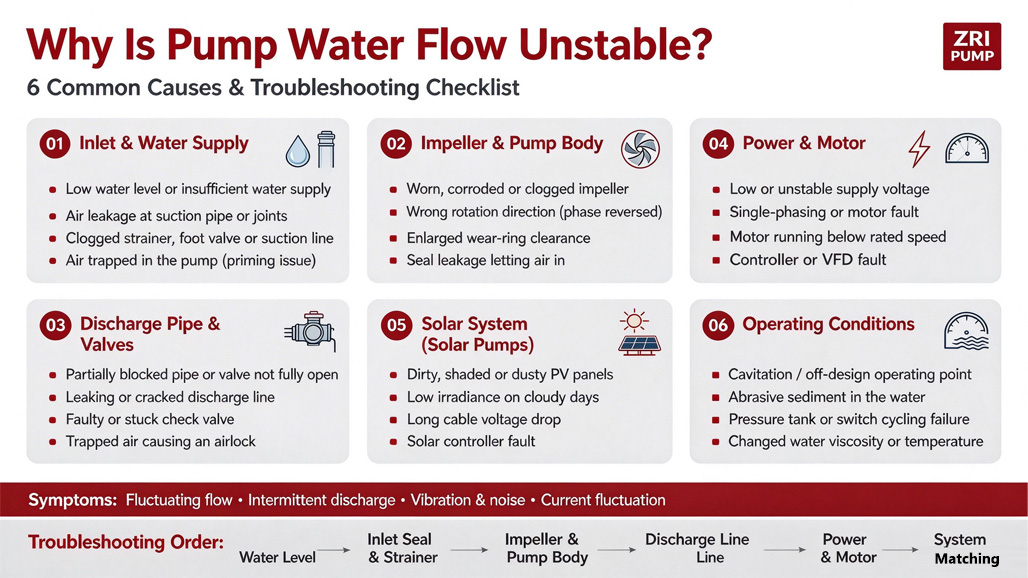
| Problem | Likely cause | Action |
|---|---|---|
| Won't start | No sun, bad connection, dry-run trip | Check panels, controller, sensor |
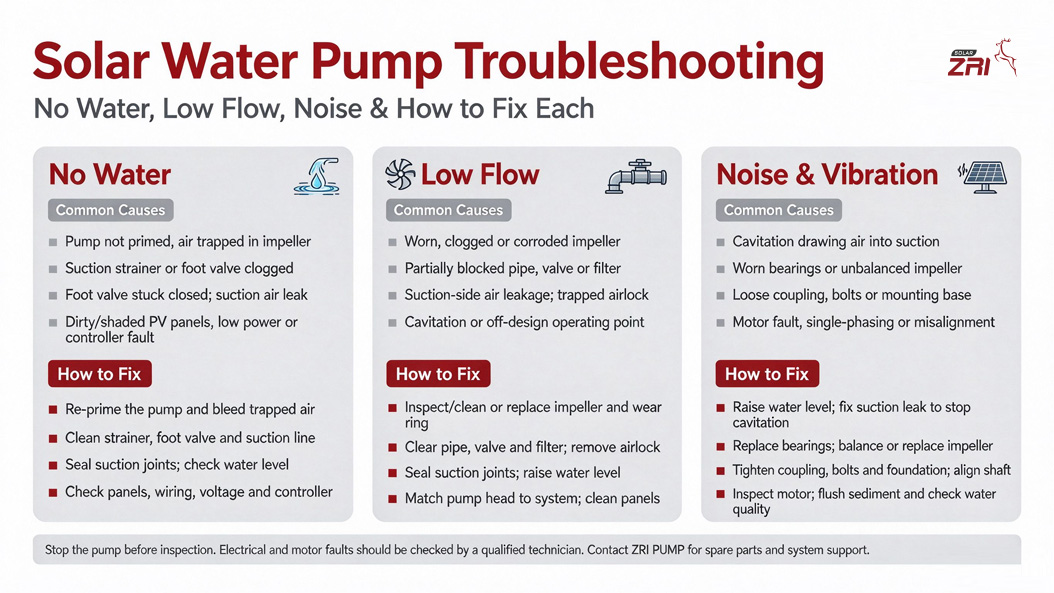
| Low flow | Dirty panels, voltage drop, clogged strainer | Clean, measure V at pump, check leaks |
| Cycles on/off | Low yield, level control, loose wire | Monitor level; check settings |
| No delivery | Stuck check valve, air lock, downhole break | Release air; may need pull |
| Muddy water | Too deep, damaged screen | Raise pump; rehabilitation |
Cost Analysis
| Component | Qty | Total |
|---|---|---|
| Submersible pump 2.2 kW | 1 | ~$1,000 |
| MPPT controller 3 kW | 1 | ~$575 |
| Solar panels 400W | 8 | ~$1,400 |
| Mount, cable, pipe, valves | set | ~$1,417 |
| Protection & sensors | set | ~$355 |
| Professional install | 2–3 d | ~$1,000 |
| Total system | $5,000–$8,000 |
ROI vs diesel (15 yr): solar ~$7,250 vs diesel ~$60,900 — payback ~1.2 yr, save ~$53,650, 0 vs ~135 t CO₂. Vs grid electric: ~$7,250 vs ~$14,950 — payback ~5.5 yr.
Frequently Asked Questions
No. Practical suction limit 7–8 m; submersible required.
1.5–2.5 kW for 30–50 m³/day residential; confirm with ZRI SOLAR PUMP.
40–60 m, ≥5 m below dynamic level, ≥3–5 m above bottom.
Requires lifting gear & expertise; professional install recommended at 80 m.
8–15 years; seals/bearings at 5–8 yr.
Dry-run overheats; fails in minutes — use dry-run protection.
~3–4 kW for a 2 kW pump.
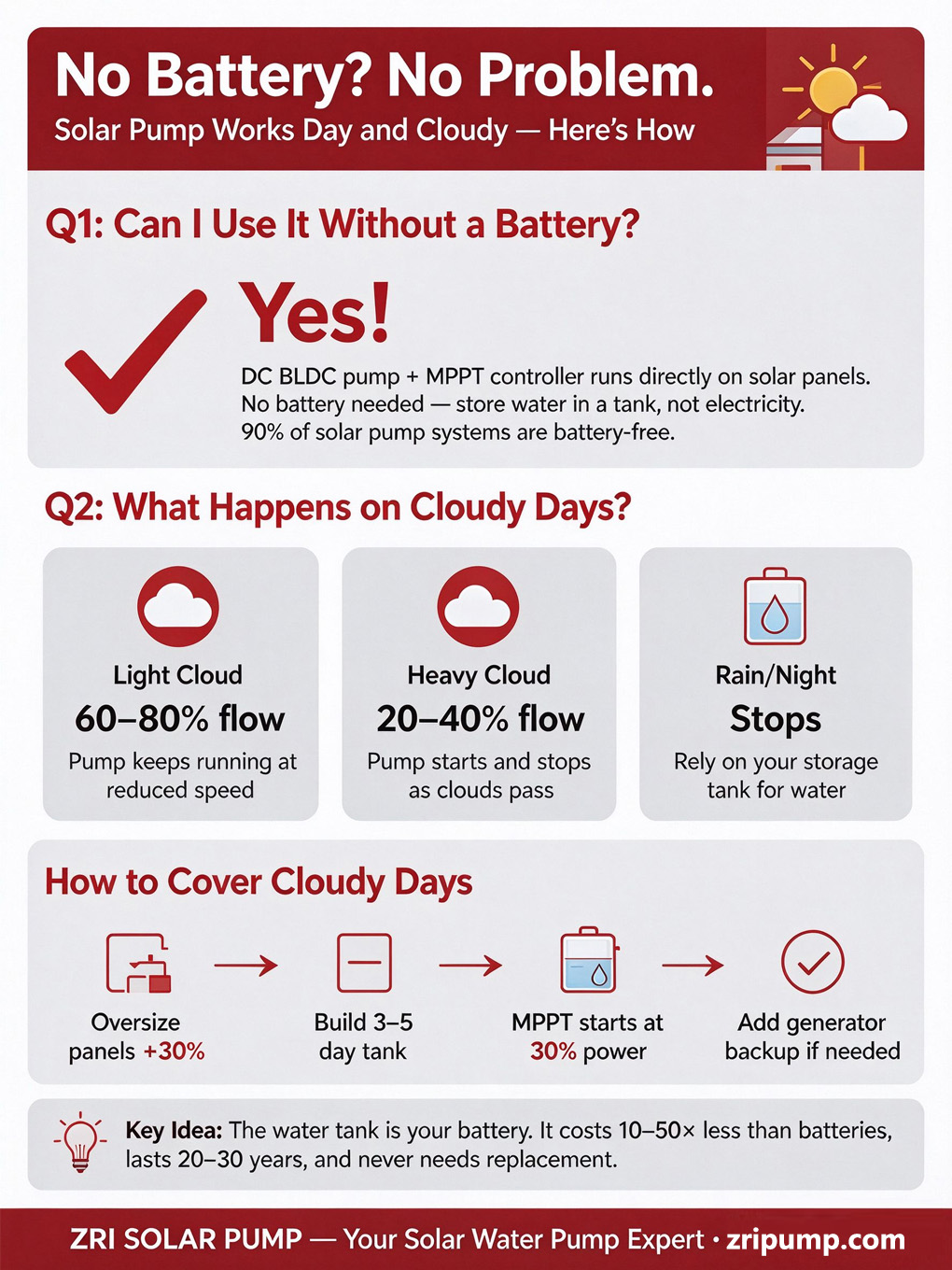
Yes, hybrid controller with solar primary.
Leave ≥1″ clearance; 6″ casing → 4″ pump.
Panels/checks monthly; major service 5–8 yr (pull pump).
Specify 316/316L stainless.
Remote troubleshoot; then pull & ship or local service.
Arrestors on input & output + grounding.
Add tank height to lift (10 m tank + 50 m = 60 m).
>7–8 m submersible only; 3–7 m optional; <3 m surface cheaper.