
 DC SOLAR SUBMERSIBLE PUMP
 AC/DC Solar submersible Pump
 DC Solar Surface Pump
 AC/DC solar surface Pump
 Solar swimming Pool Pump
 Built-in Controller Solar Pump
 Solar Pump inverter
 Pump Accessories


 Mr Youkee Kong
Can Solar Water Pumps Work Without Batteries? Cloudy Day Operation Guide | ZRI SOLAR PUMP
Can Solar Water Pumps Work Without Batteries? Cloudy Day Operation Guide | ZRI SOLAR PUMP
1 · Quick Answer
Performance by Weather
| Weather | Irradiance | Pump Performance |
|---|---|---|
| Full sunshine | 1000 W/m² (100%) | Full flow & pressure |
| Partly cloudy | 600–800 W/m² (60–80%) | 60–80% of rated |
| Overcast | 200–400 W/m² (20–40%) | 20–40% or stops |
| Heavy cloud/rain | 50–150 W/m² (5–15%) | Typically stops |
| Night | 0 W/m² (0%) | Stops completely |
Direct-Coupled vs Battery System
| Feature | Direct-Coupled | Battery-Based |
|---|---|---|
| Cost | Lower (no battery) | Higher (+30–60%) |
| Maintenance | Minimal | Higher (replace 3–7 yrs) |
| Lifespan | System 15–20 yrs | Battery only 3–7 yrs |
| Cloudy day | Reduced or stops | Runs from battery (limited) |
| Night | No pumping | Pumps till depleted |
| Efficiency | Higher (no loss) | Lower (15–25% loss) |
| Reliability | Higher (fewer parts) | Lower (battery fails) |
| Best for | Tank storage (90%) | 24/7 pumping (rare) |
 2 · How Direct-Coupled Systems Work
A direct-coupled system (battery-free, sun-driven) has four parts: PV array, MPPT controller, pump (submersible or surface), and a water storage tank (stores water, not electricity). It runs whenever sunlight is available—no battery.
A Day in Operation
Morning: low light, output below startup threshold, pump does not start. Mid-morning: light rises, MPPT soft-starts the pump at 20–30% speed and water begins flowing. Midday (9:00–15:00): near-peak output, pump at full capacity—most daily water is produced here. Late afternoon: declining light, pump slows but keeps extracting water. Night: output drops below threshold, pump stops, controller sleeps.
Cloudy Day Behavior
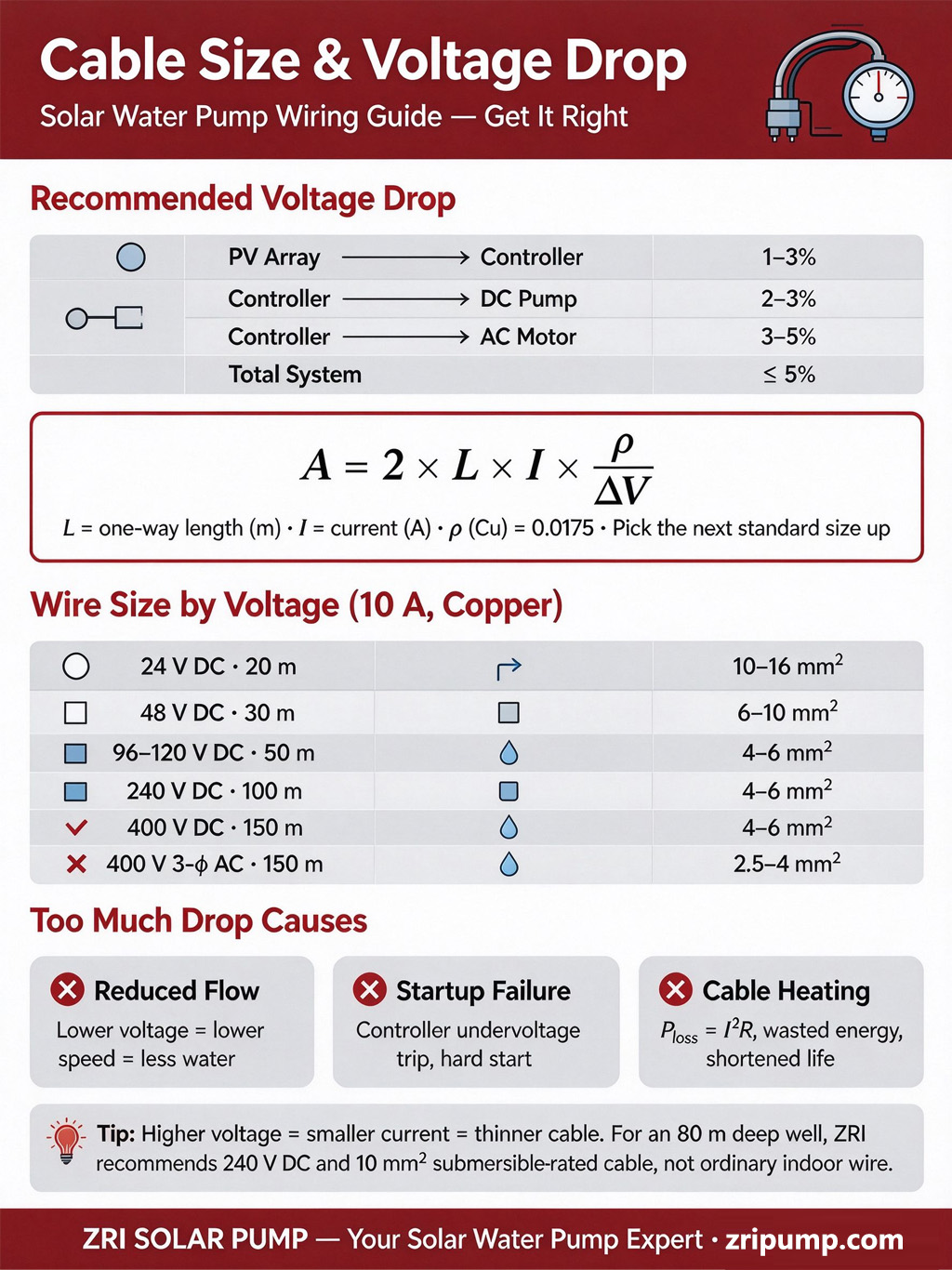
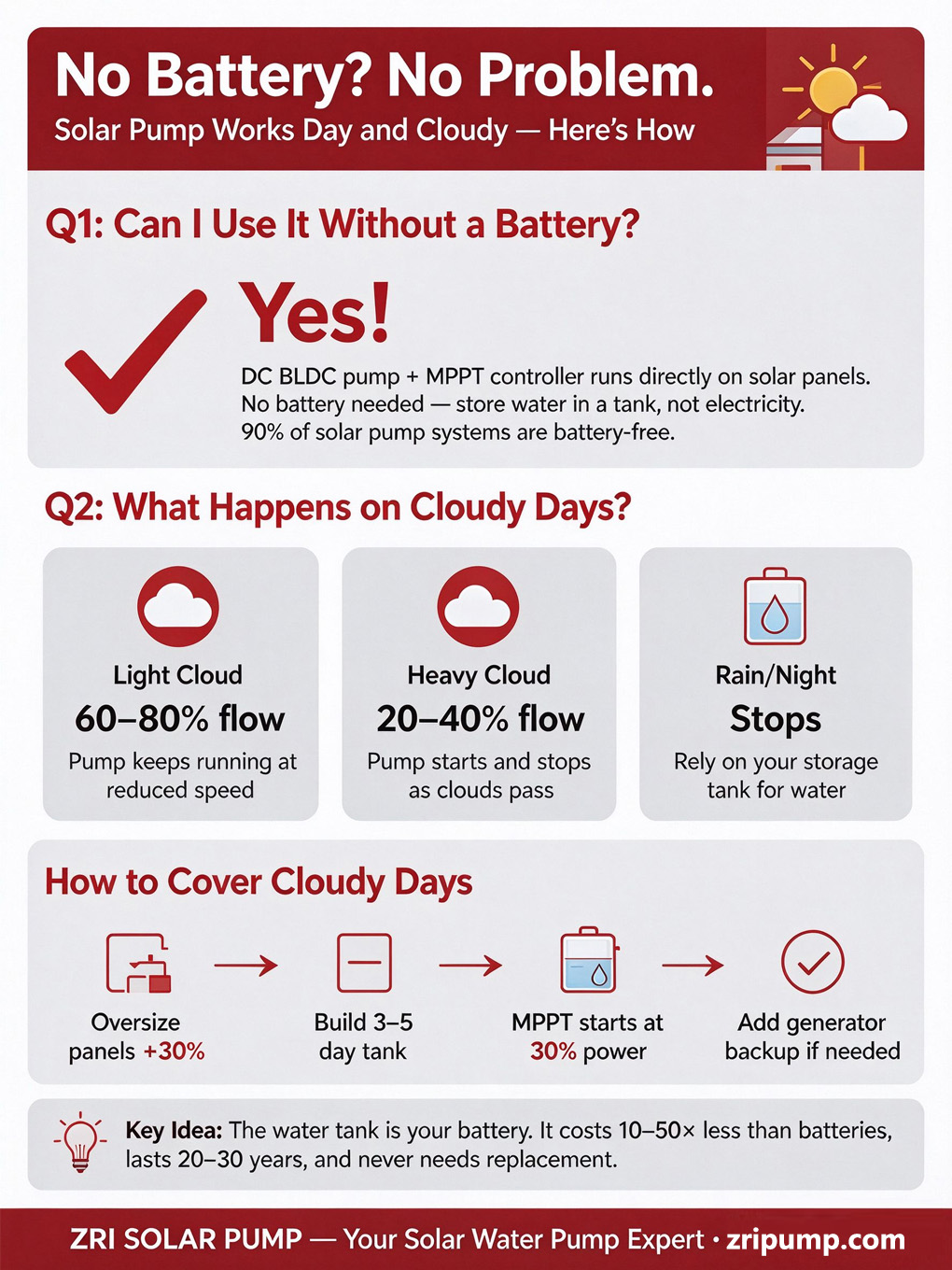
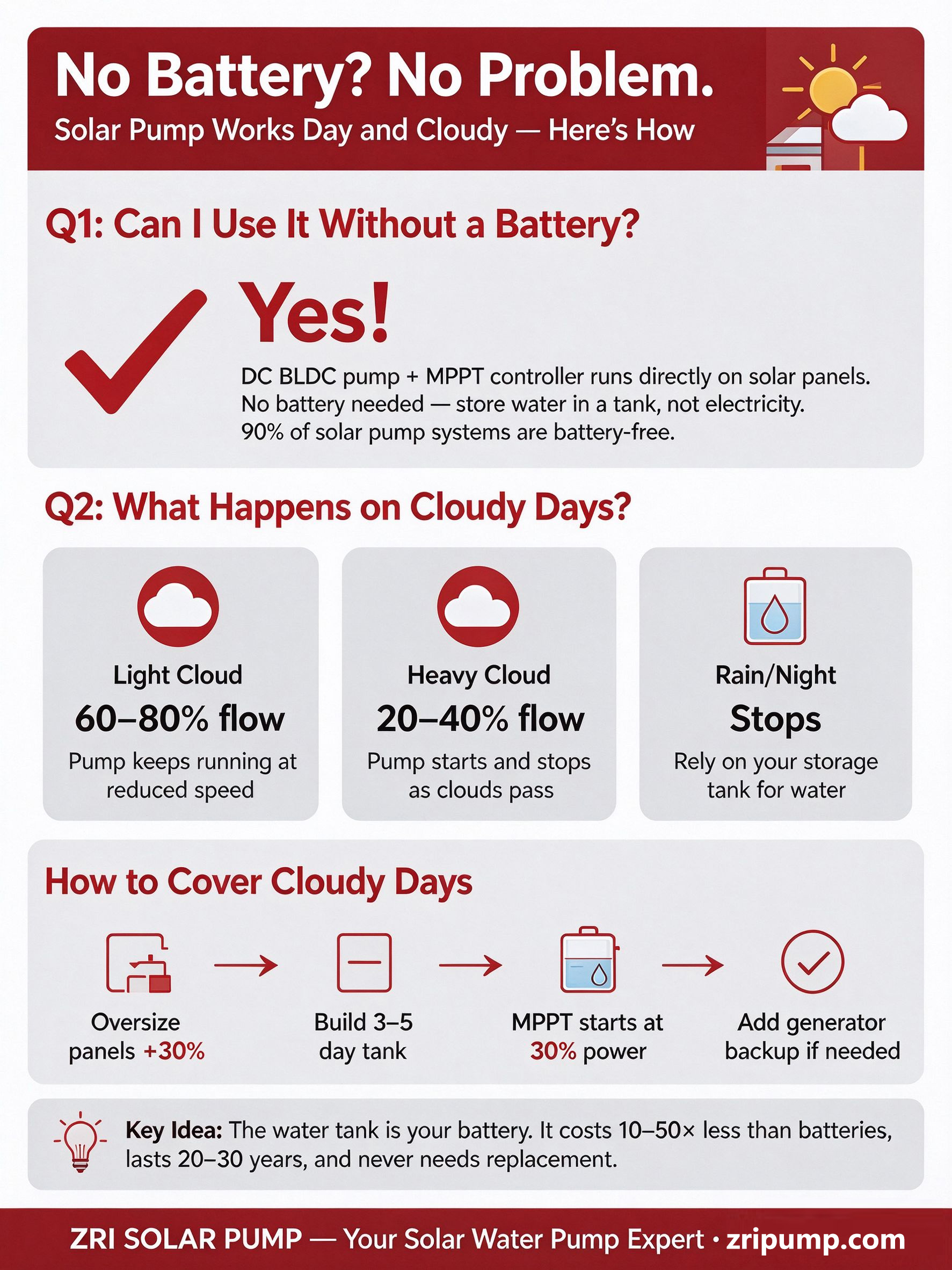
- Light clouds: 60–80% of clear-sky output; pump runs continuously at reduced capacity—still a productive day.
- Moderate clouds: 30–50% output; pump starts/stops as clouds pass; daily output 30–50% of clear day.
- Heavy cloud/rain: 10–20% output; pump usually cannot start or stops quickly, waiting for better conditions.
3 · The Role of MPPT Controllers
MPPT (Maximum Power Point Tracking) is critical for battery-free operation, keeping the panels at peak output for the pump.
- Power optimization: tracks the best operating point, harvesting 20–30% more than direct connection.
- Voltage conversion: efficiently steps 100–400V PV down to pump voltage, freeing panel configuration.
- Soft start: ramps speed with power, cutting mechanical stress, extending life, avoiding surge currents.
- Variable speed: matches pump speed to available sun—slow in low light, fast in bright—maximizing daily water without abrupt cycling.
- Protection: dry-run, over/under-voltage, over-current, over-temperature, lightning (surge suppression).
- Monitoring: live voltage/current/power, daily production and fault logs; some models offer Bluetooth/Wi-Fi/4G.
4 · Water Storage: The Battery Alternative
For most uses, storing water beats storing electricity.
- Cost: tank $0.50–2.00/L vs battery $200–500/kWh—water storage is 10–50× cheaper.
- Lifespan: polyethylene/GRP 20–30 yrs, concrete 50+ yrs; batteries only 3–7 yrs.
- Maintenance: tanks need only annual cleaning; batteries need monitoring, balancing, replacement, and degrade.
- Unlimited cycles: tanks refill millions of times; batteries limited to 1,000–5,000 cycles.
- Safe: water has no fire, explosion or toxic-chemical risk; batteries contain lead, lithium, acid.
- Scalable: easy to add capacity (10,000+ L readily); large battery storage gets prohibitively expensive.
- Gravity pressure: elevated tanks pressurize distribution with no pump.
Sizing the Tank
Formula: Tank Capacity = Daily Demand × (1 + Buffer Days)
| Climate | Buffer Days | Example |
|---|---|---|
| Sunny (Middle East, N. Africa) | 1–2 | Home 800 L×3 ≈ 2,500 L |
| Mixed (Europe, N. America) | 2–3 | Farm 2,500 L×4 = 10,000 L |
| Rainy (tropical) | 3–5 | Irrigation 30,000 L×3 = 90,000 L |
| Critical (hospitals) | 5–7 | Scale as needed |
Tank Types
| Type | Capacity | Notes | Cost/L |
|---|---|---|---|
| Polyethylene | 100–50,000 L | Light, corrosion-free, no build; freeze-prone, ≤10k L/unit | $0.5–1.5 |
| GRP (fiberglass) | 500–100,000 L | Light, strong, buried; pro install | $1.0–2.5 |
| Steel | 1k–1M+ L | Large, elevated; rusts, needs upkeep | $1.5–3.0 |
| Concrete | 5k–10M+ L | On-site, 50+ yr; long build | $0.3–1.0 |
| Excavated pond | 50k L+ | Very cheap; evaporation, not for drinking | $0.05–0.2 |
Placement: elevated tanks (tower) give gravity pressure and work during outages; ground tanks need a booster pump; underground tanks resist freeze/algae but require pumping out.
5 · Cloudy-Day Design Strategies
- Strategy 1 · Oversized array (20–40%): a 2.2 kW pump with 3.0 kW panels still yields 1.5 kW at 50% irradiance (68% capacity); earlier start, later stop. Adds $600–1,000, +30–50% cloudy-day output.
- Strategy 2 · Multi-day storage (3–5 days): 2,000 L/day with a 10,000 L tank survives 2–3 consecutive cloudy days and buffers maintenance.
- Strategy 3 · Hybrid backup: add grid (hybrid controller, solar-primary, auto-switch at low tank) or generator (used 5–10% of years). Adds $200–800.
- Strategy 4 · Demand management: prioritize drinking/cooking, cut landscaping, adopt drip irrigation—zero-cost water extension.
- Strategy 5 · Rainwater harvesting: roof feeds the same tank; rain often coincides with clouds, supplementing exactly when solar is lowest.
6 · When Batteries Are Actually Needed
Only a few scenarios truly need batteries—most are cheaper with grid/generator backup.
Where Batteries Help
- Critical 24/7 supply: hospitals, emergency, industrial cooling—uninterrupted day and night.
- Night irrigation: hot regions avoiding evaporation; often solved by daytime filling + gravity drip.
- No storage space: high-rises, urban, mobile sites that cannot fit a large tank.
- Unpredictable demand: public stations with wild swings needing buffer.
- Mobile/temporary: disaster relief, temporary sites needing full off-grid flexibility.
Battery Types
| Type | Cost/kWh | Life | Notes |
|---|---|---|---|
| Flooded lead-acid | $100–150 | 3–5 yrs | Cheapest, needs watering, heavy |
| AGM/Gel | $150–250 | 4–7 yrs | Sealed, maintenance-free, deep-cycle |
| LiFePO₄ | $300–500 | 7–15 yrs | Long life, 80–90% usable, light |
| NMC | $250–400 | 5–10 yrs | High density, needs thermal control |
7 · ZRI SOLAR PUMP Battery-Free Solutions
- Ultra-efficient MPPT: starts at 30% power, 100–450V input, 0.1 s tracking, VFD smooth speed—20–40% more water on cloudy days than standard controllers.
- High-efficiency PM brushless motor: 88–94% efficient (vs 75–85% AC), low start torque, 30–100% variable speed, better in low light.
- System design service: array sizing for your climate, tank sizing, performance modeling, cloudy-day and economic analysis; online calculators and local insolation data.
- Hybrid backup (if needed): solar+grid (add $200–500, solar 70–90%, grid backup), solar+generator (add $300–800, used 5–15%), solar+battery+grid (highest cost, rare).
8 · Real-World Case Studies
| Case | System | Storage | Result | 20-yr Saved |
|---|---|---|---|---|
| Arizona, USA home (sunny) | 1.5 kW pump + 2 kW array (+33%) | 3,000 L | 5 yrs, zero shortage | $4,500 |
| Germany farm (mixed) | 3 kW pump + 4.5 kW array (+50%) | 15,000 L | 99.8% available | $16,000 |
| Kenya village (tropical) | 5.5 kW pump + 7.5 kW array (+36%) | 50,000 L | 3 yrs, no shortage | $12,000 |
| Spain irrigation (Med.) | 7.5 kW pump + 10 kW array (+33%) | 200,000 L | Reservoir >50% | $34,000 |
All four run battery-free, relying on oversized arrays + tank buffers for cloudy days—even Germany's mixed climate and Kenya's rainy season needed no backup power.
9 · Frequently Asked Questions
Yes. Most systems are direct-coupled: panels power the pump in daylight and water is stored in tanks, not batteries. About 90% of applications need none.
It keeps running at reduced capacity—partly cloudy 60–80%, very cloudy 20–30% (intermittent), heavy cloud/rain 5–15% (usually stops).
Store water in a tank during daylight. Size it for nighttime use plus a cloudy-day buffer—cheaper and more reliable than batteries.
Depends on storage; 3–5 days of buffer handles typical periods. A 10,000 L tank covers 5 days for a 2,000 L/day household.
No. 90% of applications need none. Batteries suit rare 24/7 cases with no tank space—grid/generator is often cheaper.
50–100% more upfront plus 3–7 yr replacements: a $6,000 battery-free unit becomes $10,000–12,000, plus $4,000–6,000 every 5 yrs.
Rainy days yield ~10–20% of sunny output; the pump may start briefly between clouds or run very slowly. Heavy rain means minimal pumping.
Capacity = daily demand × (1 + buffer days): sunny 1–2, mixed 2–3, rainy 3–5, critical 5–7 days.
50–70% lower 20-yr cost, higher reliability, longer life, less maintenance, greener. Water storage is cheaper and lasts longer than batteries.
If the controller supports charging (hybrid), yes. Most users never need them after trying water storage; assess needs first.
Oversize by 30–50%; e.g. a 2 kW pump gets 2.6–3.0 kW of panels to ensure power on partly cloudy days.
Yes. It specializes in battery-free direct-coupled systems; MPPT is tuned for maximum water production without batteries, with advanced cloudy-day features.
ZRI SOLAR PUMP pumps last 10–20 yrs; batteries only 3–7 yrs. Over 20 yrs you replace batteries 3–4 times, making them far costlier.
Yes, often better—solar-primary with grid only when needed (5–15% of time) gives 100% availability without battery cost.
Rare with proper sizing. If so: conserve temporarily, use grid/generator, or arrange delivered water. Most cloudy periods end within 2–3 days.
10 · Conclusion
Battery-free + tank fits: residential ✓ agriculture ✓ livestock ✓ village supply ✓ commercial ✓ pool circulation ✓
Get Your ZRI SOLAR PUMP System
Free system sizing · cloudy-day performance modeling · storage & oversizing design