
 DC SOLAR SUBMERSIBLE PUMP
 AC/DC Solar submersible Pump
 DC Solar Surface Pump
 AC/DC solar surface Pump
 Solar swimming Pool Pump
 Built-in Controller Solar Pump
 Solar Pump inverter
 Pump Accessories


 Mr Youkee Kong
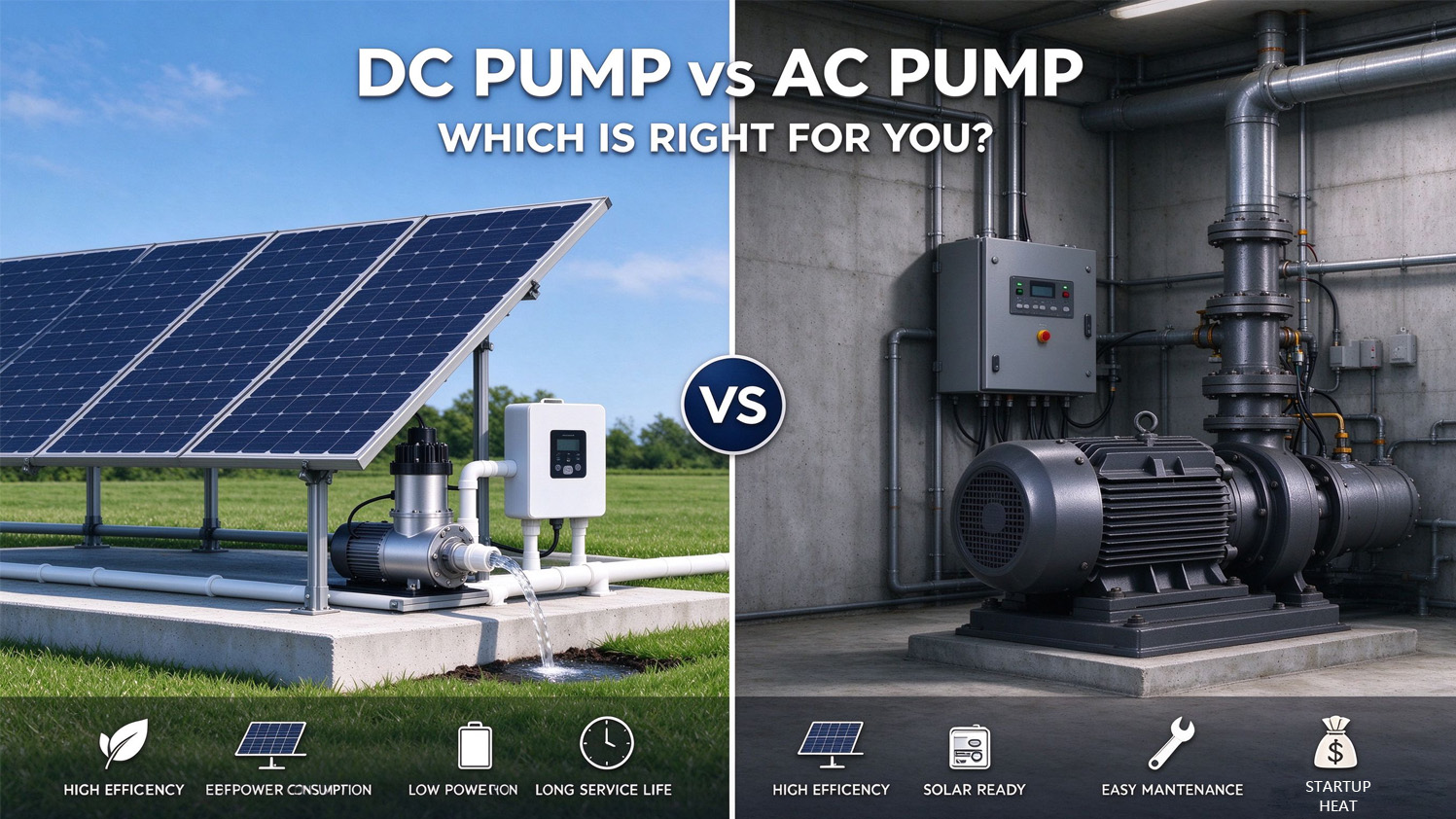
DC Pump vs. AC Pump: Which Is Better, More Efficient, and More Durable?
Compare AC pumps, and Solar Water Pumps across efficiency, durability, maintenance, applications, and certifications — with a practical ZRI SOLAR PUMP selection guide.
Expert guide by ZRI SOLAR PUMP · Solar & DC water pumping solutionsQuick Answer
Neither DC nor AC is universally better. The right choice depends on power source, environment, flow, head, duty cycle, maintenance, and cost.
At a glance
- DC pumps — solar, batteries, mobile gear, remote sites, low-voltage.
- AC pumps — fixed grid installs, high flow, continuous, industrial.
- Solar water pumps — built around DC since PV panels make DC.
- Durability hinges on motor, materials, sealing, cooling, protection, water, install, maintenance — not AC vs DC.
For off-grid and solar use, a correctly selected ZRI SOLAR PUMP is efficient and reliable. For grid systems, AC is often the better long-term fit.
DC vs. AC Comparison
| Feature | DC Pump | AC Pump |
|---|---|---|
| Power source | Battery, solar, DC supply | Grid, generator, inverter |
| Efficiency | High in low-voltage & solar | High direct to grid |
| Solar fit | Excellent | Needs inverter/controller |
| Install | Simpler for small systems | Fixed electrical installs |
| Maintenance | Low, esp. brushless | Low, design-dependent |
| Continuous | OK when sized right | Very good on stable grid |
| Remote | Excellent | Needs gen/inverter |
| Cost | Good for small systems | Good for large fixed |
| Uses | Solar, fountains, RVs, aquariums | HVAC, industrial, irrigation |
| Durability | High if voltage/dry-run safe | High if overload/heat safe |
What Is a DC Pump?
A DC pump runs on direct current from batteries, solar panels, or DC adapters — brushed, brushless (BLDC), diaphragm, centrifugal, submersible, or surface designs. A BLDC pump uses electronic commutation, cutting wear and maintenance.
Advantages
- Solar-ready — PV makes DC; ideal for solar water systems.
- High efficiency — runs off battery/controller, no DC→AC→DC loss.
- Remote-friendly — farms, gardens, ponds, cabins, emergency.
- Low-voltage — 12/24/36/48 V DC, simple integration.
- Variable speed — matches demand, sunlight, pressure.
Limitations
- Output limited vs large industrial AC pumps.
- Varies with battery voltage or sunlight.
- Needs controller for speed, dry-run, MPPT.
- Wrong polarity/voltage or thin cable can damage it.
- Cheap brushed DC pumps wear brushes faster.
What Is an AC Pump?
An AC pump runs on grid, generator, or inverter power — used in residential, commercial, agricultural, and industrial systems (centrifugal, self-priming, multistage, sewage, booster, submersible).
Advantages
- Continuous duty on stable supply for water, cooling, irrigation.
- Wide power range — small home to large industrial.
- High flow/head with broad motor and hydraulic options.
- Easy fixed integration — buildings, HVAC, pipelines.
- Mature tech with established service networks.
Limitations
- Needs grid, generator, or inverter.
- Inverter + solar adds complexity and losses.
- Install may need qualified electrician.
- Outages stop it without backup.
- Cost can beat a solar pump where sun is free.
Which Is More Durable?
Short answer
A quality DC and a quality AC pump can both last long. Durability follows the application and conditions — not the motor type.
Durability factors: motor design, bearings, impeller/shaft materials, sealing, cooling, overload & dry-run protection, water temperature/quality, sediment, install accuracy, run hours, voltage stability, maintenance.
A premium BLDC pump can outlast a poor AC pump; a well-designed AC pump serves years in continuous duty.
Why BLDC lasts
No mechanical brushes → less wear, arcing, friction, maintenance, noise. But its electronics need protection from heat, moisture, surges, wrong voltage, poor power.
Why AC lasts
AC induction motors are robust in continuous duty when sized right, ventilated, overload-protected, run in rated voltage/frequency, with proper valves, filters, piping.
Better for Solar Pumping?
For most direct solar systems, a DC solar water pump wins: panels make DC, the pump uses it via a controller, skipping DC→AC conversion.
Benefits
- Direct PV, lower conversion loss
- Remote/off-grid ready
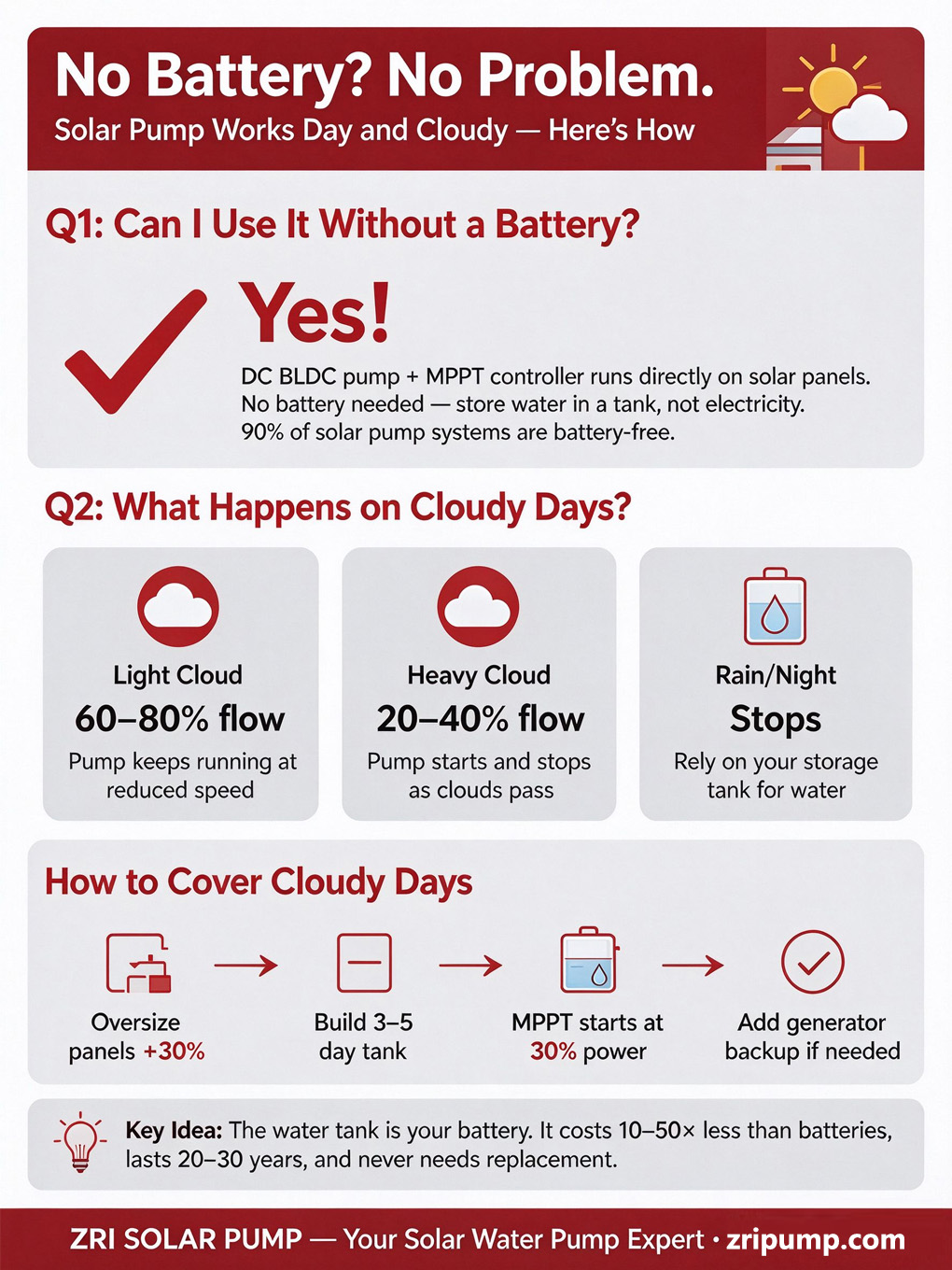
- With or without battery
- Tank storage as energy buffer
- Submersible & surface options
- Livestock, irrigation, domestic, garden
Can AC run on solar?
Yes — via an inverter, adding a combiner and extra protection. Choose AC solar for high-power industrial pumps, existing AC units, or AC-familiar technicians. For small/medium off-grid, DC is simpler and more efficient.
Which Uses Less Energy?
Energy use depends on pump/hydraulic/motor efficiency, operating point, and conversion losses. Approximate hydraulic power:
ρ = density · g = gravity · Q = flow · H = total head · η = efficiency
A DC pump may save energy in solar by skipping conversion, but an efficient grid AC pump can match or beat a poor DC pump. Match the pump to the real duty point.
Energy factors
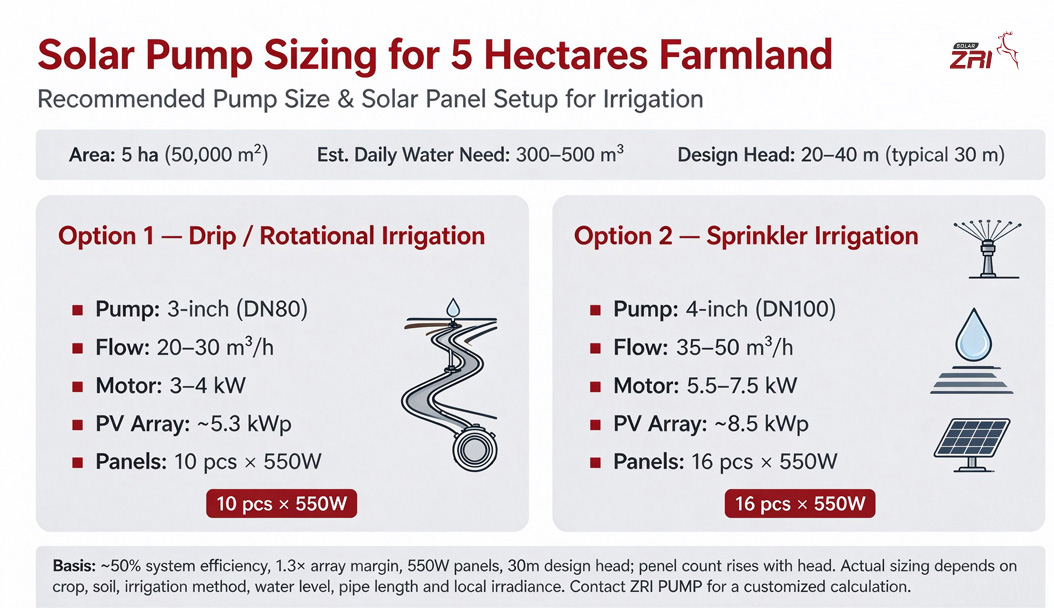
- Flow, total head, pipe size/length, elbows/valves
- Pump, motor, controller efficiency; water temperature
- Schedule, solar intensity, battery losses
Best Pump by Application
Solar Pumping
DCDC solar pump; store water in tank.
Remote Irrigation
DCSolar/submersible; size to depth, demand, sun.
Residential
DC off-grid/RV; AC booster grid; VSD variable.
Industrial
ACWider range, continuous; DC for low-voltage.
Fountains/Aquarium
Low-voltage DC small/quiet; AC large commercial.
Emergency
DC+battery or AC+generator by flow/runtime.
How to Choose
Certifications to Check
Verify per model, market, voltage, application. Request valid certificates, test reports, or declarations.
- CE — EEA; safety, EMC, RoHS, LVD. Ask for Declaration of Conformity.
- RoHS — restricts hazardous substances; verify per market.
- EMC — no harmful interference; key for controllers/VSDs.
- UL / ETL — US/Canada by model, install, local rules.
- IEC — machines, appliances, pumps, EMC, IP, safety.
- IP Rating — ingress protection; higher 2nd digit = more water safe.
- ISO 9001 — quality system, not a per-unit guarantee.
Verification checklist
- Certificate number & scope
- Issuing / testing organization
- Validity & applicable models
- Test standard & edition
- Rated voltage & frequency
- Factory location
- Declaration of Conformity
- Test reports for the exact series
Avoid unverified logos or vague "international certification" claims.
How ZRI PUMP Helps
ZRI PUMP delivers DC, BLDC, solar submersible/surface, battery, circulation, booster, fountain/pond pumps, custom systems, and OEM/ODM.
Confirm before ordering
Flow · head · voltage · power · motor · duty · IP · temp · controller · dry-run/overload · certification · warranty · spares. Judge by official datasheet and pump curve.
ZRI SOLAR PUMP Selection Guide
| Application | Recommended | Key Factors |
|---|---|---|
| Small solar fountain | DC fountain pump | Low noise, flow |
| Garden irrigation | DC / solar pump | Head, volume, sun |
| Deep well | Solar submersible | Depth, bore, head, quality |
| Livestock | Solar pump + tank | Demand, tank, dry-run |
| Remote cabin | DC + battery | Voltage, pressure, capacity |
| Household booster | AC / DC booster | Pressure, duty, control |
| Industrial | AC / DC | Continuous, materials, power |
| Pond / aquarium | Low-voltage DC | Flow, noise, reliability |
Maintenance Tips
DC Pumps
- Correct voltage & polarity
- Shield controller from rain
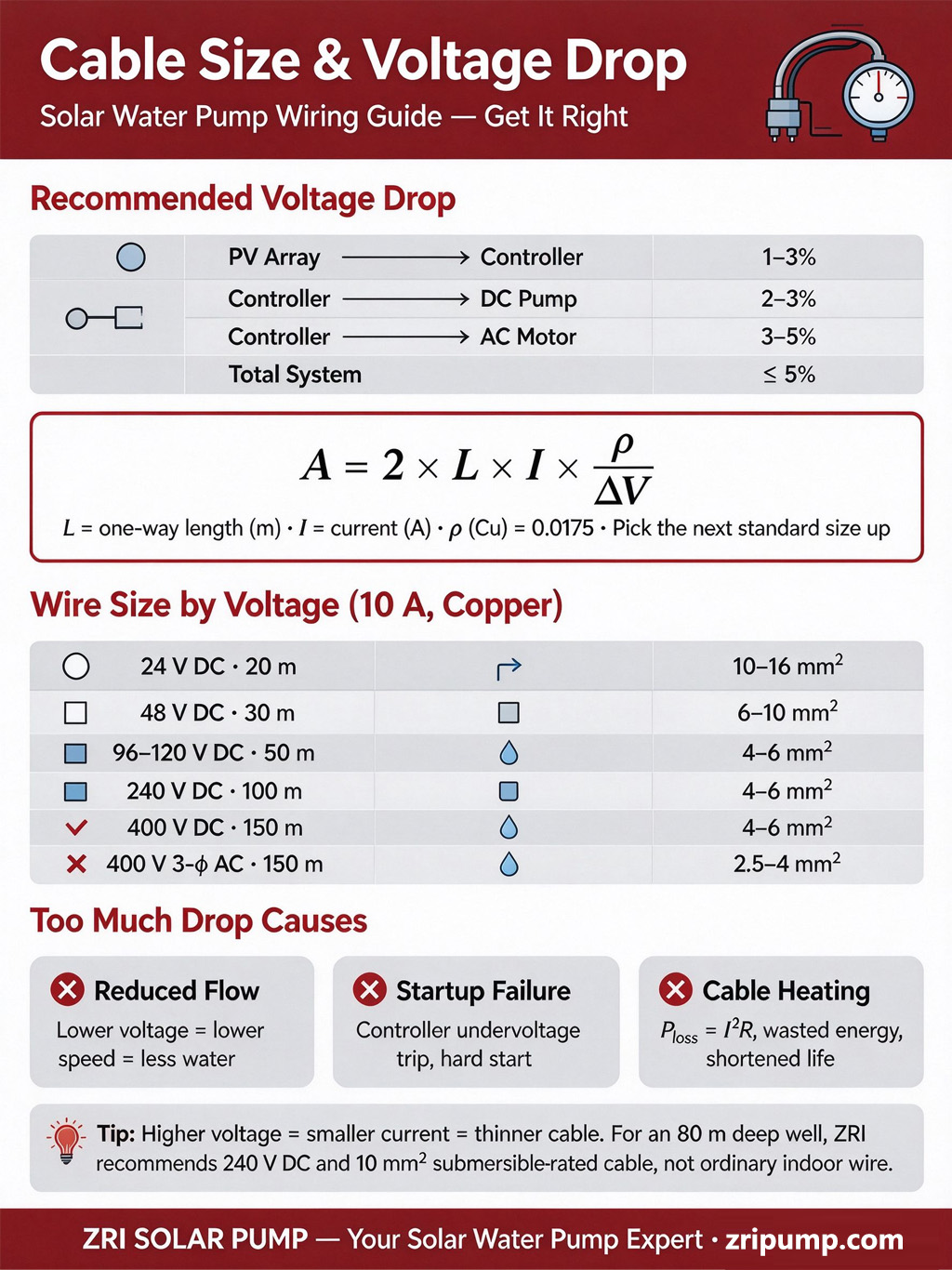
- Size cables vs drop
- Clean filters; no dry-run
- Clean panels; check batteries
AC Pumps
- Match voltage/frequency
- Overload protection & ground
- Inspect seals, vents
- Watch noise/vibration
- Lube per schedule
All pumps
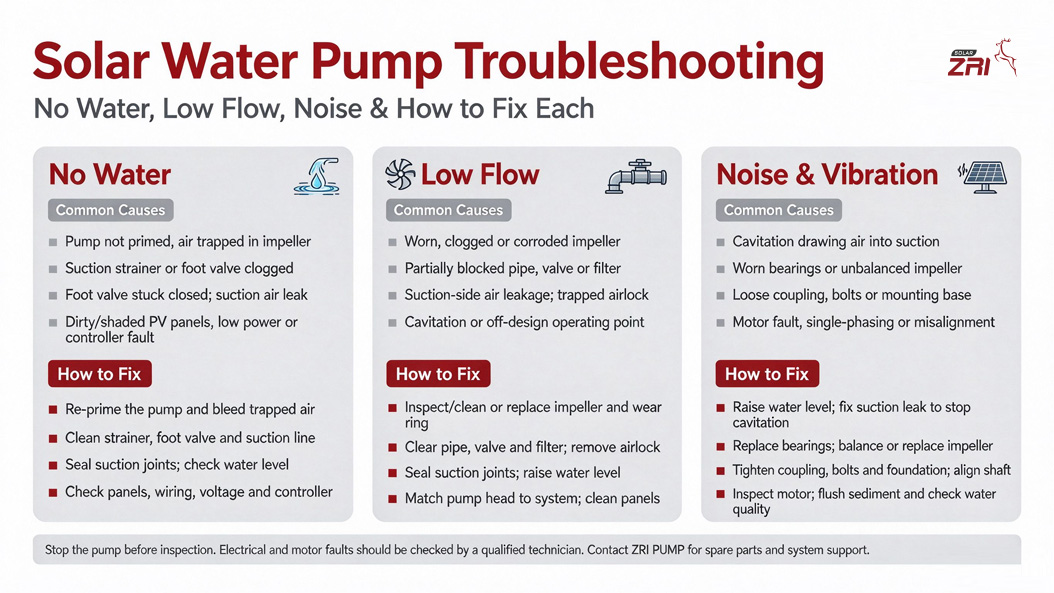
- Right pump for the fluid; don't exceed rated head/flow.
- Block sand/abrasives; add check valves.
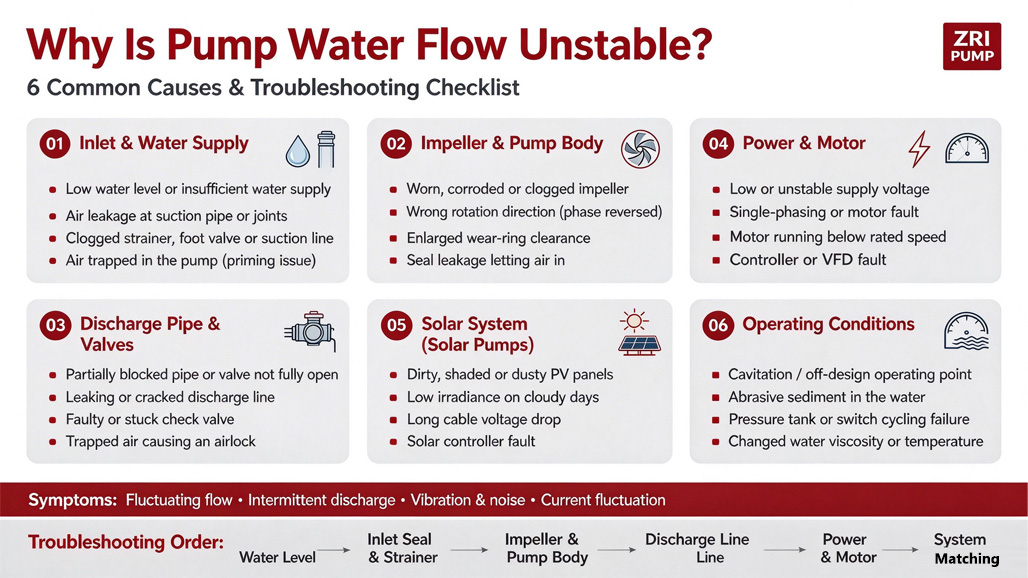
- Monitor flow, pressure, noise, power; fix seals/cables.
Common Buying Mistakes
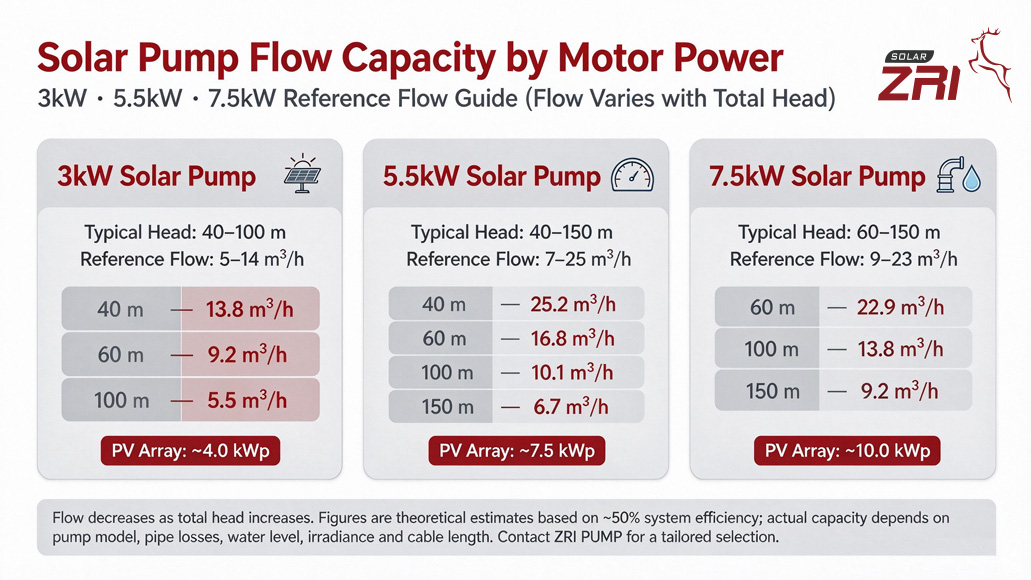
- Max flow only — real flow is far lower at head.
- Ignore total head — pump may miss the height.
- Wrong solar panel — mismatch voltage/current/power.
- Oversize — waste, pressure, water hammer.
- Undersize cable — drop, heat, short life.
- Dry running — ruins seals/bearings/motor.
- Unverified certs — demand model-specific docs.
Frequently Asked Questions
A: DC is better for solar, batteries, remote sites, and low-voltage. AC is often better for fixed grid installs, higher output, and continuous operation.
A: Neither is automatically more durable. A quality brushless DC pump lasts long; a robust AC induction pump serves years. Sizing, protection, water quality, and maintenance decide.
A: Some are continuous-duty; others are intermittent. Check the datasheet before continuous use.
A: Yes, via a suitable inverter — but a DC solar pump reduces conversion losses and simplifies the system.
A: Yes. Many run straight from panels via a controller; tanks store water as an alternative to batteries.
A: Many small BLDC pumps are quiet, but noise depends on motor, impeller, bearings, mounting, and design. A well-installed AC pump can also be quiet.
A: Submersible solar or AC, by depth, bore diameter, flow, head, and power. Professional sizing is recommended.
A: Request the official certificate, declaration, test report, model range, scope, issuer, and validity — matched to the exact model and market.
Conclusion
Choose DC when
Solar · battery · low-voltage · remote/off-grid · compact · variable speed · efficient PV.
Choose AC when
Stable grid · high flow/head · continuous industrial · easy AC infra · broad range.
For solar, remote irrigation, livestock, and off-grid supply, a ZRI PUMP solar water pump is efficient and practical. For fixed, high-capacity, grid use, AC fits better.
The most durable pump isn't "DC" or "AC" — it's the one matched to hydraulic need, power, water, schedule, environment, and protection.
Final Recommendation
Compare the official ZRI PUMP datasheet, pump curve, duty cycle, protection, materials, warranty, and verified certifications before you buy.
Explore ZRI PUMP Solutions