
 DC SOLAR SUBMERSIBLE PUMP
 AC/DC Solar submersible Pump
 DC Solar Surface Pump
 AC/DC solar surface Pump
 Solar swimming Pool Pump
 Built-in Controller Solar Pump
 Solar Pump inverter
 Pump Accessories


 Mr Youkee Kong

How to Choose a Solar Water Pump: DC vs AC/DC, Impeller Materials & Pump Diameter
How to Choose a Solar Water Pump: A Practical Guide to DC, AC/DC, Materials and Pump Size
Choosing a solar water pump sounds simple at first. You find a pump with the right power, check the price, and then make a decision.
In real projects, it is rarely that easy.
A pump that works well on one farm may perform poorly in another project, even when the two pumps have similar motor power. The reason is usually not the motor itself. It comes down to the actual working conditions — water demand, total head, water source, water quality, well diameter and available power.
This is especially important for agricultural irrigation, borehole water supply, livestock watering and remote projects where reliable electricity is not always available.
So, how do you choose the right solar water pump?
The best place to start is not with horsepower. Start with the application.
In this guide, we will look at three common questions buyers often ask: DC vs AC/DC solar pumps, plastic vs stainless steel impellers, and 3-inch vs 4-inch submersible pumps. We will also explain the basic information you should prepare before selecting a specific model.
The Short Answer: What Solar Water Pump Should You Choose?
There is no single solar pump that is suitable for every project.
As a general starting point:
- Pure DC solar pump: suitable for off-grid projects and applications that mainly pump water during daylight hours.
- AC/DC hybrid solar pump: worth considering when grid backup or more continuous water supply is required.
- Engineering plastic impeller: can be suitable for clean water and applications with low abrasive content.
- Stainless steel impeller: a better option to consider when sand, silt, demanding water conditions or long operating hours are involved.
- 3-inch solar submersible pump: suitable for relatively narrow boreholes.
- 4-inch solar submersible pump: generally provides more options for higher-flow applications and larger wells.
But these are only starting points.
The final pump selection should be based on:
Flow + Head + Water Source + Water Quality + Well Diameter + Power Availability
That combination tells you much more than motor power alone.
What Should You Know Before Buying a Solar Water Pump?
Before asking a pump manufacturer for a quotation, try to collect a few basic project details.
It will make the selection process much easier.
1. How Much Water Do You Need?
The first question is simple:
How much water do you need per hour or per day?
For example, a small household water supply may only require a few cubic meters per hour, while an agricultural irrigation project could need significantly more.
If the required flow is 10 m³/h, choosing a pump simply because it has a certain horsepower does not tell you whether it can actually deliver 10 m³/h under your working conditions.
This is why the pump performance curve is important.
2. What Is the Total Head?
The second major factor is total dynamic head.
Many buyers initially think head means only the vertical distance between the water source and the destination. It is actually more than that.
The system may need to account for:
- Static water level
- Dynamic water level
- Elevation difference
- Pipe friction
- Valves and fittings
- Required outlet pressure
For example, a project requiring 10 m³/h at 80 m head needs a pump capable of delivering that flow at that head.
Simply saying, “I need a 3 HP solar pump,” is not enough information for proper selection.
3. Where Does the Water Come From?
The water source also matters.
It could be:
A deep well
A borehole
A river
A pond
A reservoir
A municipal water supply
A borehole application may require a submersible solar pump, while a surface water source may allow a different pump configuration.
4. What Is the Water Quality?
Water quality can affect the life of the hydraulic components.
Before selecting the pump, check whether the water contains:
Sand
Silt
Suspended particles
Salt
Corrosive substances
Clean groundwater and sandy surface water should not automatically be treated as the same application.
5. What Power Sources Are Available?
You should also decide whether the system will use:
Solar power only
Solar + grid power
Solar + battery
Solar + another backup source
This is one of the main factors when comparing pure DC and AC/DC hybrid solar pumps.
6. What Is the Well Diameter?
For a submersible pump, the borehole diameter is a physical limitation.
A pump cannot simply be installed because its hydraulic performance looks good on paper. It also needs to physically fit inside the well with sufficient clearance.
This is where the 3-inch vs 4-inch decision becomes important.
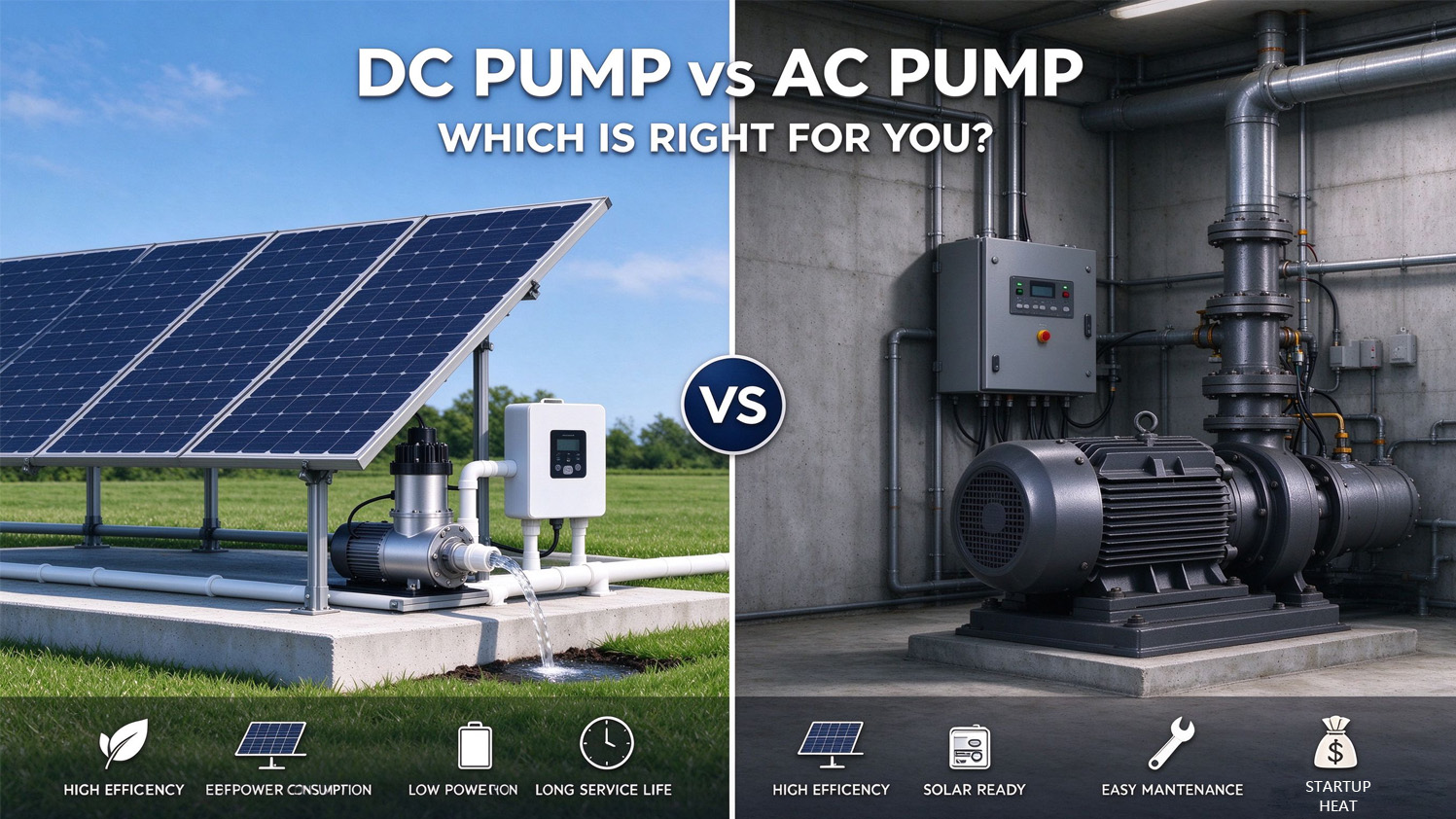
DC vs AC/DC Solar Pump: Which Is Better?
The answer depends on how the pump will be operated.
Pure DC Solar Water Pump
A typical solar DC pumping system can be arranged as:
Solar Panels → Solar Pump Controller → DC Motor → Water Pump
The main attraction of this setup is its relatively simple structure.
A DC solar pump can be a practical option for remote areas where grid electricity is unavailable. It can also work well for applications where water is mainly pumped during daylight hours.
Typical applications include:
Remote farms
Livestock watering
Small irrigation systems
Rural water supply
Borehole pumping
One important point, though: solar power changes throughout the day.
Cloudy weather, early morning, late afternoon and seasonal changes can all affect available solar energy. Pump output may therefore change with the available power.
For a water-storage application, this is often manageable. Instead of trying to store electricity, the system can pump water into a tank or reservoir when sunlight is available.
That can be a much simpler approach.
AC/DC Hybrid Solar Pump
An AC/DC hybrid system provides more flexibility because the pump can use solar power and grid electricity, depending on the system design.
A typical arrangement may look like:
Solar Panels + Grid → Hybrid Controller/Inverter → Pump
This type of system can make sense when the project has access to the grid but electricity is unstable, or when water needs to be supplied outside normal solar hours.
The main advantages include:
Solar and grid flexibility
Better continuity of water supply
Reduced dependence on one power source
Suitability for larger systems
More flexible operating schedules
The trade-off is that the system can be more complicated and may require additional electrical equipment.
So, DC is not automatically better than AC/DC.
If the project is completely off-grid and only needs daytime pumping, a pure DC system may be the more straightforward choice.
If the project needs backup power or longer operating hours, an AC/DC hybrid system may make more sense.
Plastic vs Stainless Steel Impeller
The next question is about materials.
This is often overlooked when buyers compare pump prices, but it can become very important over time.
When Is a Plastic Impeller Suitable?
Engineering plastics such as Noryl are used in some solar pump designs because they can offer good corrosion resistance, low weight and competitive cost.
For clean water applications with low abrasive content, an engineering plastic impeller can be a reasonable and economical choice.
Typical applications may include:
- Clean groundwater
- Household water supply
- Small irrigation systems
- Garden irrigation
- Low-sand water sources
There is no need to choose stainless steel simply because it sounds more durable.
The material should match the application.
What If the Water Contains Sand?
This is where the situation changes.
Sand and silt can gradually wear hydraulic components. Depending on the concentration and particle size, abrasive water may contribute to:
- Reduced hydraulic efficiency
- Lower water output
- Changes in pump performance
- Increased maintenance
- Shorter component life
The actual wear rate depends on many factors, including water quality, particle concentration, operating hours and pump design.
If the water contains a significant amount of sand, material selection becomes much more important.
When Should You Consider Stainless Steel?
Stainless steel impellers are often considered for more demanding applications where mechanical strength, corrosion resistance or wear resistance are important.
Common stainless steel grades include 304 and 316, although the appropriate grade depends on the actual water chemistry.
Stainless steel may be worth considering when:
The water contains sand or silt
The pump runs for many hours every day
Downtime is expensive
The project requires long-term operation
The water chemistry is more demanding
The pump is used for commercial irrigation
The initial purchase price may be higher, but that is only one part of the cost.
For a long-running irrigation project, maintenance and replacement costs also matter.
A Practical Example from an Agricultural Project
In one agricultural irrigation project in Nigeria, ZRI engineers recommended a stainless steel impeller solution because the local water source contained a relatively high amount of sand.
The stainless steel option had a higher initial cost than the plastic impeller version.
However, the project conditions made wear resistance more important than simply choosing the lowest quotation.
During operation, the plastic impeller solution experienced noticeable flow reduction, while the stainless steel pump maintained more stable performance.
The lesson was quite straightforward:
The cheapest pump at the time of purchase is not always the lowest-cost pump over the whole project life.
That is why material selection should be based on the actual water conditions rather than price alone.
3-Inch vs 4-Inch Solar Submersible Pump
For borehole applications, pump diameter is another important consideration.
But remember:
Well diameter is the first physical constraint, not the only selection criterion.
You still need to consider flow and head.
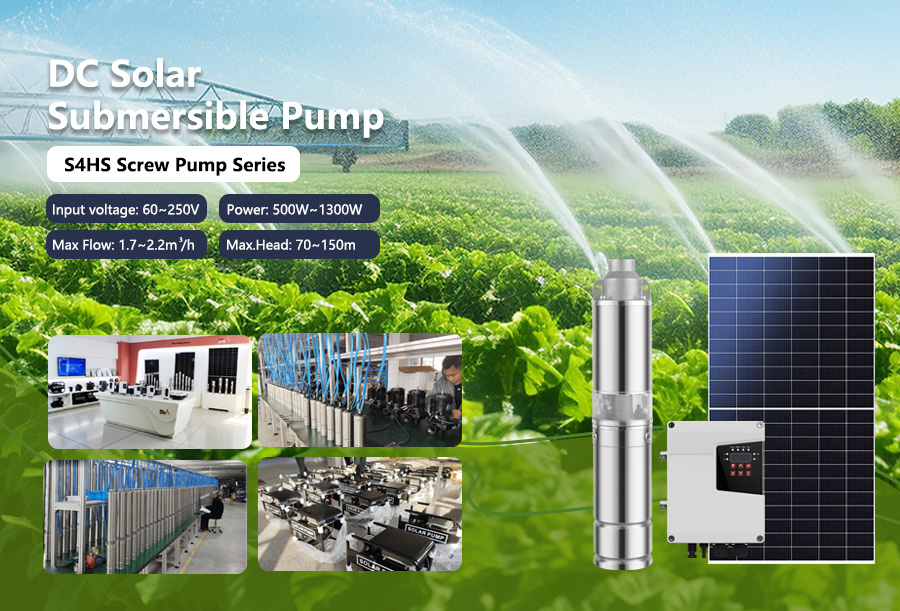
3-Inch Solar Submersible Pump
A 3-inch solar submersible pump is designed for relatively narrow wells.
ZRI's 3-inch product families include models such as:
S3SS
S3HS
S3PC
S3PCB
S3SC
Depending on the specific model, these pumps can be used for household water supply, agricultural irrigation and other small-to-medium water pumping applications.
Some 3-inch models can reach flow rates around 7.5 m³/h, while selected models are designed for higher-head applications.
The actual operating point always depends on the model and system conditions.
The main advantage of a 3-inch pump is simple: it can fit into smaller boreholes.
If the well diameter is limited, a larger pump may not even be an option.
4-Inch Solar Submersible Pump
A 4-inch pump normally requires a larger borehole but provides more choices for higher-flow applications.
ZRI's 4-inch product families include:
S4SS
S4HS
S4PC
S4PCB
S4SC
These pumps can be considered for agricultural irrigation, commercial water supply and projects where higher pumping capacity is required.
But bigger does not always mean better.
If the well is narrow or the borehole yield is insufficient, moving from a 3-inch pump to a 4-inch pump will not solve the real problem.
The pump still needs to match the water source.
How Do You Decide Between a 3-Inch and 4-Inch Pump?
A simple preliminary guide is:
Choose a 3-inch pump when:
The borehole is relatively narrow
Water demand is moderate
The required flow can be achieved by a suitable 3-inch model
Consider a 4-inch pump when:
The borehole is larger
Higher flow is required
The application is agricultural or commercial
The required performance is beyond the practical range of a 3-inch pump
For larger projects, 6-inch, 8-inch or larger submersible systems may also be considered.
The final selection should always be checked against the pump performance curve and actual borehole conditions.
A Better Way to Select Your Solar Water Pump
Rather than starting with motor power, use this process.
Step 1: Determine the Required Flow
Define how much water the project actually needs.
For example:
Required flow: 10 m³/h
Step 2: Calculate Total Head
Include:
Vertical lift
Water level
Pipe friction
Fittings
Required outlet pressure
For example:
Total head: 80 m
Now the pump requirement is much clearer:
10 m³/h at 80 m head
Step 3: Check the Power Source
Decide whether the system will use solar only or solar plus grid.
This helps determine the appropriate pump architecture.
Step 4: Check Water Quality
Determine whether the water is clean, sandy, silty, saline or chemically aggressive.
This helps guide material selection.
Step 5: Check the Borehole Diameter
Measure the actual internal diameter of the well.
Do not estimate it if accurate information is available.
Step 6: Check the Pump Curve
This is the final step.
The selected pump needs to deliver the required flow at the required head.
Two pumps with the same motor power can have very different hydraulic performance.
That is why pump selection should never be based on horsepower alone.
Three Typical Solar Pump Applications
Small Off-Grid Water Supply
For a remote household or small farm with clean groundwater, daytime pumping and a narrow borehole, a possible system could include:
Pure DC solar pump
3-inch submersible pump
Suitable plastic or corrosion-resistant hydraulic components
Solar pump controller
PV panels
Water storage tank
A model such as S3SS1.2-56-24-120D may be considered if its performance matches the actual flow and head requirements.
Medium Agricultural Irrigation
A medium-sized agricultural project may have:
Higher water demand
Solar power
Unstable grid electricity
Sandy water
Longer operating hours
In this situation, an AC/DC hybrid system combined with a stainless steel or suitable wear-resistant hydraulic design may provide more flexibility.
A 4-inch pump can also be considered when the borehole and required flow allow it.
Large Agricultural or Commercial Project
For larger irrigation systems, the requirements can be considerably different.
The project may need:
High flow
Large pumping head
Long operating hours
Larger borehole
Higher motor power
A 6-inch, 8-inch or larger pump may then be more appropriate.
At this level, the complete system design becomes particularly important. PV capacity, inverter selection, cable sizing, protection, pipe diameter and pump performance all need to work together.
Solar Water Pump Selection Checklist
Before requesting a quotation from a manufacturer, prepare as much of the following information as possible:
Water source
Required flow rate
Total pumping head
Well diameter
Water quality
Sand or silt content
Daily operating hours
Solar-only or solar + grid
Required outlet pressure
Irrigation area
Application type
Existing PV capacity, if available
The more accurate these details are, the easier it is for an engineer to recommend the right pump.
Frequently Asked Questions
Is a DC solar pump better than an AC/DC hybrid pump?
Not necessarily.
A DC solar pump is often a practical choice for off-grid applications where water is mainly pumped during daylight hours.
An AC/DC hybrid system may be more suitable when grid backup, nighttime operation or a more continuous water supply is required.
Are stainless steel impellers always better than plastic impellers?
No.
For clean water and suitable operating conditions, an engineering plastic impeller can be a cost-effective option.
Stainless steel becomes more attractive when the water is abrasive, operating hours are long, or greater mechanical durability is required.
Should I choose a 3-inch or 4-inch solar pump?
Start with the borehole diameter.
Then check the required flow and total head.
A 3-inch pump may be suitable for a narrow well and moderate water demand, while a 4-inch pump may provide more options for higher-flow applications.
Can a solar water pump work without batteries?
Yes.
Many solar pumping systems can operate without batteries.
Instead of storing electricity, the system can pump water into a storage tank when solar energy is available.
This can simplify the system and avoid battery replacement costs.
However, if water is required when solar power is unavailable, grid backup, batteries or another energy source may be necessary.
How do I calculate the correct solar pump size?
Start with two numbers:
Required flow + total dynamic head
Then consider the water source, water quality, well diameter, solar conditions and operating schedule.
The final pump should be selected using the manufacturer's performance curve.
Motor power alone is not enough.
Can solar water pumps be used for agricultural irrigation?
Yes.
Solar pumping can be particularly useful for agricultural irrigation in areas with good solar resources and limited access to reliable grid electricity.
The correct pump depends on the irrigation demand, water source, required head and available power.
Final Thoughts
There is no universal “best” solar water pump.
The right pump for a small remote farm may be completely different from the right pump for a large commercial irrigation project.
Instead of asking only:
DC or AC/DC?
Plastic or stainless steel?
3-inch or 4-inch?
Start with the project itself.
Look at:
Flow + Head + Water Source + Water Quality + Well Diameter + Power Availability
Once these factors are clear, choosing the pump type, material, diameter and specific model becomes much easier.
This is also where working with an experienced pump manufacturer can make a difference. A good selection is not only about matching a model number. It is about understanding how the pump will actually work after installation.
For ZRI, this is an important part of the engineering process. The objective is not simply to recommend the biggest or most expensive pump. It is to find a configuration that matches the real working conditions and makes sense for the project over the long term.
If you are selecting a solar water pump and are not sure where to start, prepare these six pieces of information:
Required flow + total head + water source + well diameter + water quality + power conditions.
With these details, a suitable solar pumping configuration can be evaluated much more accurately.