
 DC SOLAR SUBMERSIBLE PUMP
 AC/DC Solar submersible Pump
 DC Solar Surface Pump
 AC/DC solar surface Pump
 Solar swimming Pool Pump
 Built-in Controller Solar Pump
 Solar Pump inverter
 Pump Accessories


 Mr Youkee Kong


Solar Irrigation System Design: Complete Guide for Water Pumping
Solar Irrigation System Design: A Complete Guide from Water Demand to PV Pump Sizing
How do you design an efficient, reliable solar water pump irrigation system based on crop type, irrigated area, and water source conditions? This article walks you step-by-step through the entire process—from demand analysis to PV array configuration.
Why Choose a Solar Irrigation System?
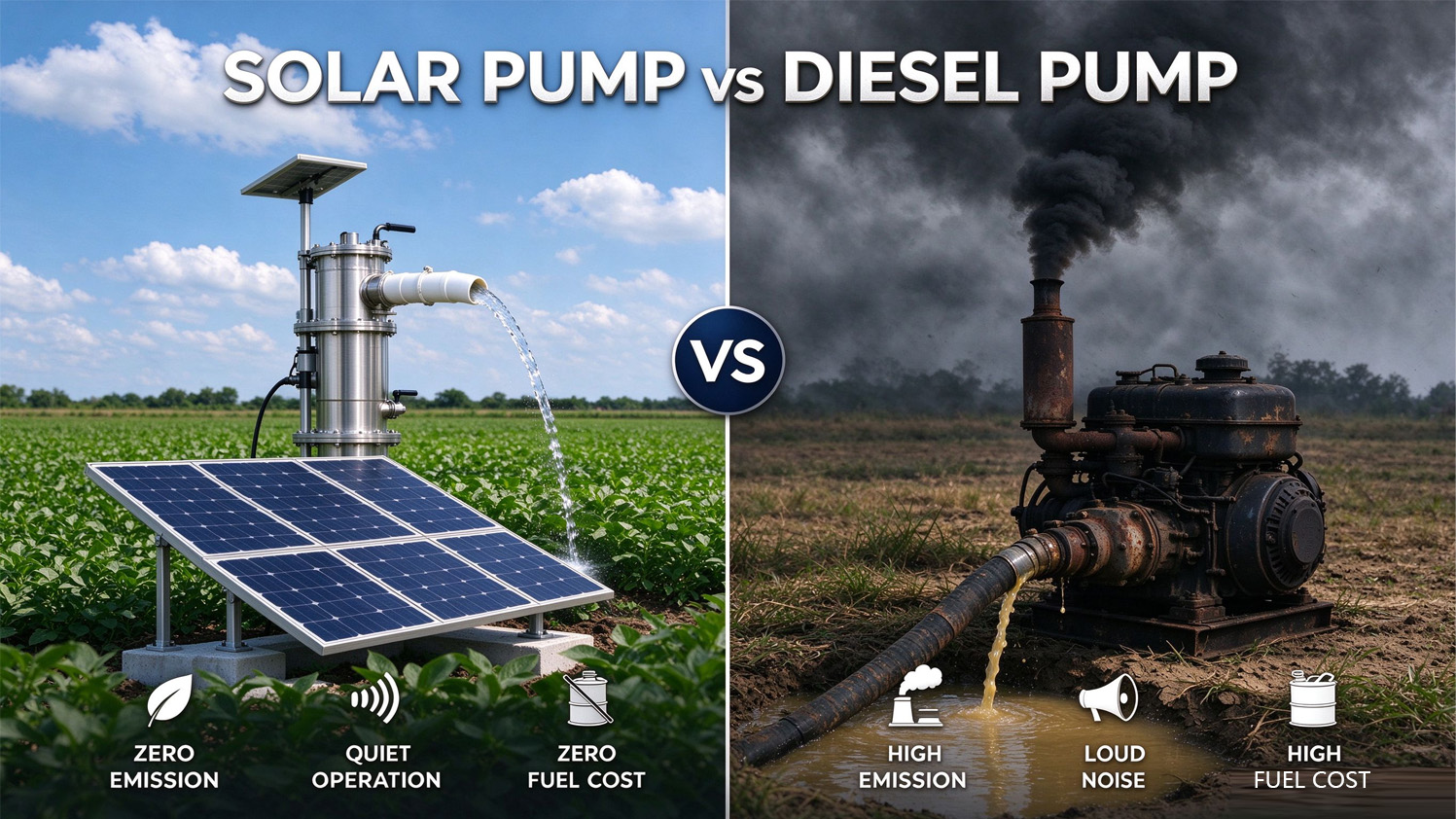
In traditional agriculture, irrigation typically relies on diesel generators or grid power. Diesel is costly and polluting, while many farmlands are far from the electrical grid. Solar water pumps are fundamentally changing this picture:
Reduced operating costs — Solar energy can significantly reduce dependence on diesel fuel and grid electricity.
Lower routine maintenance — Compared with diesel pumping systems, solar pumps generally have fewer engine-related maintenance requirements.Zero emissions — Supporting agricultural carbon neutrality
Labor liberation — Automated operation, no manual supervision needed
Unlocking remote land — Making "where there's water, there's farmland" a reality
ZRI, a professional solar pump manufacturer with 28 years of expertise, provides a detailed irrigation system design guide on its website. This article synthesizes that knowledge to help you build your own solar irrigation system from scratch.
Step 1: Demand Analysis — Calculate How Much Water You Need
1.1 Determine Your Irrigation Method
Different irrigation methods directly affect system design and efficiency:
|
Irrigation Method |
Characteristics |
Water Use Efficiency |
Best For |
|
Drip irrigation |
Water & nutrients delivered directly to roots,minimal evaporation loss |
95%+ |
Hills, slopes, orchards |
|
Sprinkler irrigation |
High mechanization, saves 30%-50% water vs. traditional |
70%-80% |
Dense field crops, grasslands |
|
Surface irrigation |
Lowest construction cost, relies on gravity |
50%-60% |
Areas with natural slope |
Drip irrigation is strongly recommended : In solar irrigation systems, it maximizes water use efficiency and pairs perfectly with the intermittent nature of solar pumping — "pump during daylight, irrigate anytime."
1.2 Calculate Daily Total Water Demand
Core Formula:
Q_day (m³/day) = Irrigation Area A (hectares) × Crop Water Need ET (mm/day) × 10
Major Crop Daily Water Requirements:
|
Crop |
Growth Stage |
Daily Need (mm) |
Total Season (m³/acre) |
|
Rice |
Full season |
4.0~8.0+ |
300~500 |
|
Wheat |
Jointing~flowering |
4.0~7.0 |
250~400 |
|
Corn |
Flowering~grain filling |
5.0~8.0 |
200~350 |
|
Cotton |
Flowering~bolling |
5.0~8.0 |
300~500 |
|
Tomato/Cucumber |
Fruiting |
5.0~8.0+ |
300~450 |
|
Citrus |
Fruit expansion |
3.0~6.0 |
400~700 |
|
Leafy vegetables |
Fast growth |
3.0~6.0 |
200~300 |
Calculation Example:
3 hectares of vegetables, average summer daily water need = 6 mm/day
Q_day = 3 × 6 × 10 = 180 m³/day
1.3 Calculate Total Head
Total Head = Vertical Head + Pipe Friction Loss
H = h1 + h2 + h3/10 + h4
Where:
- h1 : Submerged head (pump to water surface distance)
- h2 : Above-water head (water surface to wellhead distance)
- h3 : Horizontal distance (well to tank)
- h4 : Tank height
Pipe friction loss typically adds 10%-20% to the head. Smaller pipe diameter, longer pipes, and more elbows mean greater losses.
Step 2: Pump Selection — Choosing the Right Pump Is Half the Battle
2.1 Calculate Required Pump Flow
Core Formula:
Q_pump (m³/h) = Q_day (m³/day) ÷ [Peak Sunshine Hours T (hours) × Irrigation Efficiency η]
|
Irrigation Method |
Efficiency η |
|
Flood irrigation |
≈ 0.5 |
|
Furrow irrigation |
≈ 0.6~0.7 |
|
Sprinkler irrigation |
≈ 0.7~0.8 |
|
Drip irrigation |
≈ 0.85~0.95 |
Irrigation Efficiency Coefficients:
Peak sunshine hours are typically 4~6 hours, available via NASA databases or local meteorological data.
Calculation Example:
Q_day = 180 m³/day, T = 5 hours, drip irrigation η = 0.9
Q_pump = 180 ÷ (5 × 0.9) = 40 m³/h
2.2 Pump Type Selection Guide
|
Water Source Condition |
Recommended Pump Type |
Notes |
|
Deep well (>8m) |
Submersible pump |
Must match well diameter |
|
River/pond (<8m) |
Surface centrifugal pump |
Suction lift ≤ 8m |
|
Sandy water |
Stainless steel impeller pump |
Superior wear resistance |
|
Nighttime operation needed |
AC/DC hybrid pump |
Can switch to grid power |
Selection Principle:The required operating point (head + flow) should fall within the high-efficiency zone of the pump's H-Q performance curve.
2.3 Pump Power Estimatio
Pump Power (kW) ≈ [Flow (m³/h) × Head (m) × 1000 × 9.8] ÷ [360000 × 0.5 × 0.95]
Note: This is a rough estimate. It is strongly recommended to use the manufacturer's official selection parameters. ZRI offers free professional sizing services.
Step 3: PV Array Configuration — Give Your Pump Enough "Heart"
3.1 Calculate Total Solar Panel Power
Core Formula:
P_pv (kW) = [Pump Input Power (kW) ÷ System Total Efficiency η_sys] × Redundancy Factor
- System total efficiency : ~0.9 (MPPT efficiency 95% × wiring efficiency 95%)
- Redundancy factor : 1.2~1.3 (accounts for panel degradation, dust shading, temperature rise)
Calculation Example:
Pump power = 11 kW
P_pv = (11 ÷ 0.9) × 1.3 ≈ 15.9 kW → Install approximately 16 kW of solar panels
3.2 Solar Panel Configuration Example
Using ZRI's recommended ZRI450W-36MH solar panel:
|
Parameter |
Value |
|
Per-panel power |
450W |
|
VMP voltage |
41.5V |
|
VOC voltage |
49.3V |
8 panels in series:
- Total power: 450W × 8 = 3,600W
- VMP voltage: 41.5V × 8 = 332V
- VOC voltage: 49.3V × 8 = 394.4V (must be below controller's max open-circuit voltage)
Step 4: Controller Selection — The Brain of Your System
The controller is the core of the entire system and must be strictly matched to the pump:
1.Type matching: DC pump → DC controller; AC pump → AC inverter
2.Parameter matching: Rated voltage, power, and max current must be ≥ pump ratings (inverter recommended one tier higher than pump rated power)
3.Essential functions: MPPT (Maximum Power Point Tracking), dry-run protection, over-voltage/over-current/under-voltage protection
Step 5: Optimization Tips — Better Performance, Lower Cost
5.1 Store Water, Not Electricity
For agricultural irrigation, prioritize water storage over battery storage:
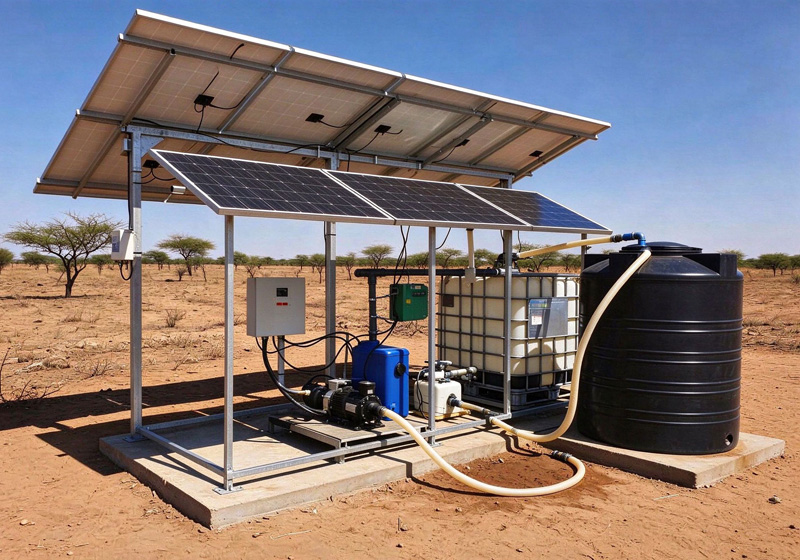
- Build a reservoir or water tank sized for 1-2 days of water demand (e.g., 180-360 m³)
- Pump at full capacity during sunshine hours and store water
- Use stored water at night or on cloudy days
- Avoid expensive battery investments
5.2 Installation Notes
- Solar panel orientation: Northern Hemisphere → face south, tilt angle ≈ local latitude
- Lightning protection: Must be installed to protect expensive equipment
- Cable selection:
|
Cable Length |
Recommended Gauge |
|
<50m |
2.5mm² |
|
50~100m |
4mm² |
|
100~200m |
6mm² |
|
>200m |
Consider built-in controller pump model |
5.3 Complete Design Summary
|
Step |
Core Task |
Example Result |
|
Demand analysis |
Daily water need + total head |
180 m³/day @ 60 m |
|
Pump selection |
Pump flow + model power |
40 m³/h @ 60 m, ~11 kW |
|
PV array |
Total solar panel power |
~16 kW |
|
System integration |
Controller + water storage |
Match parameters + build reservoir |
Real-World Solar Irrigation System Design: Kenya Farm Case
ZRI designed the following solution for a Kenyan client:
|
Parameter |
Value |
|
Well Diameter |
120 mm |
|
Dynamic Water Level |
50 m |
|
Tank Height |
10 m |
|
Horizontal Distance |
40 m |
|
Required Flow |
6 m³/h |
|
Calculated Head |
64 m |
|
Pump Type |
AC/DC Hybrid |
|
Pump Power |
2.2 kW |
|
PV Array |
3.6 kW |
|
Solar Panels |
8 × 450W |
Conclusion
Designing a solar irrigation system is essentially the progressive transformation of crop requirements → hydraulic parameters → electrical parameters → PV parameters . Once you master this logic, no matter how large the irrigation area or how complex the site conditions, you can find the optimal solution.
For large-scale projects, ZRI strongly recommends consulting their professional engineering team—28 years of industry experience can save you from many costly mistakes.