
 DC SOLAR SUBMERSIBLE PUMP
 AC/DC Solar submersible Pump
 DC Solar Surface Pump
 AC/DC solar surface Pump
 Solar swimming Pool Pump
 Built-in Controller Solar Pump
 Solar Pump inverter
 Pump Accessories


 Mr Youkee Kong
Solar Pumps for Extreme Environments: Heat, Dust, Salt & Corrosion
Solar Pumps for Extreme Environments: Heat, Dust, Salt & Corrosion | ZRI SOLAR PUMP
1 · Quick Answer
| Environment | Challenge | ZRI SOLAR PUMP Solution |
|---|---|---|
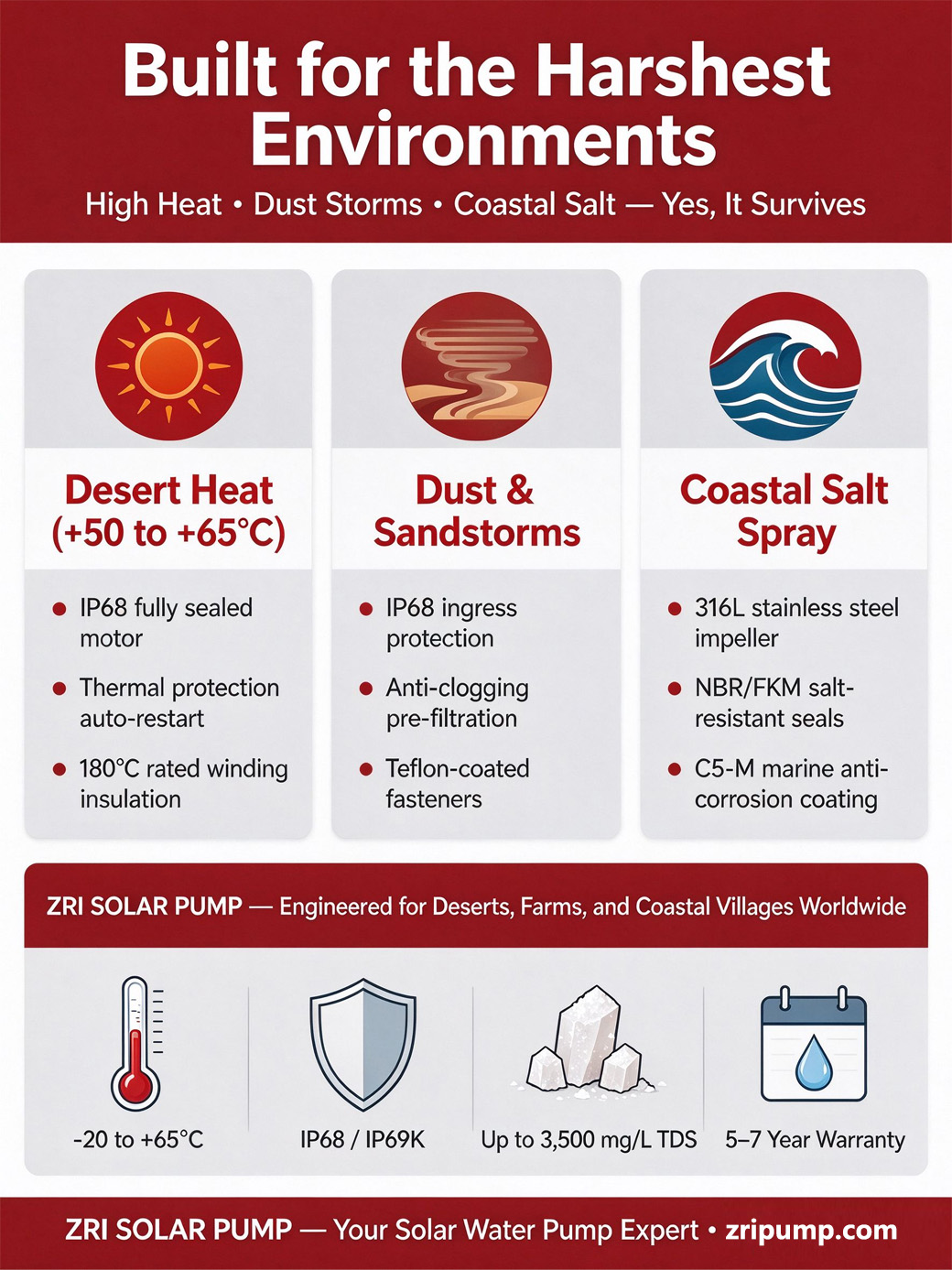
| High temp (40–55°C) | Electronics overheating, motor derating, panel loss | High-temp parts, thermal management, oversized cooling, protected enclosures |
| Desert / dust | Soiling, abrasion, ingress, bearing wear | IP65+, sealed bearings, dust-proof enclosures, anti-soiling coating, cleaning |
| Coastal / saline | Metal corrosion, insulation breakdown, aging | 316 SS, marine coatings, conformal coating, IP66+, sacrificial anodes |
| Combined extreme | Multiple simultaneous stressors | Comprehensive protection, material choice, sealed build, robust design |
Key specs: IP65–IP68; controller −20~+60°C; motor insulation F/H (155/180°C); 316 SS; UV-stable 8+ yrs; salt spray 500–1000 h (ISO 9227 / ASTM B117); IP6X dust-tight; humidity 95% RH; thermal cycling −40~+85°C.
2 · Environmental Challenges
Solar pumps run in the world's harshest sites—Sahara, Middle East, sub-Saharan Africa—exposed 365 days outdoors with temperature swings, UV, grit, moisture and little maintenance.
3 · High-Temperature Protection
Component Effects
- Panels: efficiency drops ~0.3–0.5% per °C above 25°C (12–20% at 70°C). Mitigate: oversize array 15–25% and ensure rear ventilation.
- MPPT controllers: failure rate ~doubles per 10°C. ZRI SOLAR PUMP uses oversized heatsinks, conformal-coated PCBs, active fans on larger units, smart derating + alarms, IP65/66 vented enclosures.
- Motors: insulation class sets the ceiling; submersibles cool via water (best), surface pumps via air.
| Class | Max Winding Temp | Typical Use |
|---|---|---|
| B | 130°C | Standard, mild climates |
| F | 155°C | Industrial / hot (ZRI standard) |
| H | 180°C | Severe heat (ZRI premium) |
Thermal derating: 40°C≈100%, 50°C≈90–95%, 60°C≈80–85% power; a slightly larger motor preserves output. Cables: 90°C+ conductor, XLPE/EPR, upsized, terminals re-torqued.
Standards & Testing
IEC 60068-2-2 dry heat; IEC 61215/IEC 61730 thermal cycling (−40~+85°C)×200, damp heat 85°C/85%×1000 h; IEC 60034-1 motor rise; plus 24/7 endurance runs.
Case · Saudi Arabia Farm
Riyadh, summer 45–50°C, >1,100 W/m². ZRI 5.5 kW submersible + 8 kW array (45% oversized), shaded controller, Class H motor, 180 m well. At 68–72°C panel it outputs ~6.5 kW (81%); motor 55–65°C (water-cooled). 4 yrs, zero heat failures, 99.2% availability.
4 · Dusty & Sandy Environments
Impacts
- Panel soiling: 2–10% loss/month, 20–50% uncleaned in 6–12 months. Fix: clean every 1–4 wks, anti-soiling coating (−30–60%), steeper tilt, auto-cleaning for large sites.
- Ingress into electronics: shorts, abrasion, heat—it comes down to IP rating:
| 1st digit (solid) | Meaning | 2nd digit (liquid) examples |
|---|---|---|
| 5 = dust-protected | Limited ingress, no harm | 4 = splashing water |
| 6 = dust-tight | No dust entry | 5 = jets; 6 = powerful jets; 7 = immersion 1 m; 8 = continuous |
Recommendation: IP54 mild, IP65 moderate, IP66 severe, IP67/68 immersed. ZRI controllers: IP65 standard, IP66 harsh, optional marine-grade (IP66 + conformal); submersible motors IP68. Sealed glands, O-rings, filtered breather vents, bottom entry.
Bearings & Wear
Fine dust can cut bearing life from 10 yrs to 1–3. ZRI SOLAR PUMP uses brushless PM motors (no brush dust), sealed bearings, food-grade lube, 316 shafts in corrosive/abrasive service.
Testing
IEC 60529 / ISO 20653 (IP5X/6X), IEC 60068-2-68 (2 g/m³, 50–150 μm), MIL-STD-810G 510.5; ZRI parts meet IP6X (48+ h for harsh), field-tested.
Case · Outback Australia Station
N. Territory, summer 35–48°C, iron-oxide red dust, dust storms. ZRI 3 kW submersible + 4.5 kW array, IP66 controller, 120 m bore. After low-rated boxes ingested dust and panels lost 25% in 2 wks, fixes: IP67+ joints, anti-soiling coating, dry-brush every 7–10 days, controller in vented shed, filtered breather. Loss between cleans 8–12%, zero dust failures in 3 yrs, 98.5% availability.
5 · Coastal & Corrosive Environments
Corrosion Mechanisms
Wave action creates salt aerosol carried inland 10+ km; hygroscopic salt draws moisture, forming electrolyte that corrodes steel, aluminum and copper; RH >60% accelerates (tropical coasts 70–95%), making this the most corrosive natural environment.
Stainless Steel Selection (critical)
| Grade | Notes | Coastal Suitability |
|---|---|---|
| 304 | 18Cr8Ni, cheaper | ✗ rusts in salt spray |
| 316 | +2% molybdenum, pitting-resistant | ✓ recommended (ZRI standard) |
| 316L | lower carbon, better welds | ✓ for welded parts |
| Duplex 2205/2507 | stronger, costlier | only extreme offshore (seawater) |
ZRI SOLAR PUMP coastal pumps: 316 shaft/housing (coastal models), 304/316 or polymer impeller, 316 fasteners, marine-coated brackets.
Coatings & Electronics
- Steel: hot-dip galvanize (70–100+ μm), powder coat (60–150 μm), marine epoxy/polyurethane (150–300 μm, 15–25 yr), hard-anodize aluminum.
- Electronics: conformal coating (acrylic/silicone/polyurethane/epoxy/parylene); ZRI coats all PCBs, potting critical parts; 316 or coated-alum IP66 enclosures, filtered breather, gold-plated connectors.
- Fasteners: avoid galvanic corrosion—matching 316, nylon/EPDM isolators, anti-seize compound.
Testing
ASTM B117 / ISO 9227 salt spray (coastal 500–1000 h; ZRI standard 500 h, marine 1000 h); IEC 60068-2-52 cyclic mist is more realistic. Note: test hours are comparative acceleration, not equivalent years.
Case · Caribbean Island Resort
200 m from ocean, 25–32°C, 70–90% RH, hurricane-exposed. ZRI 2.2 kW submersible + 3.5 kW array, marine-grade controller (IP66 + conformal + 316), all-316 hardware, IP68 glands, anodized frame. Controller sheltered, dielectric grease, desiccant breather, monthly rinse. 5 yrs, zero corrosion failures; conformal + IP66 kept PCBs pristine, few fasteners surface-rusted.
6 · Combined Extremes: Hot Coastal Deserts
Gulf/Red Sea/NW Australia combine 40–50°C, 60–90% RH, salt spray, dust storms, UV index 11+ and large day-night swings—the toughest mix for panels, electronics and structures.
Case · Oman Coastal Industrial Site
5 km from sea, summer 42–48°C, 70–85% RH, dusty salt air. ZRI 7.5 kW submersible + 12 kW array (60% oversized), solar/grid hybrid, 316L pump + duplex 2205 shaft, controller in AC room, IP68 cable. Extras: zinc anodes, anti-fouling, anti-soiling coating, auto cleaning, alarms, annual pull. 6 yrs at 99.7% availability; vs diesel saves $14,500/yr, 3.1-yr payback, $245,000 net over 20 yrs.
7 · ZRI SOLAR PUMP Solutions
Standard Features (all systems)
- PM motors: F/H insulation, 304/316 housing, sealed bearings, thermal protection, IP68 submersible.
- Advanced MPPT: IP65 (IP66 harsh), −20~+60°C, big heatsink, conformal PCB, smart derating, IP67 glands.
- UV-stable PV cable (EN 50618/IEC 62930, 90°C+, 8-yr); submersible cable immersion-rated.
- Certifications: CE (where applicable), ISO 9001, model-specific test reports on request.
Enhanced Options
- Marine-grade controller (IP66 + 316/coated Al + conformal + potting): +10–15%.
- High-temp controller (−25~+70°C + fan): +8–12%, for >50°C.
- Marine pump build (316L + duplex shaft + Viton): +15–25%.
- Anti-soiling coating: $3–5/panel; full extreme package: +20–30% (incl. 5-yr warranty).
System Design Services
Environmental assessment → material specification (grade/coating/IP/cable) → performance modeling (derating, soiling, maintenance) → installation guidance → maintenance planning and training.
8 · Maintenance for Extreme Environments
Schedule
- Monthly (or after storms): clean panels (soft brush, deionized water, cool hours); visual inspection; coastal fresh-water rinse; check flow/faults.
- Quarterly: powered-off electrical check (corrosion, torque, grease); grounding; seals & breather (replace desiccant); performance vs baseline.
- Annually: full electrical + insulation (megger) test; pump condition (bearing noise, current); coating/anode check; update log.
- Every 3–5 yrs: replace seals/bearings/anodes; recoat; swap electrolytic capacitors.
Cleaning Tips
Panels: cool hours, deionized water, soft brush, no pressure washer. Coastal: wipe exterior, never force water into enclosures. Connectors: powered off, contact cleaner + dielectric grease.
Failure Modes & Prevention
| Failure Mode | Symptoms | Prevention |
|---|---|---|
| Controller overheat | shutdown / intermittent | shade, ventilate, high-temp model, active cooling |
| Panel soiling | gradual output drop | regular cleaning, coating, tilt |
| Bearing failure | noise / vibration / seize | sealed bearings, inspect, block ingress |
| Connector corrosion | high R / heat / arc | IP67+, dielectric grease, inspect |
| PCB corrosion | erratic / short | conformal coat, IP66+, desiccant |
| Steel corrosion | rust / weakness | 316 or coating, inspect & touch-up |
9 · Frequently Asked Questions
Yes—use submersible (water-cooled) pumps, shade/ventilate the controller, specify Class F/H insulation, oversize array 20–30% for thermal loss.
Dust blocks sunlight, cutting output 2–10%/month and up to 20–50% in 6–12 months uncleaned; clean weekly to monthly by severity.
IP65 minimum for moderate dust, IP66 for severe. First digit 6 means dust-tight.
Yes, if specified: 316 stainless, IP66 enclosures, conformal coating, marine coatings, plus regular fresh-water rinsing.
316 adds 2–3% molybdenum for far better chloride resistance; 304 rusts in salt spray, so use 316 near the coast.
Light dust monthly, moderate bi-weekly, severe or after storms weekly; clean immediately if output drops sharply.
Yes. High humidity accelerates corrosion and faults—use IP66, conformal coating, 316 SS, desiccant breather vents, inspect.
A thin polymer layer on circuit boards blocking moisture, salt, dust and contaminants that cause corrosion and shorts—essential in harsh environments.
Not recommended. It generates heat and must dissipate it; direct sun causes overheating and early failure. Install shaded/ventilated or indoors.
With correct spec, install and maintenance, ZRI systems typically last 10–20 years; controllers may need replacement after 10–15 years.
Monthly cleaning/rinse/inspect; quarterly electrical check, seals, performance; annually full inspection, coating, insulation test. More severe = more frequent.
ZRI offers extended warranties up to 5 years for systems with the full extreme-environment package; standard warranties may have limits—confirm with sales.
Yes, at the highest level: 316 SS, IP66+ enclosures, conformal coating, marine coatings, proper install and aggressive maintenance—the toughest combined extreme.
IP per IEC 60529 (report), salt spray ASTM B117 / ISO 9227 (500–1000 h coastal), CE, insulation class IEC 60034, ISO 9001.
Yes—high-temperature, salt-spray, dust-ingress, humidity and thermal-cycling tests; model-specific reports on request.
With correct design, quality components and maintenance, ZRI pumps deliver reliable long-term performance in deserts, tropics and coasts.
10 · Conclusion
ZRI SOLAR PUMP engineers for the world's harshest environments: material selection, thermal management, ingress protection, extensive testing, customization and global field experience across deserts, tropics and coasts—from Sahara to Middle East, tropical resorts, Outback and African villages.
Get Your ZRI SOLAR PUMP Extreme-Environment System Design
Provide location & climate, temperature/humidity, distance to coast, dust exposure and maintenance access