
 DC SOLAR SUBMERSIBLE PUMP
 AC/DC Solar submersible Pump
 DC Solar Surface Pump
 AC/DC solar surface Pump
 Solar swimming Pool Pump
 Built-in Controller Solar Pump
 Solar Pump inverter
 Pump Accessories


 Mr Youkee Kong

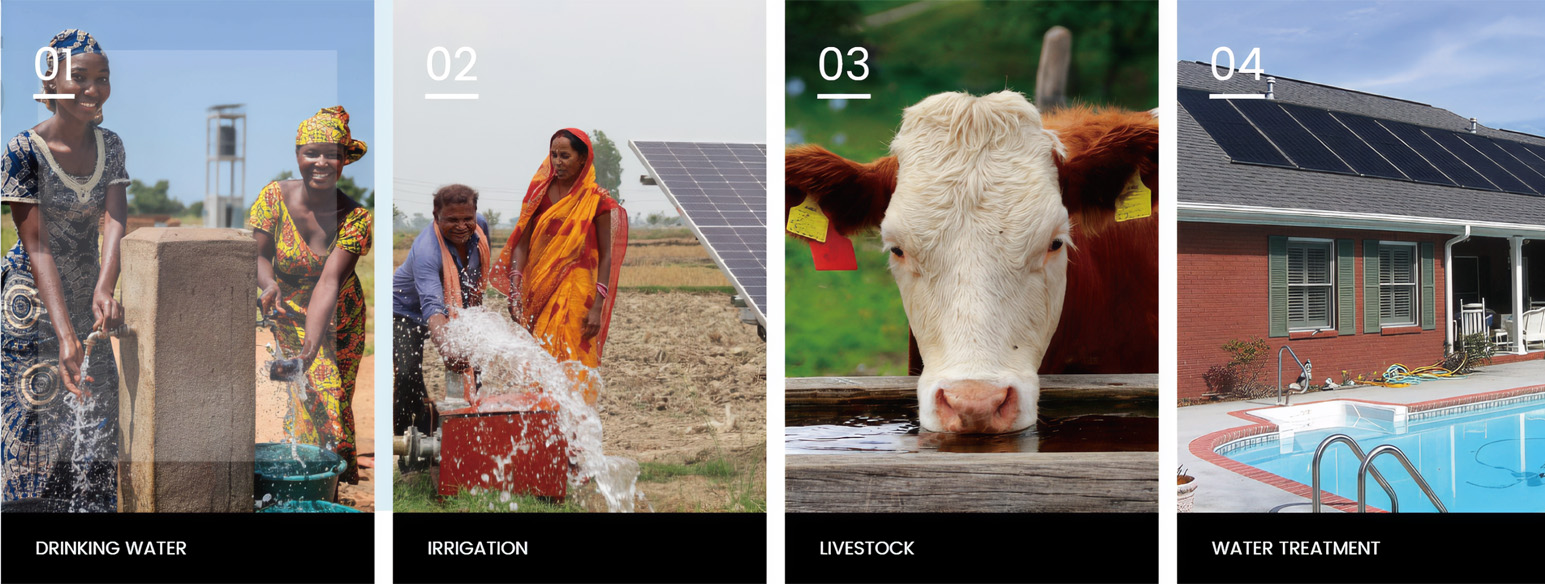
Four Core Applications of Solar Water Pumps: A Practical Guide
Four Core Applications of Solar Water Pumps: A Practical Guide
Solar water pumps are often described in a very simple way: use solar energy to pump water. That is basically true, but when you actually work on a project, things are not quite that simple.
A solar water pumping system used for drinking water is different from one used for farm irrigation. A livestock watering system has its own requirements, while water treatment may require stable pressure, corrosion resistance, and longer operating hours.
So, there is no single solar water pump that is suitable for every project.
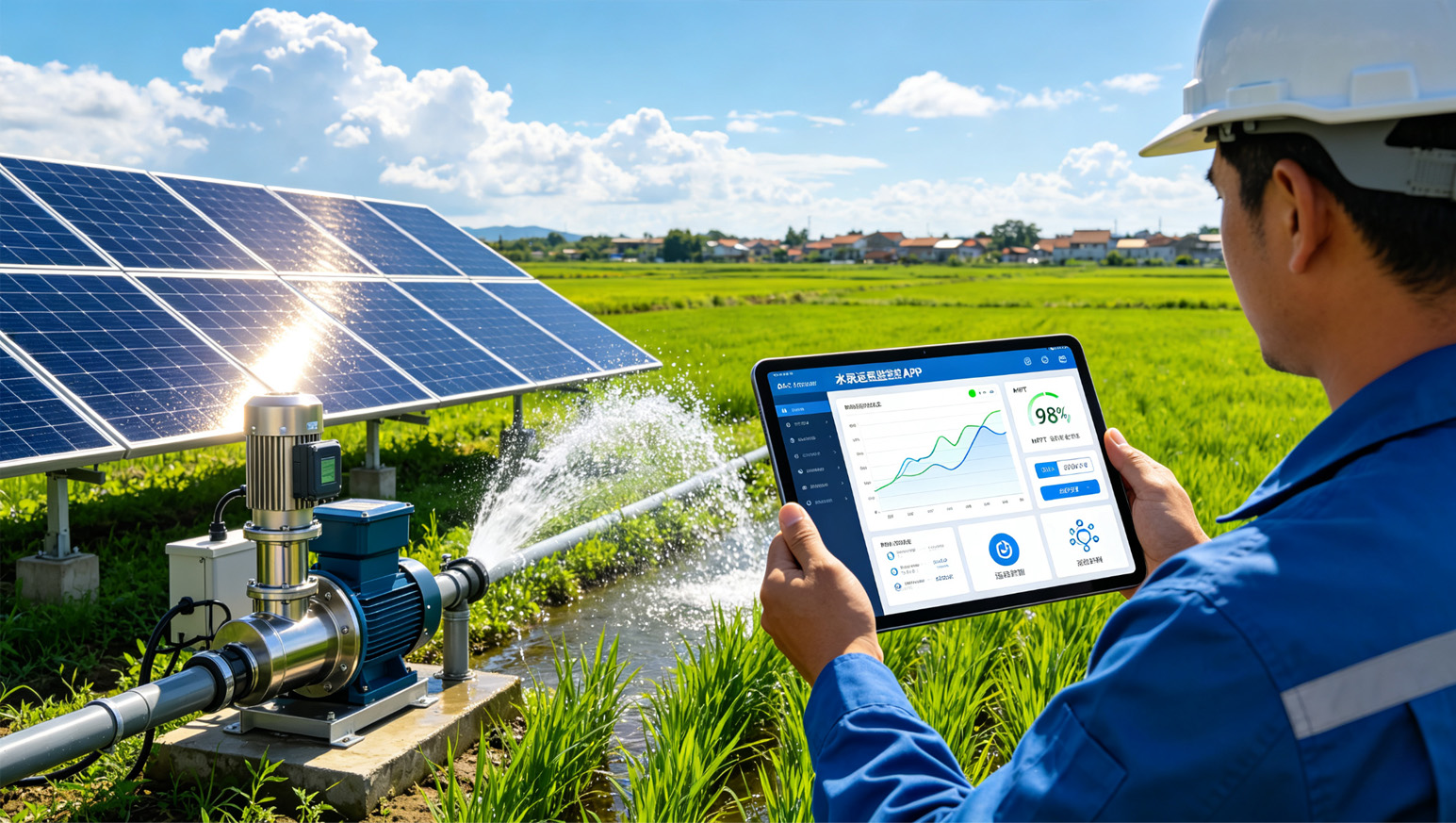
In this article, we look at four common solar water pump applications: drinking water supply, agricultural irrigation, livestock watering, and water treatment. We will also look at some of the basic points that should be considered when selecting a solar pump.
Scenario 1: Solar Water Pumps for Drinking Water Supply
For many remote villages, households, and islands, reliable access to clean water is still a challenge. These locations may have a suitable groundwater source, but no reliable electricity grid nearby.
This is where a solar water pump can be useful.
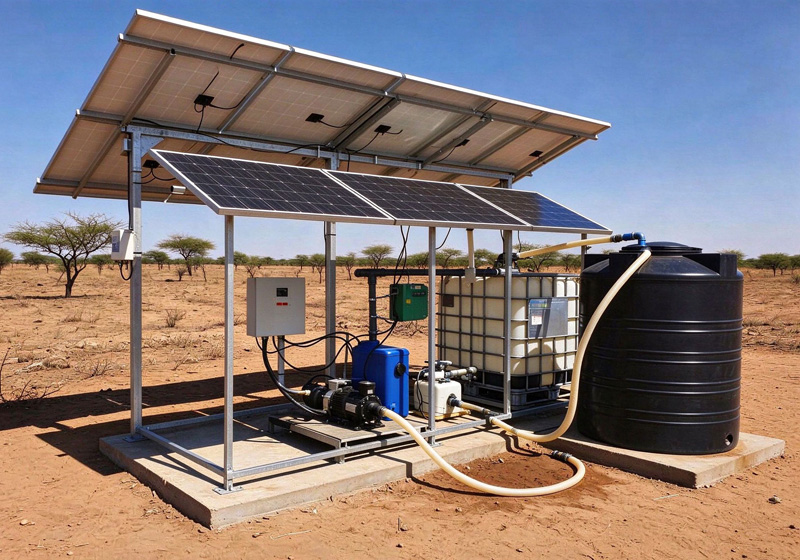
A solar pump can use electricity generated by solar panels to pump water from a borehole, deep well, river, lake, or other suitable source into a storage tank. There is no need to transport diesel fuel to the site every few days, and the system can continue working even when grid electricity is not available.
For remote water supply projects, this can make a big difference.
Three Typical Applications
1. Household Water Supply
For an off-grid household, a small solar water pumping system can provide water for drinking, cooking, washing, and general household use. Low noise is another advantage, especially when compared with a diesel generator installed close to the house.
2. Village and Community Water Supply
For a village or small community, the system is usually larger. Water is pumped from a well or another source into a storage tank and then distributed to different users. In sunny areas, solar energy can reduce the long-term operating cost of the water supply system.
3. Remote Water Utility Projects
Solar water pumps can also be used when water utilities need to extend services to remote communities. Instead of building expensive grid infrastructure or relying completely on diesel generators, solar pumping can be considered as part of an independent water supply system.
What Should Be Considered?
|
Key Question |
Why It Matters |
|
What is the water source? |
Determines pump type |
|
What is the well diameter? |
Determines suitable submersible pump size |
|
What is the dynamic water level? |
Affects total head |
|
How high is the storage tank? |
Adds to required head |
|
How far is the tank from the well? |
Creates pipe friction loss |
|
How much water is needed? |
Determines pump flow |
|
Is the water suitable for drinking? |
Determines material requirements |
|
Is water needed at night? |
May require storage or AC/DC hybrid operation |
For drinking water, material selection is also important. Stainless steel and other suitable food-contact materials may be required depending on local regulations and water quality.
Solar Water Pump Selection Example
For example, consider a project in Kenya:
• Well diameter: 120 mm
• Dynamic water level: 50 m
• Tank height: 10 m
• Horizontal distance: 40 m
• Required flow: 6 m³/h
• Nighttime water supply required
A possible solution is the ZRI Z4PC9-125-300-2200-A/D, a 4-inch AC/DC hybrid solar water pump.
The reference performance is around 6.9 m³/h at 64 m head.
Of course, this is only an example. Actual pump selection should be based on the complete pump curve, pipe size, friction loss, water source conditions, and actual site data.
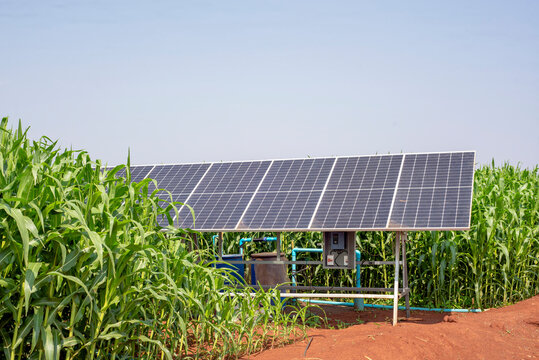
Scenario 2: Solar Water Pumps for Agricultural Irrigation
Agricultural irrigation is probably the application most people think of when they hear "solar water pump."
And there is a good reason for that.
Many farms are located far away from the electrical grid. Running power lines to a remote field can be expensive, while diesel pumping means the farmer has to continuously deal with fuel costs, transportation, engine maintenance, and sometimes unstable fuel supply.
Solar energy offers another option.
During the irrigation season, there is usually plenty of sunlight. In many cases, the period when crops need more water also happens to be the period with stronger solar radiation.
That makes solar irrigation a fairly natural combination.
Why Solar Pumps Work Well for Irrigation
- Agricultural land is often far from the grid.
• Grid extension can be expensive.
• Diesel fuel can become a significant operating cost.
• Solar energy is available during the daytime.
• Automatic controllers can reduce manual operation.
• Water tanks can store water for use after sunset.
A solar irrigation pump does not necessarily have to pump water directly to the crops. In many projects, pumping water into a storage tank first is actually a better solution.
Three Common Irrigation Methods
|
Irrigation Method |
Typical Water Efficiency |
Solar Compatibility |
|
Drip irrigation |
95%+ |
★★★★★ |
|
Sprinkler irrigation |
70–80% |
★★★★ |
|
Surface irrigation |
50–60% |
★★★ |
Drip irrigation is particularly interesting for solar pumping. Water is delivered closer to the root zone, which helps reduce evaporation and runoff. More importantly, the irrigation schedule does not have to follow the exact solar pumping schedule if a water storage tank is used.
In simple terms: Pump water during the day → store water → irrigate when needed.
Four Basic Steps for Solar Irrigation System Design
Step 1: Calculate water demand
Daily water demand = Irrigated area × Crop water requirement. The actual calculation should also consider crop type, climate, soil, irrigation method, and local evapotranspiration.
Step 2: Calculate total head
Total head = Vertical lift + Pipe friction loss + Required pressure
Step 3: Select the solar irrigation pump
The pump should provide the required flow at the calculated head. Do not select a pump only because the motor has a higher kW rating. The pump curve is more useful.
Step 4: Configure the solar panels
The PV array needs to provide enough power for the pump and controller while allowing for system losses and changing solar conditions.
ZRI Solar Pump Options for Irrigation
|
Series |
Pump Type |
Typical Application |
|
S3SS |
3-inch screw submersible pump |
Higher head, lower flow |
|
S3PC |
3-inch centrifugal pump |
Medium flow, economical projects |
|
S4PC |
4-inch centrifugal pump |
Larger flow requirements |
|
S3SC / S4SC |
Stainless steel impeller submersible |
More demanding water conditions |
The final choice still depends on well diameter, water quality, required flow, head, and solar conditions.
Scenario 3: Solar Water Pumps for Livestock Watering
Livestock need water every day, whether there is grid electricity or not.
This sounds obvious, but it becomes a real problem when cattle farms, ranches, or grazing areas are located several kilometers away from the nearest power supply.
A solar livestock watering system can pump groundwater into a tank or trough automatically, making water available in more remote grazing areas.
Three Changes Solar Pumps Can Bring to Livestock Farming
1. Lower Long-Term Energy Costs
Solar energy is free after the initial system installation. Compared with a diesel pump that needs fuel every day, a solar pump can reduce ongoing energy expenses considerably.
2. More Flexible Pasture Management
Water does not have to be available only near the main farm buildings. With properly located water tanks, livestock can be moved to more remote grazing areas. This can support rotational grazing and help avoid excessive pressure on one piece of pasture.
3. More Reliable Water Supply
Remote farms may experience unstable grid power or frequent outages. A properly designed solar pumping system operates independently from the grid. This is particularly useful during hot periods when animals consume more water.
Step 1: Calculate Daily Livestock Water Demand
Daily water demand = Number of animals × Daily water requirement per animal
|
Livestock |
Approximate Daily Water Intake |
|
Adult cattle |
40–100 L/day/head |
|
Adult horse |
30–50 L/day/head |
|
Sheep |
4–12 L/day/head |
|
Pigs |
10–25 L/day/head |
|
Poultry |
0.2–0.5 L/day/head |
Actual consumption changes with temperature, animal size, feed, production stage, and other conditions.
Livestock Watering Example
Suppose a farm has:
• 100 cattle × 70 L/day
• 500 sheep × 8 L/day
The total is:
100 × 70 + 500 × 8 = 11,000 L/day
So the farm needs approximately 11 m³/day.
If the location receives about five effective peak-sun hours:
11 ÷ 5 = 2.2 m³/h
A preliminary pump flow of about 2.2 m³/h can therefore be considered. But again, the pump must also meet the required head. Flow alone is not enough.
Important Points for Solar Livestock Watering
|
Consideration |
Details |
|
Water storage |
2–3 days of storage is recommended for important water supplies |
|
Automatic control |
Float valves, water-level sensors, and controllers can reduce manual operation |
|
Cold-weather protection |
Protect pipes against freezing in cold regions |
|
Water source protection |
Reduce contamination and protect exposed equipment from animals |
|
Backup |
Battery, grid, or auxiliary generator can be considered for critical farms |
Scenario 4: Solar Water Pumps for Water Treatment
Water treatment is somewhat different from agricultural irrigation or livestock watering.
The pump is not simply moving water from A to B. It may need to work together with filtration equipment, membranes, pressure systems, chemical dosing systems, and other treatment equipment.
Because of this, pump selection becomes more specific.
What Does a Solar Pump Need to Handle in Water Treatment?
- Chemical corrosion resistance
• Stable flow and pressure
• Compatibility with filtration equipment
• Compatibility with RO or ultrafiltration systems
• Long operating hours
• Suitable pump and seal materials
For example, water containing chlorine or certain acidic and alkaline chemicals may require corrosion-resistant materials.
For processes requiring long or continuous operation, an AC/DC hybrid solar water pump system can be useful. Solar energy can provide the main power source when available, while AC power can support operation when solar power is insufficient.
ZRI's solar pump inverter range includes solutions from approximately 4 kW to 160 kW, providing options for different water treatment and larger pumping projects.
Other Applications of Solar Water Pumps/h2>
The four scenarios above are the major applications, but solar water pumps are not limited to them.
Park and Landscape Water Features
Solar pumps can circulate water in fountains, ponds, and landscape features. Low operating cost and low noise can be useful for public parks and green spaces.
Swimming Pool Circulation
Solar swimming pool pumps can circulate pool water during daylight hours and reduce dependence on conventional electricity.
Construction Site Drainage
For temporary construction sites without convenient grid access, solar pumps can provide a relatively simple drainage solution.
Desertification Control
In dry regions, solar pumping systems can supply water for vegetation irrigation and sand-fixing projects.
Solar Water Pump Selection Quick Reference
|
Application |
Common Pump Type |
Main Priority |
Drive |
|
Drinking water |
Submersible |
Water quality, head, flow |
DC / AC/DC hybrid |
|
Irrigation |
Submersible / centrifugal |
Flow, head, efficiency |
DC / AC/DC |
|
Livestock |
Submersible / surface |
Reliability, storage |
DC / AC/DC |
|
Water treatment |
Centrifugal |
Pressure, materials |
AC/DC hybrid |
There is no universal “best solar water pump.” The best pump is the one that matches the actual working conditions.
How to Select the Right Solar Water Pump?
Before asking a supplier for a quotation, it is useful to prepare several basic parameters:
1. Water source
2. Well diameter
3. Static and dynamic water level
4. Required flow rate
5. Total vertical lift
6. Pipe length and pipe diameter
7. Required pressure
8. Water quality
9. Daily water demand
10. Available solar radiation
11. Required operating hours
12. Whether water storage is available
13. Whether AC backup is required
The most important thing is to provide the actual flow and head requirement.
For example, saying “I need a 2 kW solar pump” is usually not enough information.
A better inquiry would be:
Water source: borehole
Well diameter: 4 inch
Water level: 50 m
Tank height: 10 m
Pipe length: 100 m
Required flow: 5 m³/h
With this information, a supplier can make a much more useful pump recommendation.
Frequently Asked Questions About Solar Water Pumps
1. What are solar water pumps mainly used for?
Solar water pumps are commonly used for drinking water supply, agricultural irrigation, livestock watering, groundwater pumping, water treatment, swimming pools, drainage, and remote water supply projects. The system size and pump type depend on the required flow, head, water source, and application.
2. Can a solar water pump work at night?
Yes, but the pump needs an additional energy or water storage solution. The most common approach is to pump water into a storage tank during the day and use the stored water at night. An AC/DC hybrid system or battery storage can also be used when nighttime pumping is necessary.
3. How do I choose the right solar water pump?
The main parameters are flow rate, total head, water source, well diameter, water quality, and operating time. Pump power alone should not be used for selection. The pump's flow-head curve should match the actual project requirements.
4. Are solar water pumps suitable for agricultural irrigation?
Yes. Agricultural irrigation is one of the most common applications for solar pumping. Solar irrigation pumps are particularly suitable for farms located in remote areas where grid electricity is expensive or unavailable.
5. Can solar pumps be used for livestock watering?
Yes. A solar livestock watering system can pump water from wells or other sources into storage tanks and livestock troughs. A sufficiently sized water tank is recommended because livestock need water even during cloudy weather or at night.
6. Do solar water pumps need batteries?
Not necessarily. Many solar pumping systems do not use batteries. Instead, they pump water into a storage tank during sunny hours. Water storage is often more economical than electrical battery storage for water pumping applications.
7. What happens when there is no sunlight?
Pump output decreases when solar radiation is low. A properly designed system can reduce this problem through water storage, a larger PV array, an AC/DC hybrid power supply, or battery backup, depending on project requirements.
8. Can solar water pumps handle sandy water?
Some pump designs are more suitable for water containing sand or other particles than others. For wells with sandy water, pump material, impeller design, wear resistance, and filtration should be considered before selecting a model.
9. Are solar water pumps expensive?
The initial investment can be higher than a basic conventional pump because the system may include solar panels, a controller, mounting structures, and other components. However, solar pumping can reduce fuel and electricity costs over the operating life of the system, especially in remote areas.
10. What information should I provide when requesting a solar pump quotation?
At minimum, provide the water source, well diameter, water level, required flow, total head, pipe length, daily water demand, and application. The more accurate the project information, the more accurate the solar pump recommendation will be.
Conclusion
Solar water pumps are not a simple “one pump fits all” product.
For drinking water, water quality and reliable supply are usually the first concerns.
For agricultural irrigation, flow, head, irrigation efficiency, and water storage matter more.
For livestock watering, reliability, automation, and storage capacity become especially important.
For water treatment, pressure, material compatibility, corrosion resistance, and operating stability need more attention.
This is why solar water pump selection should always start from the application and site conditions, rather than simply choosing a pump based on motor power.
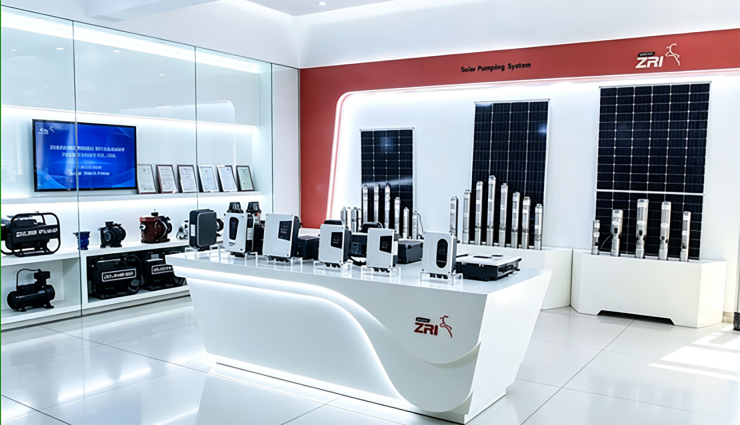
ZRI provides a range of solar water pumping solutions covering different applications, including 3-inch to 8-inch pumps, low-power DC solar pumps, and AC/DC hybrid solar pumping systems.
If you are working on a solar water pumping project, you can send us the water source, well diameter, water level, required flow, head, and daily water demand. These details are usually enough to start discussing a suitable solution.
Email: ula@zripump.com
Phone: +86 16605763305