
 DC SOLAR SUBMERSIBLE PUMP
 AC/DC Solar submersible Pump
 DC Solar Surface Pump
 AC/DC solar surface Pump
 Solar swimming Pool Pump
 Built-in Controller Solar Pump
 Solar Pump inverter
 Pump Accessories


 Mr Youkee Kong
Solar Water Pump Cable Length & Wire Size Calculator: Voltage Drop Guide | ZRI SOLAR PUMP
Solar Water Pump Cable Length & Wire Size Calculator: Voltage Drop Guide | ZRI SOLAR PUMP
1 · Quick Answer
Basic formula (two-wire DC): A = 2 × L × I × ρ / ΔV, where A=area (mm²), L=one-way length (m), I=operating current (A), ρ=resistivity (Cu≈0.0175, Al≈0.0282 Ω·mm²/m), ΔV=allowable drop (V). Three-phase AC: A = √3 × L × I × ρ × cosφ / ΔV.
Always pick the next standard size above the result, then verify ampacity, temperature correction, installation method and local code.
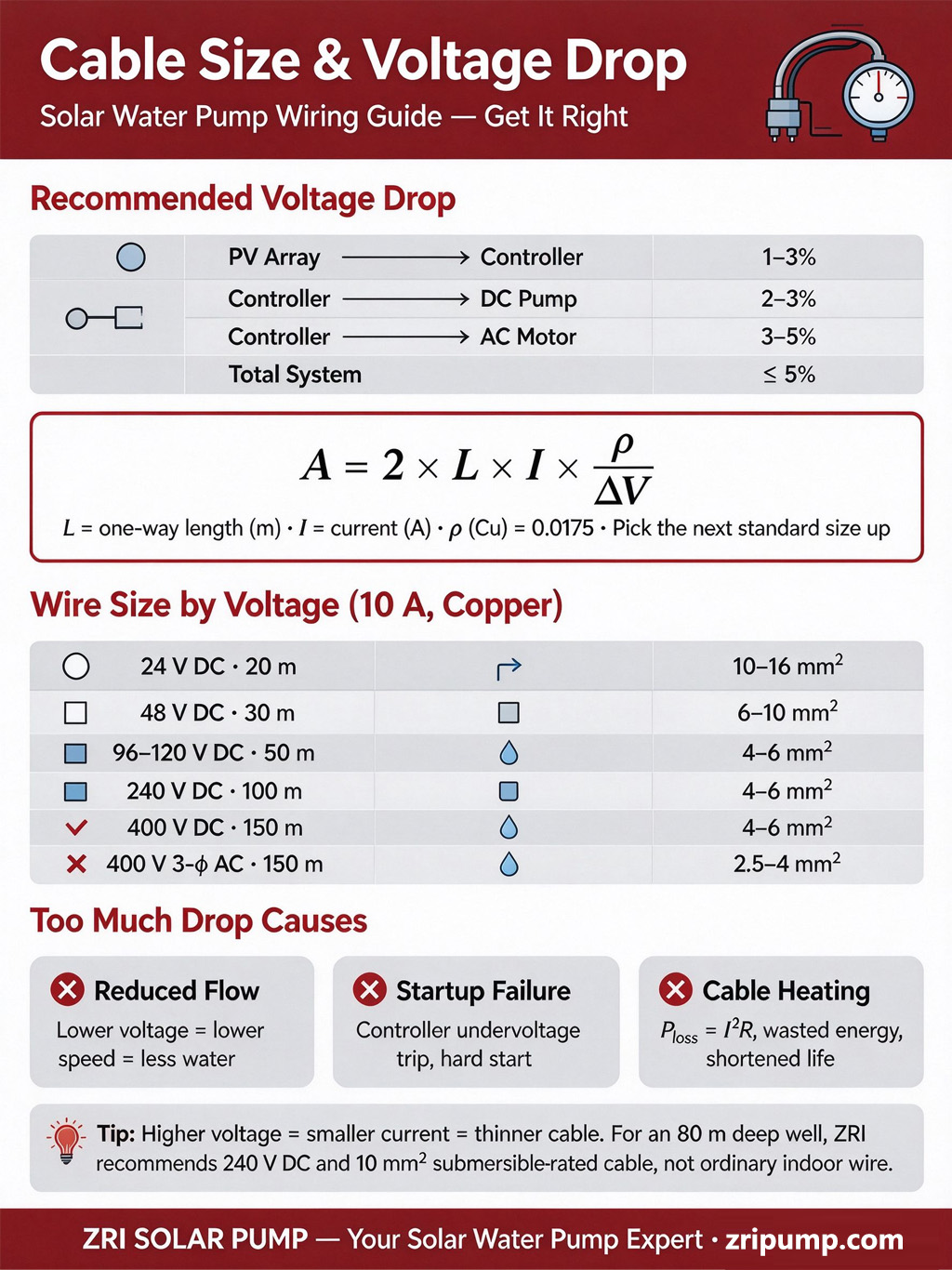
Voltage-Drop Targets
| Circuit | Recommended Drop |
|---|---|
| PV array → controller | 1–3% |
| Controller → DC pump | 2–3% |
| Controller → AC motor | 3–5% |
| Total system | ≤5% preferred |
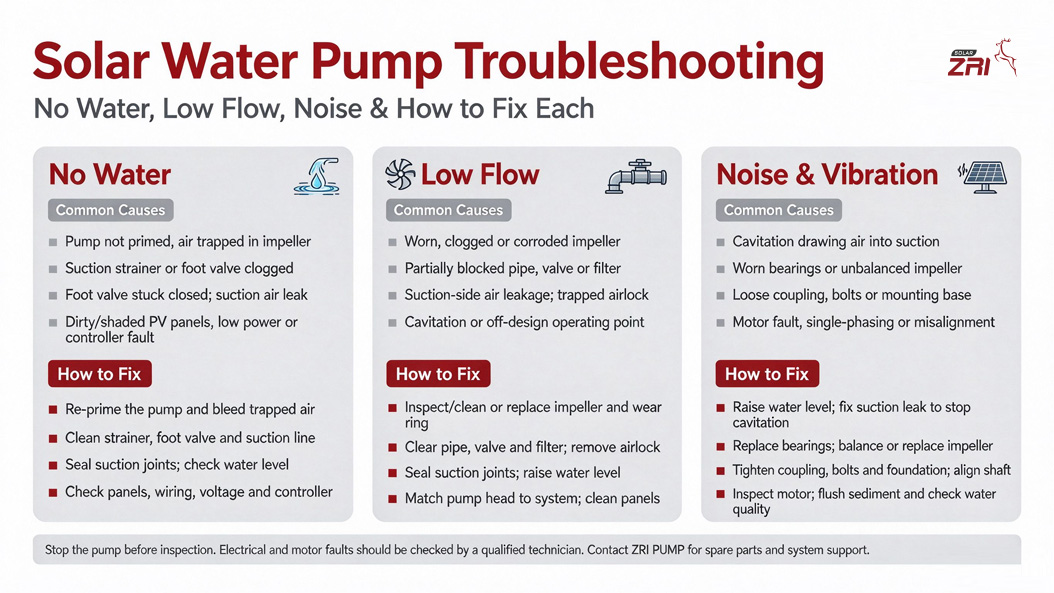
Excessive drop causes: lower speed, reduced flow/pressure, controller undervoltage trips, motor overheating, hard startup, lower efficiency, premature damage.
2 · What Is Voltage Drop
Voltage drop is the voltage lost to cable resistance—every conductor resists, and current flow converts some energy to heat. Longer cable and higher current mean greater drop.
Simple Example
120 V DC, 10 A, 50 m one-way, 6 mm² Cu: ΔV = 2×50×10×0.0175 / 6 ≈ 2.92 V; percentage 2.92/120 ≈ 2.43%—generally acceptable.
3 · Why Voltage Drop Matters
A solar pump's available power swings all day; weak-light and startup are the most sensitive moments. Common effects:
- Reduced flow: lower voltage → lower speed → less flow and pressure.
- Startup failure: low voltage at start prevents starting, causes cycling, or trips the controller.
- Controller undervoltage: a ZRI SOLAR PUMP controller shuts down if input/motor voltage drops below its safe range.
-
Cable heating:
P_loss = I²R; the squared-current relation makes high-current low-voltage systems very sensitive to size. - Less daily water & efficiency: weaker morning/evening/cloudy output wastes solar energy that could become pumped water.
4 · How Long Can the Cable Be?
It depends on voltage and current. Below are preliminary estimates (Cu, ~10 A); final sizing must use actual current, voltage, length, installation and allowed drop.
| Voltage | Current | One-way | Copper Range |
|---|---|---|---|
| 24 V DC | 10 A | 20 m | 10–16 mm² |
| 48 V DC | 10 A | 30 m | 6–10 mm² |
| 96–120 V DC | 10 A | 50 m | 4–6 mm² |
| 240 V DC | 10 A | 100 m | 4–6 mm² |
| 400 V DC | 8 A | 150 m | 4–6 mm² |
| 400 V 3-phase AC | 8 A | 150 m | 2.5–4 mm² |
5 · DC vs AC Cable
DC two-wire: ΔV = 2×L×I×ρ / A (factor 2 = both conductors). Single-phase AC: multiply by cosφ. Balanced 3-phase: ΔV = √3×L×I×ρ×cosφ / A—lower per-conductor current, cheaper long-distance.
- PV↔controller: PV-rated cable; inside well: submersible pump cable.
- Never ordinary indoor cable in a wet well; confirm insulation covers PV open-circuit voltage.
- Outdoor: UV-resistant; protect against abrasion, rodents, water and mechanical damage.
6 · How to Size the Cable
- Collect data: power, voltage, maximum current, cable type, one-way length, temperature, Cu/Al, allowed drop, DC/single-phase/3-phase, starting current.
- Choose drop target: per the table (array 1–3%, DC pump 2–3%, AC 3–5%).
-
Convert to volts:
ΔV = system voltage × percentage(e.g. 120 V×3% = 3.6 V). -
Apply formula: DC
A = 2×L×I×ρ / ΔV. - Select next standard size: 5.2 mm² → choose 6 or 10 mm², not 4 mm².
- Verify ampacity: apply correction for ambient temp, grouping, conduit, burial, rooftop, soil, sun, wet conditions.
- Check startup: ensure pump-end voltage stays sufficient during morning start, cloud movement, restart and low water level.
7 · Sizing Examples
Example 1 · 48 V DC Pump
500 W, 48 V, 10.4 A, 30 m, Cu, 3% (ΔV=1.44 V): A = 2×30×10.4×0.0175 / 1.44 ≈ 7.58 mm² → recommend 10 mm² (6 mm² may be thermally ok but exceeds drop limit).
Example 2 · 120 V DC Submersible
1200 W, 120 V, 10 A, 50 m, Cu, 3% (ΔV=3.6 V): A ≈ 4.86 mm² → recommend 6 mm².
Example 3 · 240 V DC Pump
2400 W, 240 V, 10 A, 100 m, Cu, 3% (ΔV=7.2 V): A ≈ 4.86 mm² → recommend 6 mm². Twice as long as Example 2, but higher voltage permits similar area.
ZRI SOLAR PUMP Field Case · 3 kW Deep Well
240 V DC, max 12.5 A, 80 m well, controller→pump 90 m one-way, Cu, 3% (ΔV=7.2 V): A = 2×90×12.5×0.0175 / 7.2 ≈ 5.47 mm² → standard 6 mm²; given well heat, long hours and startup, designers often add margin to 10 mm² submersible cable, then verify ampacity, insulation, immersion rating and controller max cable length.
8 · Loss & Energy Calculation
Resistance: R = 2×L×ρ / A, ΔV = I×R, P_loss = I²×R.
Example: 6 mm² Cu, 50 m, 10 A → R≈0.292 Ω, ΔV=2.92 V, P_loss≈29.2 W. At 8 h/day: 29.2×8=233.6 Wh ≈ 0.234 kWh; over a year ≈ 85.4 kWh. A larger conductor costs more upfront but cuts long-term losses.
9 · Cable Types & Standards
Four Cable Types
- PV cable: array↔controller—UV-resistant, double-insulated, weatherproof, rated for max PV voltage (EN 50618 / IEC 62930).
- Submersible cable: wellhead↔motor—continuous-immersion rated, flexible, correct voltage, sealed joints.
- Motor cable: controller↔motor—depends on voltage, output waveform (PWM/VFD), shielding, EMC and grounding.
- Comm/sensor cable: level, pressure, RS-485—keep away from power cables to reduce interference.
Relevant Standards (by market)
IEC: 60228, 60364-5-52, 60364-7-712, 62548, 62930, 60502, 60034, 61800, 61643; EN 50618; UL: 4703, 854, 508C, and NFPA 70/NEC; also VDE, BS 7671, AS/NZS 3000, NOM.
10 · Installation & Common Mistakes
Installation Tips
- Measure the actual route: well depth + wellhead-to-controller + controller-to-array + service loops; don't use horizontal distance only.
- Use one-way length; two-wire DC uses factor 2—never multiply by 2 twice.
- Minimize joints; each splice adds resistance, water ingress and failure risk.
- In the borehole, secure cable to the riser pipe; avoid sharp bends and casing edges.
- Ground/bond properly; separate power and signal lines; label both ends (polarity/phase/ground/pump/well).
Top Mistakes
- Sizing by wattage alone; ignoring the return conductor; using average instead of maximum current.
- Ampacity-only sizing (drop may still be too high); confusing AWG with mm²; ignoring temperature rise.
- Sizing for midday only; ordinary cable in a wet well; ignoring controller max-cable-length; oversizing mechanically.
11 · Frequently Asked Questions
No single maximum. With correct size, voltage, current, insulation, installation and drop limit, runs from a few meters to hundreds of meters are possible.
Array→controller 1–3%, controller→DC pump 2–3%, →AC 3–5%; total preferably under 5%. Follow the manufacturer.
Yes. Long or undersized cable lowers pump-end voltage and speed, cutting flow and pressure—notably in low-voltage DC.
Depends on current, voltage, length and drop. It may fit a short high-voltage run but often fails a long 24 V/48 V system.
Two-wire DC: A = 2×L×I×ρ/ΔV; pick the next standard size; verify ampacity, temperature, method and code.
Use one-way distance in the formula, then include the return via factor 2 for a two-wire circuit—don't double it.
Cable rated for submersible service and continuous immersion; ordinary indoor cable must not go in a well.
Copper has lower resistivity and is easier to terminate; aluminum is cheaper for long large jobs but needs larger area and proper terminals.
Generally yes. Same power at higher voltage means lower current, so drop and heating fall—hence high-voltage configs for deep wells.
Yes. Oversizing raises cost and difficulty. A modest increase is justified if it cuts drop and improves life—aim for code-compliant, sound sizing.
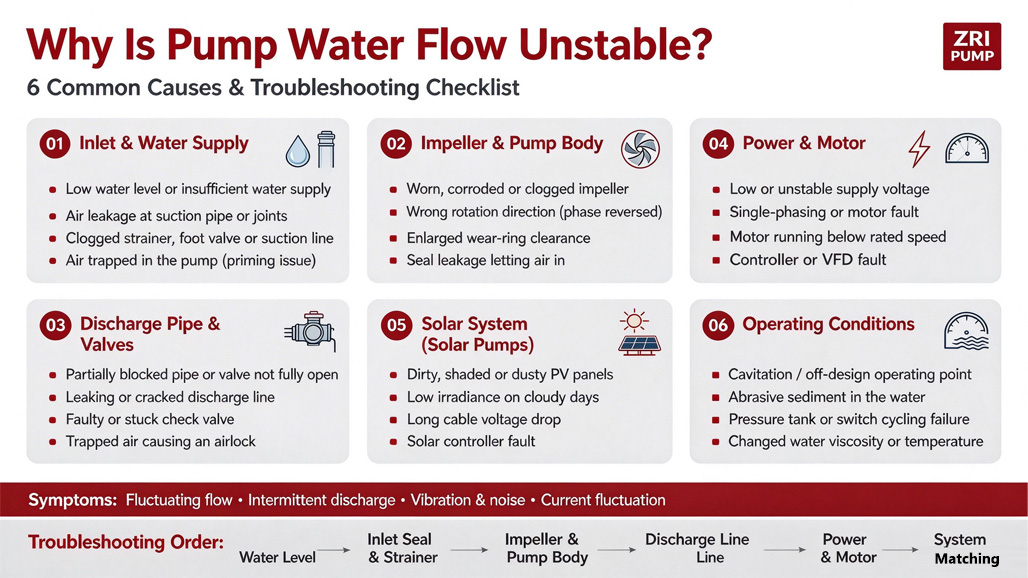
Causes: excessive drop, undersized cable, weak sun, wrong wiring, loose/corroded terminals, overload, undervoltage trip, wrong PV voltage, or water damage.
Clouds don't change resistance but cut solar power; a drop fine in bright sun can turn critical near minimum voltage.
Yes. It can recommend cable from your pump, controller, voltage, current, well depth, route and conditions—provide complete project info.
Not necessarily. PV and motor cables may differ in current, length and insulation/environment—size each section separately.
12 · Conclusion
A well-designed ZRI SOLAR PUMP system delivers: stable motor operation, reliable startup, lower loss, higher daily output, less heating, longer life and better cloudy/low-light performance.
Get Your ZRI SOLAR PUMP Cable Recommendation
Provide pump model, voltage, current, well depth, cable route, controller model and country