
 DC SOLAR SUBMERSIBLE PUMP
 AC/DC Solar submersible Pump
 DC Solar Surface Pump
 AC/DC solar surface Pump
 Solar swimming Pool Pump
 Built-in Controller Solar Pump
 Solar Pump inverter
 Pump Accessories


 Mr Youkee Kong
Water Pump Size Calculator: 50m Head, 30 Tons/Day Selection Guide
Water Pump Size Calculator: 50m Head, 30 Tons/Day Selection Guide
Quick Answer
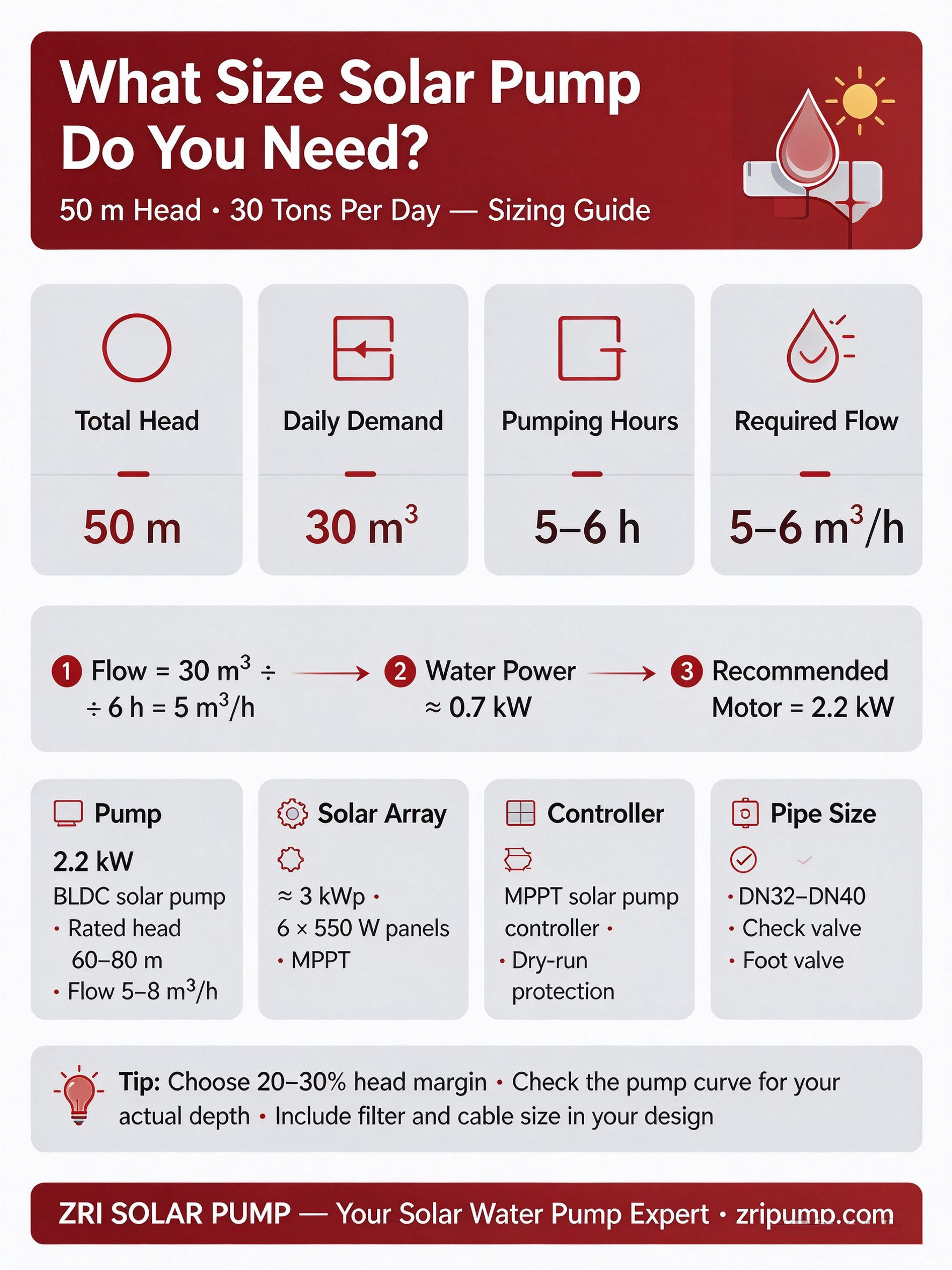
Basic calculation
- Flow: 30,000 L/day ÷ 8 h = 3,750 L/h = 62.5 L/min = 1.04 L/s
- Hydraulic power: ρ·g·Q·H = 1000 × 9.81 × 0.00104 × 50 ≈ 510 W
- Pump power (50% efficiency): 510 ÷ 0.50 ≈ 1,020 W → 1.0–1.5 kW
Recommended ZRI SOLAR PUMP selection (solar)
- Pump: 1,200–1,500 W (safety margin over 1,020 W)
- Solar array: 1,800–2,400 W (1.5–2× pump for solar losses)
- Pump type: solar submersible or surface (depends on source)
- Controller: MPPT with dry-run protection
- Daily sun: 6–8 h good sunlight
Assumes clean water at 20°C, 50 m lift, minimal friction, 50% efficiency. Real systems add friction, seasonal sun, and a 10–20% margin — see steps below.
Pump Selection Fundamentals
Proper sizing rests on three parameters: Flow (Q), Total Dynamic Head (TDH), and Power (P).
1. Flow rate (Q)
Volume moved per unit time. Units: L/min, L/h, m³/h, GPM, GPH. Conversions: 1 m³/h = 16.67 L/min; 1 GPM = 3.785 L/min; 1 ton = 1,000 L = 1 m³.
Your case: 30 m³; 8 h → 3,750 L/h (62.5 L/min), 6 h → 5,000 L/h (83.3 L/min).
2. Total Dynamic Head (TDH = Hs + Hf + Hp + Hv)
- Static head Hs: vertical lift — 50 m
- Friction head Hf: pipe loss, ~5–20% of static — est. 5–10 m
- Pressure head Hp: delivery pressure; 1 bar = 10 m; 0 for gravity tank, 20 m for 2-bar system
- Velocity head Hv: usually negligible
Gravity system ≈ 57 m TDH; pressurized (2 bar) ≈ 77 m TDH.
3. Power (P)
-
Hydraulic Ph = ρ·g·Q·H (ρ=1000, g=9.81) → simplified
Ph(W) = Q(L/min) × H(m) × 0.163 - Pump Pp = Ph / η_pump (η 40–70%)
- Motor Pm = Pp / η_motor (η 70–90%)
- System Ps = Pm / η_controller (MPPT η 85–95%)
Overall η_system ≈ 30–60%.
Step-by-Step Sizing
Step 1 — Define requirements
Daily 30 tons; static head 50 m; source sets pump type; delivery (tank/irrigation); schedule (solar vs grid/battery); water quality.
Step 2 — Flow rate
Conservative sun: tropical 6–8 h, temperate 4–8 h, high-lat winter 3–5 h. Size to 6–7 h → Q≈4,286 L/h=71.4 L/min; target 70–85 L/min.
Step 3 — Total dynamic head
Example: 1.5" (40 mm) HDPE, 60 m, 80 L/min → ~0.12 m/m = 7.2 m; fittings ~1.2 m. Hf ≈ 8.4 m. Gravity TDH = 50+8.4 ≈ 60 m; pressurized = 50+8.4+20 ≈ 80 m.
Step 4 — Hydraulic power
Ph = Q × H × 0.163 = 80 × 60 × 0.163 ≈ 785 W (matches ρ·g·Q·H detailed calc).
Step 5 — Pump power
With 45% pump efficiency: Pp = 785 ÷ 0.45 ≈ 1,744 W → spec 1.5–2.0 kW.
Step 6 — Motor & system power
Motor 80%: 1,744÷0.80=2,180 W. Controller 90%: 2,180÷0.90=2,422 W. Solar array 2.4–3.0 kW.
Step 7 — Safety margin
+15% pump → 2,006 W ≈ 2.0 kW; +20% array → 2,906 W ≈ 3.0 kW.
Final Recommendation
Gravity tank filling (60 m TDH)
| Component | Specification |
|---|---|
| Flow rate | 70–85 L/min (4,200–5,100 L/h) |
| Total dynamic head | 60 m |
| Pump power | 1.5–2.0 kW |
| Pump type | Solar submersible or surface |
| Solar array | 2.5–3.5 kW |
| Solar panels | 8–12 × 300W or 6–8 × 400W |
| Controller | MPPT 2.5–3.5 kW rated |
| Cable size | 6–10 mm² |
| Pipe diameter | 40–50 mm (1.5–2") |
| Daily output | 25–35 m³ |
Pressurized system (80 m TDH)
| Component | Specification |
|---|---|
| Flow rate | 60–75 L/min (3,600–4,500 L/h) |
| Total dynamic head | 80 m |
| Pump power | 2.0–2.5 kW |
| Pump type | Multi-stage solar submersible |
| Solar array | 3.5–4.5 kW |
| Solar panels | 10–15 × 300W or 8–11 × 400W |
| Controller | MPPT 3.5–4.5 kW rated |
| Cable size | 10–16 mm² |
| Pipe diameter | 40 mm (1.5") |
| Daily output | 22–32 m³ |
ZRI SOLAR PUMP Model Examples
Option 1 — Solar submersible (deep wells/boreholes)
- Pump: 2.0 kW, 72–96V DC, head 80 m, 70–90 L/min @60m, BLDC, 304 SS, 4"
- Controller: MPPT 3.0 kW, 96–400V in / 72–96V out, >98%, dry-run/overload/lightning
- Array: 3,000 W, 8×375W, 2S×4P, ~148V string
Option 2 — Solar surface (shallow wells/ponds, lift <7m)
- Pump: 1.5 kW, 110V DC, head 65 m, 65–80 L/min @60m, BLDC, self-priming
- Controller: MPPT 2.5 kW, 72–300V in / 48V out, >97%
- Array: 2,500 W, 7×360W, 2 strings
Option 3 — Hybrid solar/grid (24-h capability)
- Pump: 2.0 kW dual input (solar + AC 220V), auto-switch, battery charge
- Primary: 2.5 kW solar; backup: grid via inverter/charger; optional 48V lithium bank
Detailed Selection Factors
1. Water source
Deep well/borehole → submersible (check diameter, depth, water level, sand). Shallow/pond/river/tank → surface pump; max suction ~7–8 m at sea level.
2. Pump curve matching
Read shut-off head, BEP, max flow. Place operating point (60 m, 80 L/min) near BEP; off-curve = low efficiency, wear, noise. Request the curve from ZRI SOLAR PUMP.
3. Material by water type
| Water type | Suitable materials |
|---|---|
| Clean fresh | 304 SS, plastic, cast iron |
| Brackish/salt | 316 SS, bronze, special plastics |
| Corrosive/acidic | 316L SS, titanium, coatings |
| High sand | Hard-wearing, sand-resistant design |
| Hot (>40°C) | High-temp seals & materials |
4. Motor type
BLDC: high efficiency, long life, low noise — best for solar. Brushed DC: cheaper, needs maintenance. AC induction: robust, needs inverter for solar. Permanent magnet: compact, high efficiency.
5. Controller features
Essential: MPPT, soft start, dry-run protection, under/over-voltage, over-temperature. Advanced: level control, remote monitoring, data logging, VFD, grid backup, mobile app.
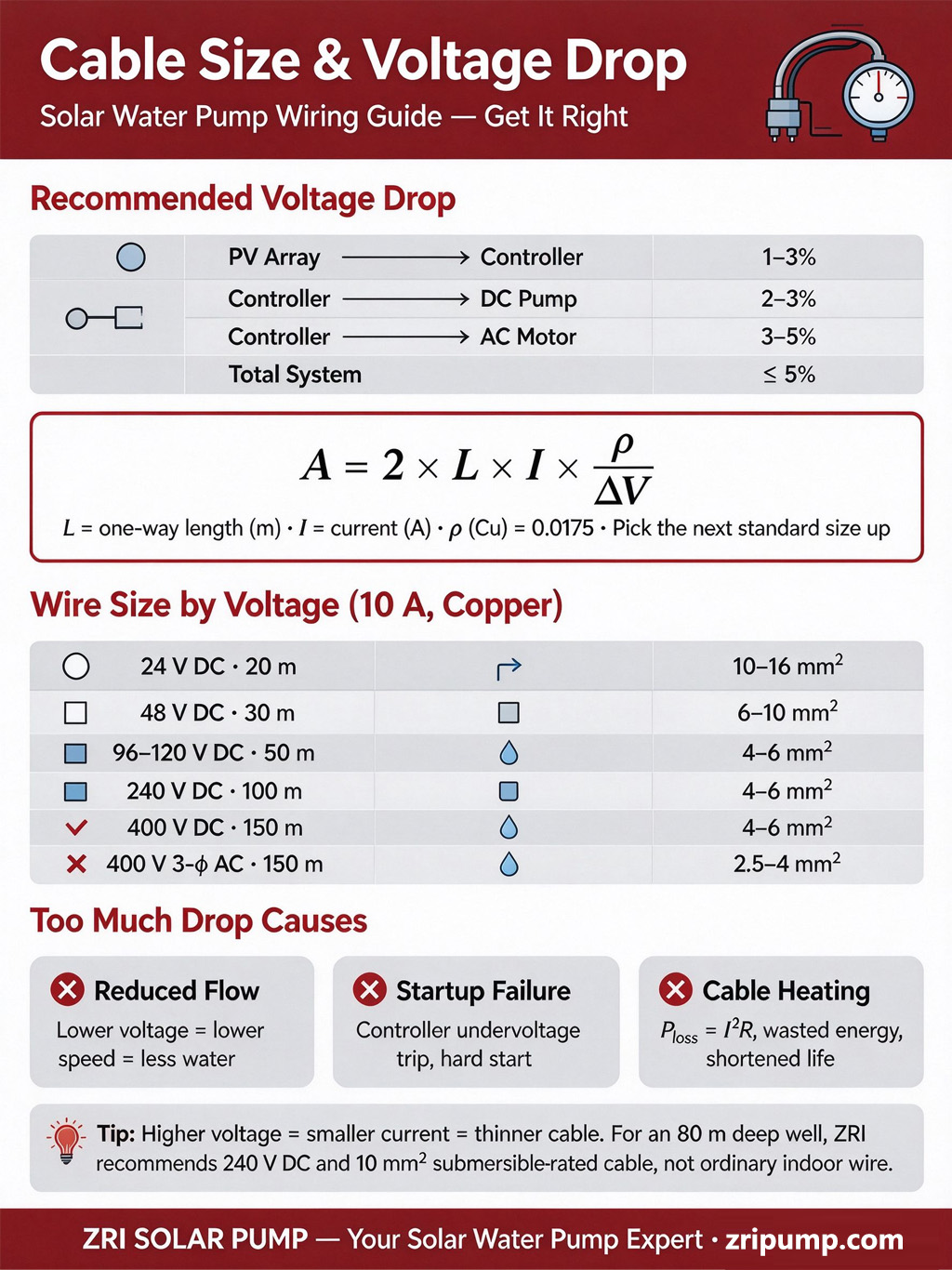
6. System design
Panels: series raises voltage for long runs; parallel tolerates shading; 3 kW → 8–10 panels, string 100–200V. Cable: ΔV=2·L·I·ρ/A; 96V/20.8A/50m → ~12.6 mm², use 16 mm² (<3% drop). Pipe: 1–2.5 m/s; 80 L/min → ~34 mm, use 40–50 mm. HDPE/PVC/SS by condition.
Solar Sizing by Location
| Location | Peak sun hrs | Pump | Array | Daily output |
|---|---|---|---|---|
| Tropical (equator) | 5–6 yr-round | 1.5–2.0 kW | 2.5–3.0 kW | 28–35 m³ |
| Temperate (mid-lat) | 6–8 sum / 3–5 win | 1.5–2.0 kW | 3.0–3.5 kW | 30–35 / 15–25 m³ |
| Northern (high lat) | 6–8 sum / 2–4 win | 1.5–2.0 kW | 3.5–4.5 kW | 28–35 / 10–20 m³ |
Tilt: tropical 0–15°; temperate = latitude; northern = latitude +15° or seasonal. Winters may need storage or backup.
Cost-Benefit Analysis
Component cost (approximate)
| Component | Budget | Mid (ZRI SOLAR PUMP) | Premium |
|---|---|---|---|
| Pump 2kW | $300–500 | $600–900 | $1,000–1,500 |
| Controller 3kW MPPT | $200–350 | $400–600 | $700–1,000 |
| Solar 3kW | $600–900 | $900–1,200 | $1,200–1,800 |
| Mounting | $150–250 | $250–400 | $400–600 |
| Cables/protection | $100–200 | $200–300 | $300–500 |
| Pipes/fittings | $150–250 | $250–400 | $400–600 |
| Installation | $200–500 | $500–1,000 | $1,000–2,000 |
| Total | $1,700–2,950 | $3,100–4,800 | $5,000–8,000 |
20-year operating cost
- ZRI SOLAR PUMP solar: $0 energy + $50–100/yr maintenance ≈ $1,000–2,000
- Diesel: ~3,600 L/yr × $1.20 = $4,320/yr + maint ≈ $90,400+
- Grid: 4,800 kWh/yr × $0.15 = $720/yr ≈ $16,400
Payback solar vs diesel <1 yr; vs grid 5–7 yr. CO₂ avoided: ~9 t/yr vs diesel, 2–4 t/yr vs grid.
Tools & Methods
- Online calculators: ZRI SOLAR PUMP and others take volume, head, pipe, location → model, array, output, cost.
- Software: PVSYST, PumpLinx, EPANET, manufacturer tools.
- Consult a pro: large irrigation, multi-point, hybrid, or critical sites. ZRI SOLAR PUMP may offer engineering support.
Mistakes to Avoid
- Ignoring friction: size to TDH, not static head alone.
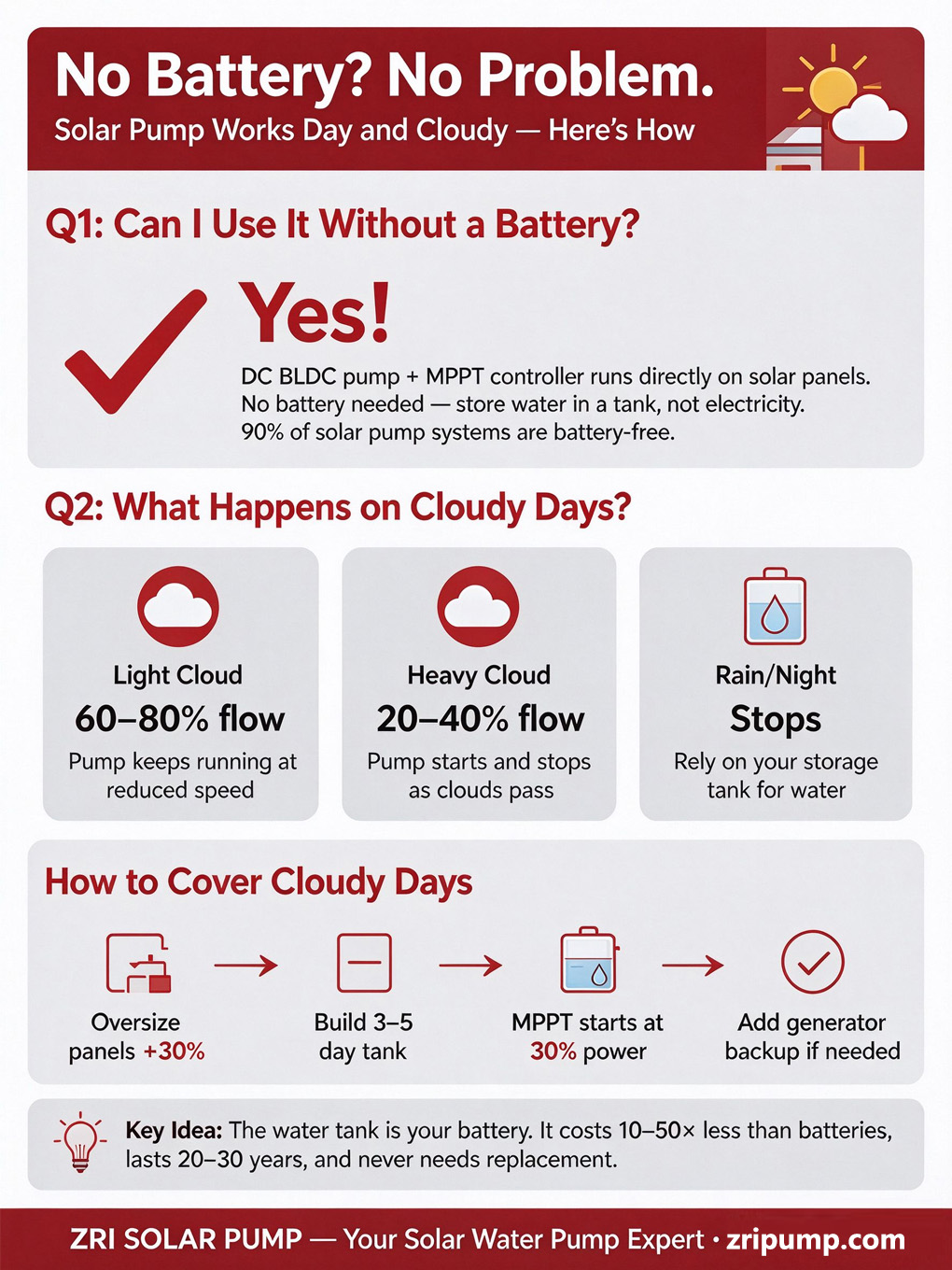
- Overestimating sun: use conservative peak-sun hours for winter/cloud.
- Undersizing pipes: causes high friction, lost flow, wasted power.
- No safety margin: add 10–20% to pump and array.
- Ignoring pump curve: match operating point to BEP.
- Wrong pump type: submersible for deep, surface for shallow.
- Inadequate cable: size for <3% voltage drop.
- No protection: include dry-run, surge, check valve, filters.
Frequently Asked Questions
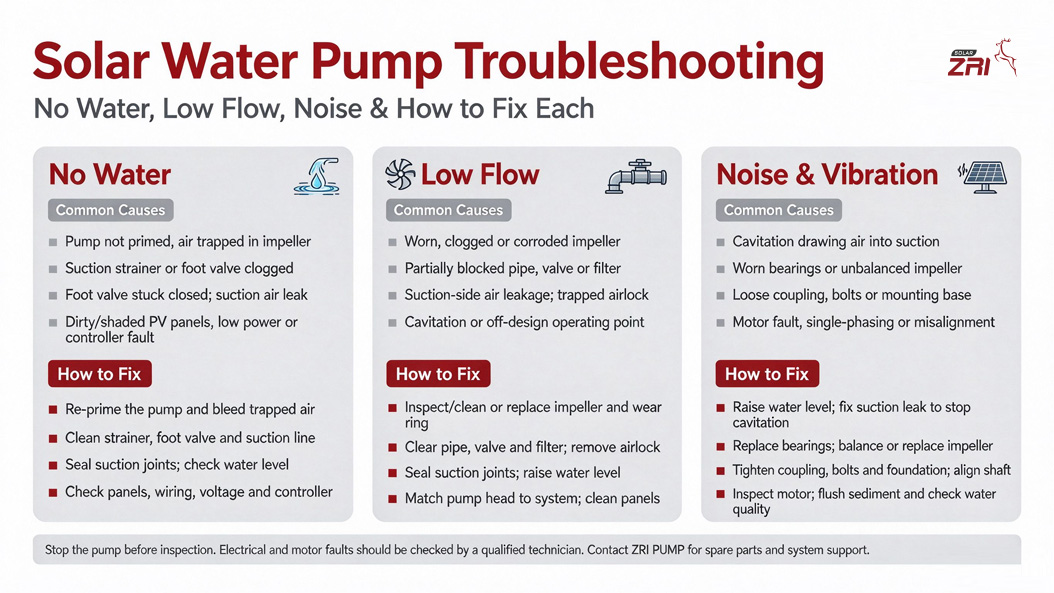
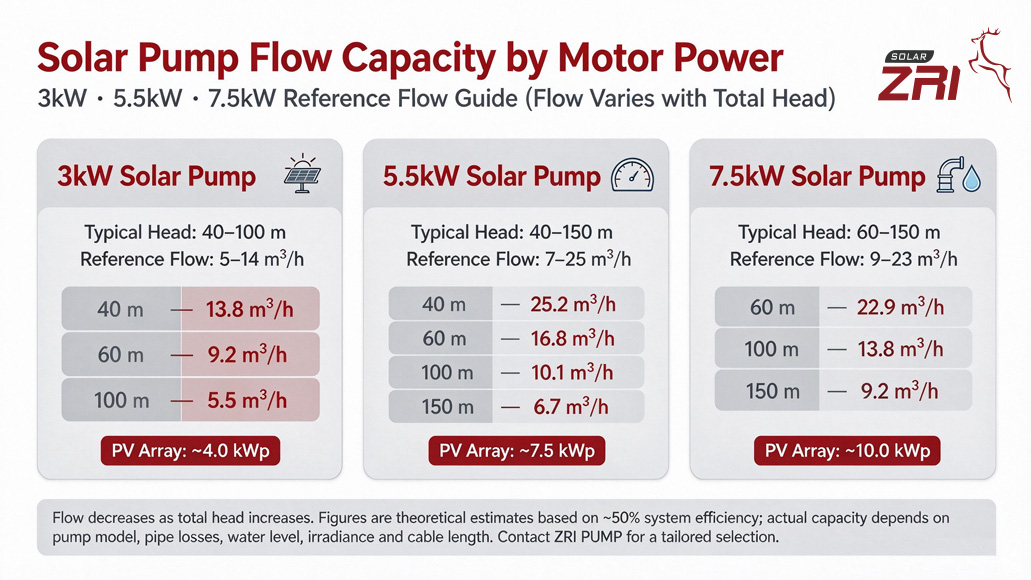
1.5–2.0 kW pump at 70–85 L/min, 60m TDH, plus 2.5–3.5 kW solar array.
Ph(W) = Flow(L/min) × Head(m) × 0.163 ÷ efficiency; add friction to static head for TDH.
Yes — single-stage handles 60–80m; multi-stage for higher heads.
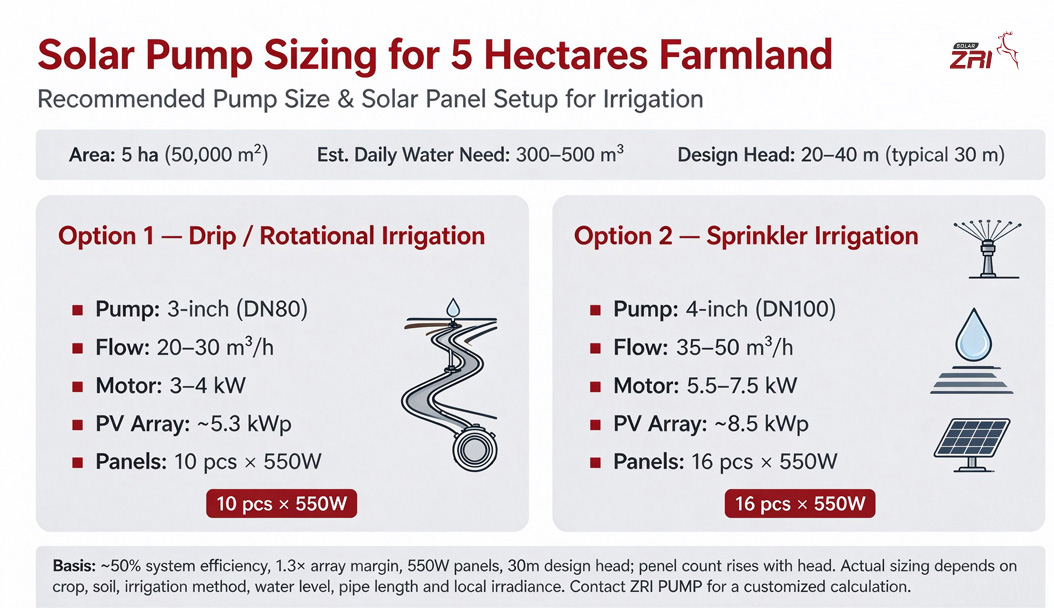
2.5–3.5 kW (8–12 × 300W) for losses and varying sun.
Inefficient, wastes energy, excess pressure, higher cost — size to need.
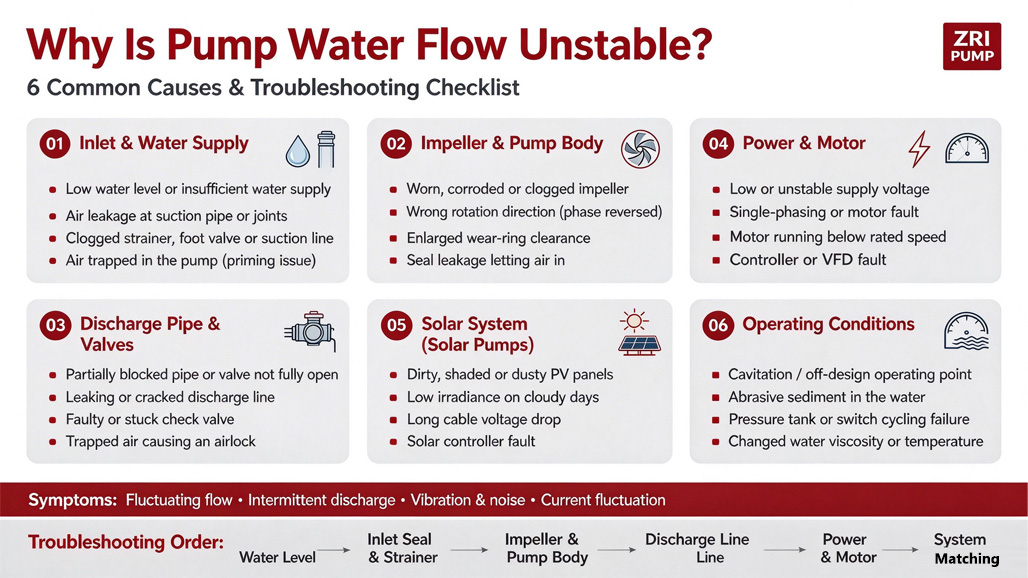
Cannot meet flow/pressure, overheats, fails demand.
Submersible for deep wells (>8m); surface for shallow (<7m suction).
Larger pipe, shorter run, smooth HDPE/PVC, fewer bends, 1.5–2.5 m/s.
Not advised; use 1.5–2× pump power for solar.
8–15 years; BLDC >10 years; seals/bearings are wear items.
Static = elevation; TDH adds friction + pressure + velocity. Size to TDH.
Size array for worst season or add storage for reduced output.
Needs inverter (cost + loss); DC solar pumps are optimized.
Above 1,000m lowers suction lift and efficiency; apply correction.
MPPT gives 10–30% more energy; use MPPT for >500W.
Conclusion
Selection process
- Calculate flow from daily volume ÷ hours
- Calculate TDH (static + friction + pressure)
- Calculate hydraulic power from flow × head
- Apply system efficiency (40–50%)
- Add 10–20% safety margin
- Select ZRI SOLAR PUMP model to spec
- Size array at 1.5–2× pump power
- Design cables, pipes, protection
- Verify operating point near BEP on pump curve
- Consult ZRI SOLAR PUMP for final recommendation