
 DC SOLAR SUBMERSIBLE PUMP
 AC/DC Solar submersible Pump
 DC Solar Surface Pump
 AC/DC solar surface Pump
 Solar swimming Pool Pump
 Built-in Controller Solar Pump
 Solar Pump inverter
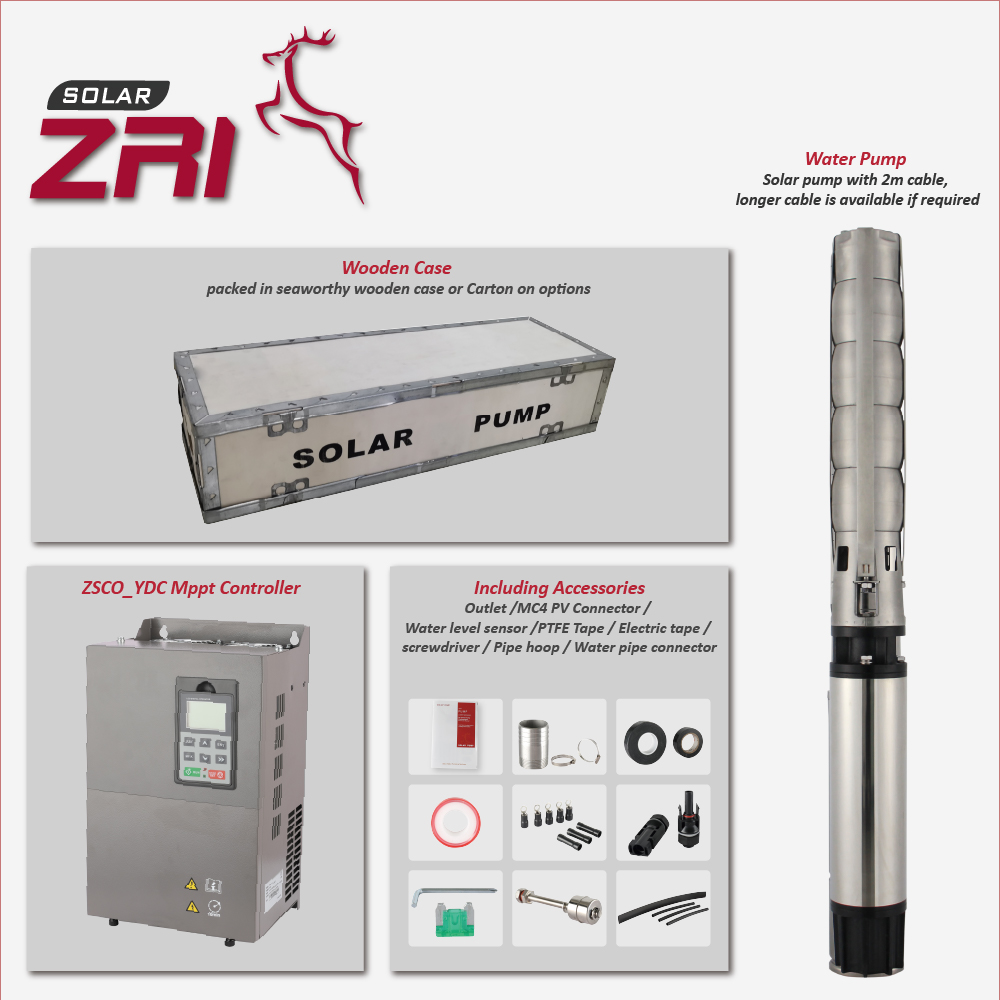
 Pump Accessories


 Mr Youkee Kong



Cable Runs, Voltage Drop and Array Siting: The Errors That Starve a Correctly Sized Solar Pump
A 42,000 Litre Pump That Delivered 25,000
An Andhra Pradesh dealer quoted a borehole package for a 2.4 hectare chilli block: a 3 inch DC deep well screw pump rated at 42,000 litres per day at 30 m head, a 1.5 kW array, and 150 m of cable to the wellhead. On the bench it made its number; in the field it delivered 24,900 litres on a clear day and the dealer paid USD 1,900 to replace cable.
Three site decisions took the water: a 6 mm2 run losing 17 per cent of the voltage, an array tilted for annual energy, and a controller sealed in a black box.
Voltage Drop: The Arithmetic Missing From the Quote
Every dealer sizes the pump. Few size the cable: drop (V) = 2 x one-way length (m) x current (A) x resistance (ohm per km) / 1000, the two being the return path. Use hot resistance, not the 20 degree figure: at 60 C a conductor carries 1.16 times its catalogue resistance.
Run that job: 1,500 W at 96 V is 15.6 A over a 300 m loop. At 6 mm2, 3.08 ohm/km cold and 3.57 hot, the loss is 16.7 V, or 17.4 per cent, so the motor sees 79.3 V. At 16 mm2 the run loses 6.2 V, or 6.5 per cent. That is the gap between 42,000 litres and 25,000.
Voltage is not a rounding error because the head-flow curve falls with the square of it: at 82 per cent speed the motor develops about 67 per cent of rated head. Against 22 m static lift plus 6 m friction, a pump rated for 30 m reaches only 20 m and stops lifting. That unit lifted only after 09:40 and dropped out at 15:20, losing 5 hours of the day.
The 3 Per Cent Rule and the Down-Hole Run
General practice allows 3 per cent for lighting and 5 per cent for other loads. A solar pump has no grid behind the meter, and every volt lost at the motor must be generated first. Write into the quote: 3 per cent on the controller-to-motor leg, 5 per cent maximum. Spend copper on the motor side: the MPPT covers array-side loss, but nothing compensates for controller-to-motor drop.
That split applies to a 4 inch AC/DC hybrid solar submersible pump too. Size for whichever mode draws the higher current; the 220 V AC leg loses a fraction of what the DC leg does, so the DC number is always checked first.
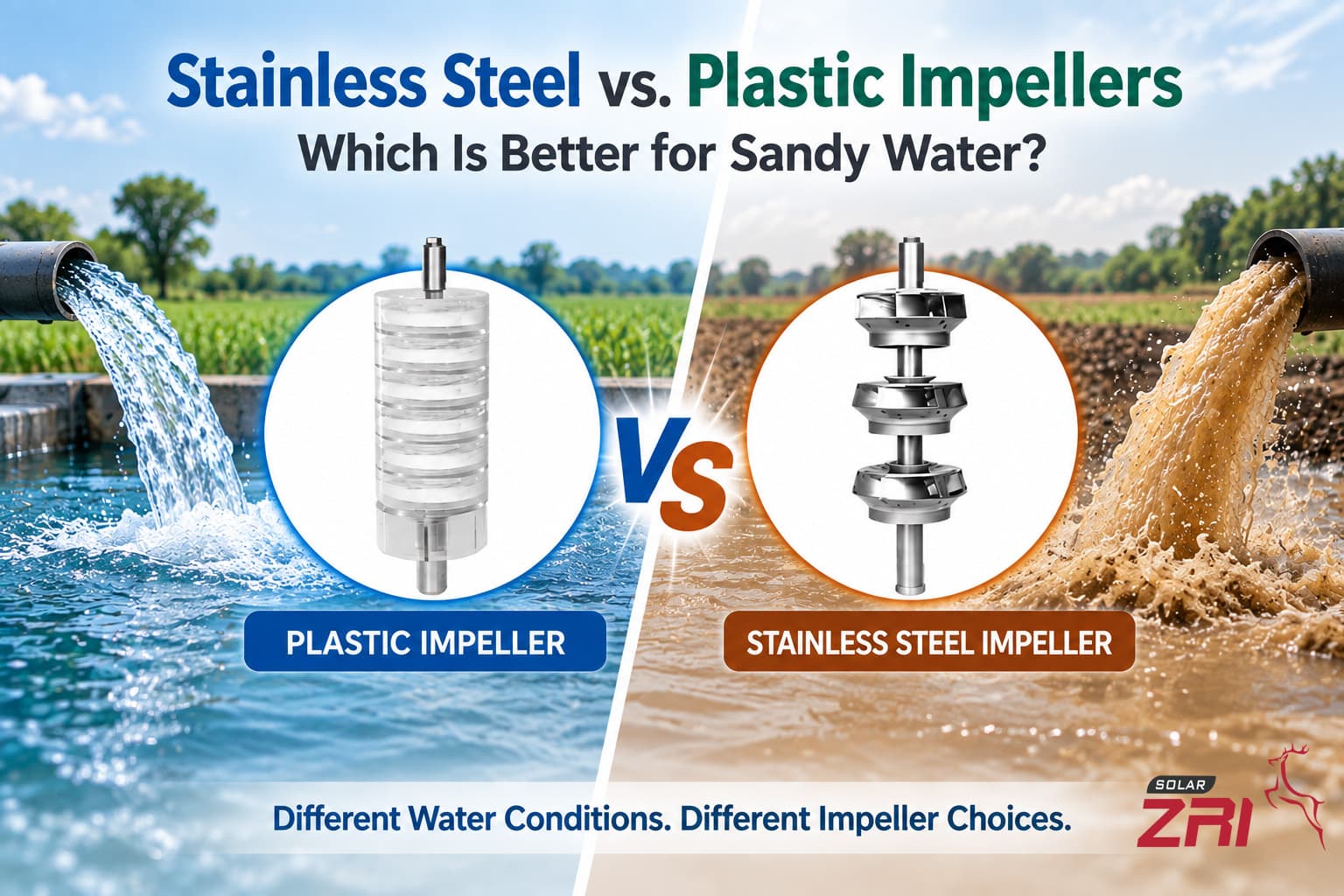
Dealers under-order the down-hole cable. Length equals pump length + static water level + drawdown + 3 m slack + surface run, declared at order time, because drop cable is moulded to the motor, not field-terminated. A 3 inch DC stainless steel impeller deep well pump ships at a fixed length, so arriving 20 m short means a submerged joint, and only a resin-filled kit rated for continuous submersion holds.
- Minimum conductor: 4 mm2. Thinner is a fire risk at 15 A.
- Maximum drop per leg: 3 per cent, measured at the motor, not the controller.
Array Siting: Tilt for the Irrigation Season
Tilt close to latitude maximises kilowatt-hours across a year, but irrigation needs the driest ninety days. A seasonal optimum costs about 4 per cent of annual energy and gains 8 to 12 per cent when the crop needs water. At latitude 17 the tilt drops from 17 degrees to 5 to 8 degrees for an April to June peak; at latitude 33, to 18 to 20 degrees. Azimuth stays within 15 degrees of true south. On a 6 ha block with a 6 inch DC stainless steel impeller deep well pump, that decides whether a cycle finishes in one day.
Shading, Series Wiring and the MPPT Window
Shade is not proportional. Modules in a string carry the same current, so the weakest one sets the string. Cover the corner of a module and a bypass diode costs you a third of it; shade 10 per cent of one module in a three module string and you lose close to 30 per cent of string power. A pole shadow at 08:00 costs little, while the same shadow at 11:00 costs the day's peak. Enforce no shadow on any module between 09:00 and 15:00 solar time in the irrigation months, checked by horizon scan.
Series voltage has two hard edges. At 45 V Voc per module and minus 0.32 per cent per degree C, three in series read 135 V at STC and 148 V at minus 5 C, against a 150 V limit, so design to 85 per cent of controller maximum input at the site record low. The other edge is heat: at 45 C ambient Vmp falls about 18 per cent, so hot Vmp must stay 15 per cent above minimum MPPT voltage.

Controller Heat, Earthing and Lightning Bonding
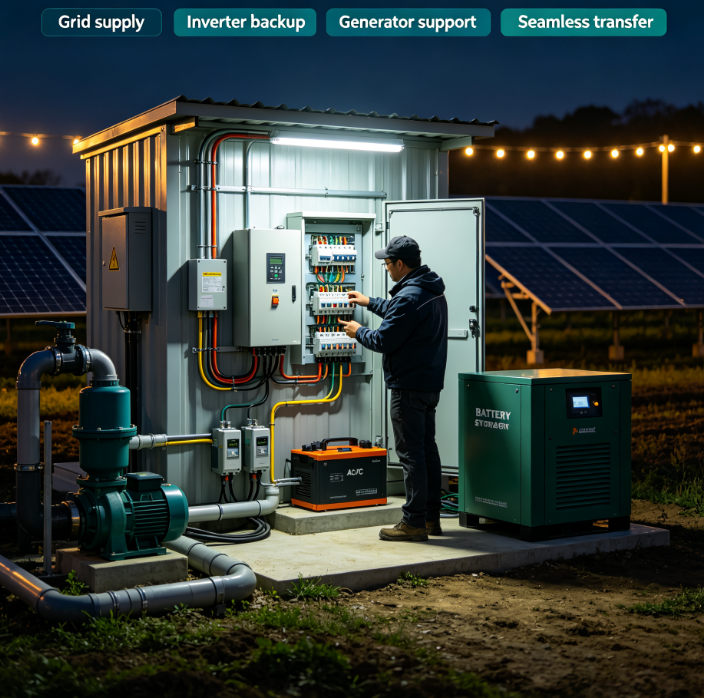
Controllers are rated for full output at 40 C, derated above it by 2 to 3 per cent per degree C, cut-out near 60 C. Inside a sealed dark box in full sun it hits 70 to 75 C and throttles exactly when water is needed most. Mount it on the shaded side of the pole with 150 mm clearance, in a vented box.
Earthing is the other quiet failure. Bond array frame, controller chassis and pump earth to one single electrode, 16 mm2 main run and 6 mm2 frames, targeting under 10 ohm, or 5 ohm on sandy soil. Two electrodes create a potential difference in a strike, which destroys controllers. Fit a DC surge protector rated 1.5 kV or lower.
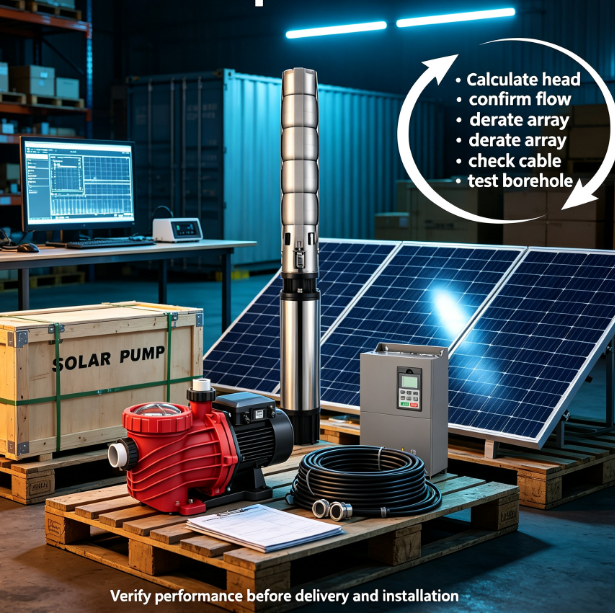
That dealer now quotes cable by calculation, and the same package delivers 41,500 litres. Before the next job: calculate drop hot, buy one size up, tilt for the irrigation months, and give the controller shade plus one earth.