
 DC SOLAR SUBMERSIBLE PUMP
 AC/DC Solar submersible Pump
 DC Solar Surface Pump
 AC/DC solar surface Pump
 Solar swimming Pool Pump
 Built-in Controller Solar Pump
 Solar Pump inverter
 Pump Accessories


 Mr Youkee Kong



How to Size a Solar Water Pump System for Remote Area Water Supply
Sizing a solar water pump system is not guesswork, it is engineering, and a system sized correctly the first time delivers water for decades without grid power. Daily water demand, well depth, static water level, recovery rate, solar irradiance, and pump curve matching all determine the correct system size. This guide walks engineers and project developers through the sizing process step by step, from field measurement to pump selection.
Featured Products:
Determining Daily Water Demand
Start with the water demand, not the pump. Calculate the total daily water requirement in cubic meters per day. For a village of 100 people, the World Health Organization guideline is 50 liters per person per day, totaling 5 cubic meters. For livestock, estimate 40 liters per cattle unit per day. For irrigation, calculate based on crop water requirements and field area.
Apply a peak factor to the daily average. Water demand varies through the day and the season. Multiply the daily average by 1.5 to determine the storage tank capacity needed to buffer demand peaks. The pump must deliver the daily total within the solar window of 5 to 7 peak sun hours.
Measuring Well Depth and Static Water Level
Three measurements define the well: total depth, static water level, and drawdown. Total depth is the distance from the ground surface to the bottom of the well. Static water level is the distance from the surface to the water surface when the well has been at rest for 24 hours. Drawdown is the additional depth the water level drops during pumping.
Measure these values in the field, do not estimate. A well log from the drilling report is useful but may not reflect current conditions. Use a water level meter to measure static water level and conduct a pump test to measure drawdown at the intended pumping rate. These numbers determine the pump setting depth and the total dynamic head.
Calculating Total Dynamic Head
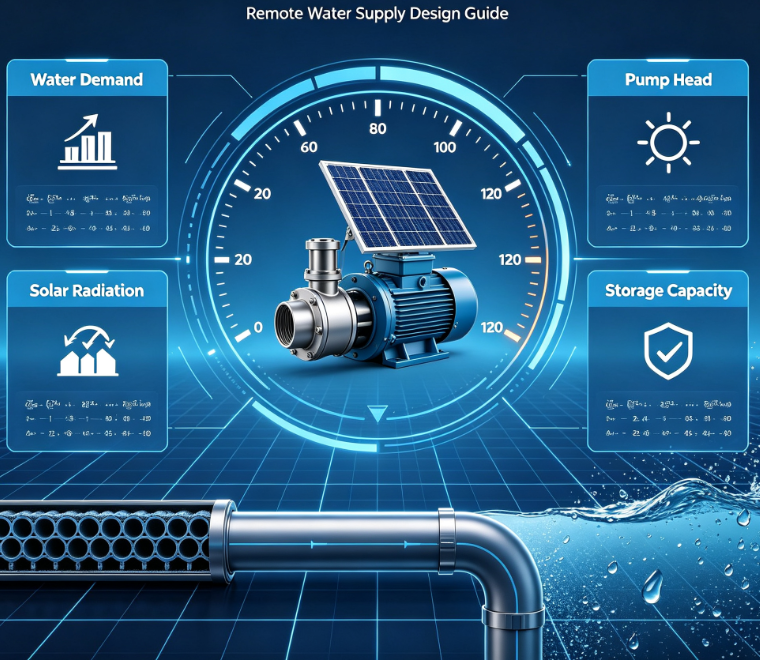
Total dynamic head is the total energy the pump must overcome, expressed in meters of water column. It is the sum of static lift from water surface to discharge point, friction losses in the pipe, and any pressure required at the discharge. For a well with 30 meter static water level, 20 meter drawdown, and 10 meter elevation to the storage tank, the static lift is 60 meters.
Add friction loss for the pipe length. For a 100 meter horizontal pipe from the well to the tank, add 3 to 5 meters of friction head depending on pipe diameter and flow rate. The total dynamic head in this example is approximately 65 meters. The pump must deliver the required flow rate at this head.
Sizing the Solar Array
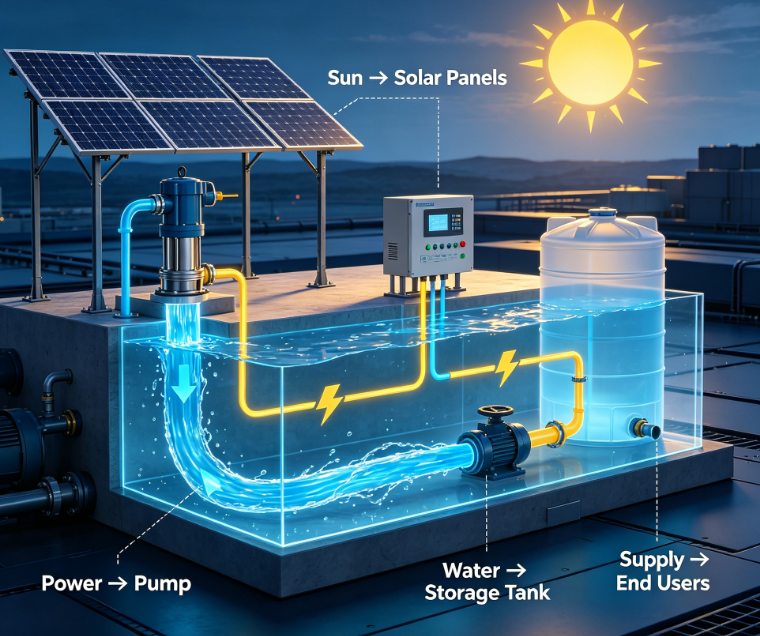
The solar array must provide enough energy to run the pump during peak sun hours. Calculate the hydraulic energy required: flow rate in liters per second multiplied by total dynamic head in meters, divided by pump efficiency. For a pump delivering 0.5 liters per second at 65 meters head with 40 percent efficiency, the required shaft power is about 800 watts.
Size the solar array at 1.3 to 1.5 times the pump rated power. This oversizing compensates for panel degradation, dust accumulation, and non peak sun conditions. For an 800 watt pump, install a 1200 watt solar array. Use an MPPT controller to maximize energy harvest across varying irradiance conditions.
Selecting the Pump Type and Model
For low flow and high head applications, such as deep wells with small daily demand, a progressive cavity or screw pump driven by a DC motor is often the best choice. For higher flow and moderate head, such as surface water or shallow well applications, a centrifugal pump with AC motor and solar inverter is more cost effective.
Match the pump curve to the system curve. The pump curve shows flow rate versus head. The system curve shows the head required versus flow rate. The intersection is the operating point. Select a pump whose operating point delivers the required daily volume within the peak sun hours. A manufacturer offering screw pumps, progressive cavity pumps, and centrifugal pumps can match the right pump to your specific well conditions.
Controller and Tank Sizing
The solar pump controller manages power from the panels to the pump, maximizing daily water output. A quality MPPT controller extracts up to 30 percent more water than a basic controller under variable irradiance. The controller should include dry run protection, overload protection, and remote monitoring capability for unattended installations.
Size the storage tank for 1.5 to 2 times the daily demand. The tank buffers the variable pump output against the variable demand, providing water at night and on cloudy days. For a 5 cubic meter daily demand, install a 10 cubic meter tank. Elevated tank placement provides gravity pressure for distribution without an additional booster pump.
Frequently Asked Questions
How many solar panels do I need for a water pump?
The solar array should be 1.3 to 1.5 times the pump rated power. For example, a 500 watt pump needs 650 to 750 watts of solar panels, which is typically 2 to 3 standard 300 watt panels. The exact number depends on the local solar irradiance and the daily water volume required.
Can a solar water pump work on cloudy days?
Yes, but at reduced output. Solar panels produce 10 to 25 percent of rated power under heavy overcast conditions. The pump controller adjusts flow rate to match available power. For applications requiring consistent daily output regardless of weather, size the storage tank for 2 to 3 days of demand to cover consecutive cloudy days.
What is the difference between a screw pump and a centrifugal pump for solar applications?
Screw pumps, also called progressive cavity pumps, are positive displacement pumps ideal for high head and low flow applications such as deep wells. Centrifugal pumps are better for high flow and moderate head applications such as surface water or shallow wells. Your well depth and daily water requirement determine which type is appropriate.
How deep can a solar water pump work?
Solar submersible progressive cavity pumps can lift water from depths up to 200 meters. For depths beyond 100 meters, a DC powered progressive cavity pump is more efficient than a centrifugal pump. The practical limit depends on the pump power, solar array size, and the daily water volume required from that depth.
Conclusion
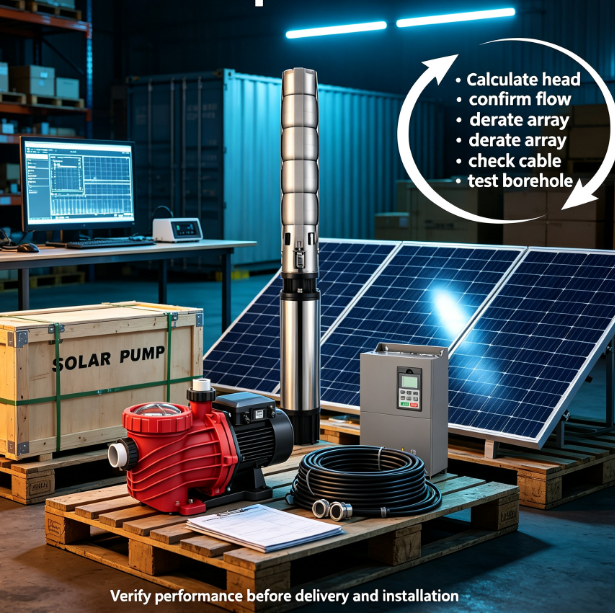
Sizing a solar water pump system requires systematic field measurement and calculation: determine daily water demand, measure well depth and static water level, calculate total dynamic head, size the solar array, select the pump type, and size the controller and storage tank. A manufacturer that offers screw pumps, progressive cavity pumps, and centrifugal pumps can provide the right pump for any well condition.