
 DC SOLAR SUBMERSIBLE PUMP
 AC/DC Solar submersible Pump
 DC Solar Surface Pump
 AC/DC solar surface Pump
 Solar swimming Pool Pump
 Built-in Controller Solar Pump
 Solar Pump inverter
 Pump Accessories


 Mr Youkee Kong




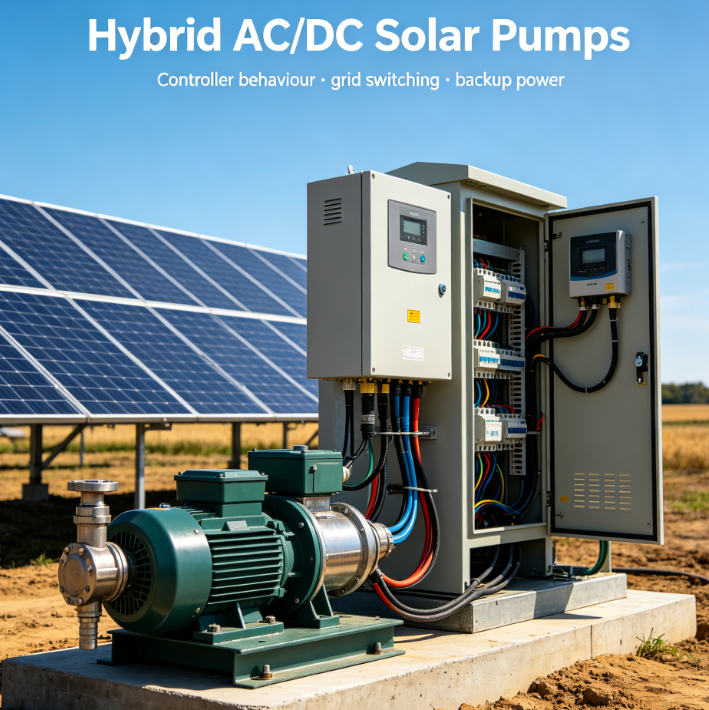
Hybrid AC/DC Solar Pumps: Controller Behaviour, Grid Switching and Backup Power
When a Greek Greenhouse Lost a Week of Water
A greenhouse operator in Thessaly bought a 4 inch hybrid solar submersible pump expecting grid power when the sun failed. The installer left the controller on its factory solar-only default, so on three cloudy March days the pump sat idle through the six hour irrigation window. The grower lost a week of scheduled watering and reported USD 9,400 in lost seedlings before anyone opened the menu. The crop was early-season tomatoes under row cover, and the missed window pushed the transplant date back by nine days. The hardware was fine, but the behaviour was never configured. The 4 inch AC DC hybrid solar submersible pump earns its promise only when priority is set on purpose at install.
What "Hybrid" Actually Means in the Controller
A hybrid controller is a three-input power manager that picks the motor's source. The three states are solar only, grid and blended priority, and each behaves differently. In blended solar-priority mode the unit takes all solar first, then grid, which is what farms want. The trap is the factory default is usually solar only, the safe state, not the best. A dealer should set the priority at install and record it.
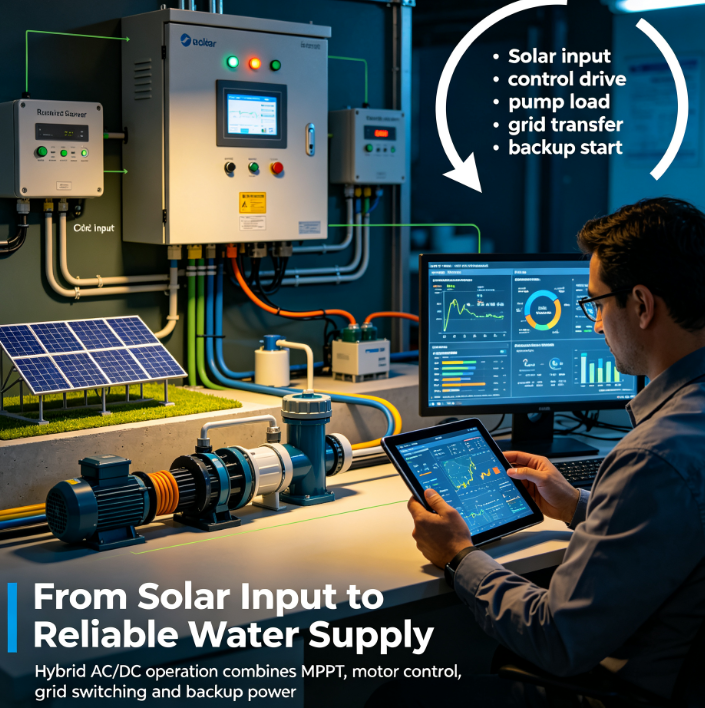
How the Switch-Over Behaves in Practice
When the array drops, the controller must move the motor between sources. A switch-over time of 2 to 8 seconds briefly stops flow. The restart delay of 30 to 120 seconds prevents relay chatter. There is a minimum solar threshold near 120 watts below which the controller will not start. The choice is hard transfer versus smooth blend: a hard transfer can stall a running pump, while a smooth blend holds pressure steady. For drip systems the blended handover is the safer spec. The 3 inch DC deep well screw solar pump keeps array-only logic simple for backup.
Generator Compatibility and Input Tolerance
Rural sites add a generator as the third source, but a controller is unforgiving of weak output. It needs stable 50 or 60 Hz frequency and faults on drift beyond plus or minus 3 Hz. A voltage sag on motor start is the usual killer: a 1.1 kW pump pulls a 40 percent dip at the socket. The rule is to size the generator at 2.5 times nameplate, so a 1.1 kW pump needs a 3 kVA set. Some units accept only a 180 to 264 volt window. A clean sine generator with AVR protects the inverter and avoids burnt boards.
AC Input Wiring and Rural Protection
The grid connection is where installs fail, since the pump installer is rarely an electrician. The AC feed needs a correct cable size for the run, typically 3 by 2.5 mm squared copper. Protection starts with a breaker matched to pump current and a 30 mA residual current device. Add Type 2 surge protection at the board because sites see frequent transient surges. Proper earthing of the controller and array frame is mandatory. The rule is firm: a qualified electrician does the AC side. The 3 inch DC stainless impeller deep well pump needs the same grid protection when hybrid.
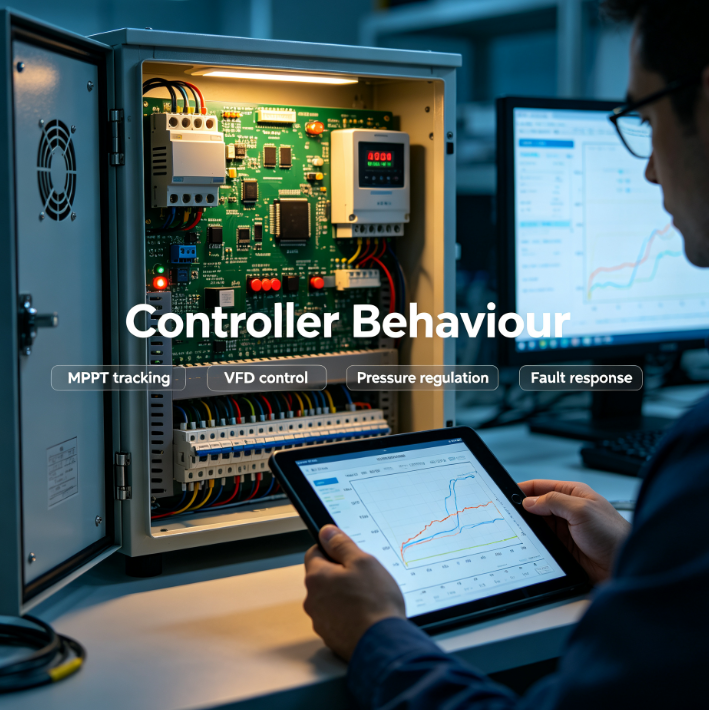
Voltage Cut-Out and the Relay Burn-Out Loop
Controllers protect the motor with low and high voltage cut-out limits that must match the supply. A low cut-out near 170 volts stops excess current on a weak grid. The danger is repeated cycling at the threshold: a relay opening dozens of times per hour burns out in one season. Set the hysteresis band to 15 volts so it does not chatter, and log the high cut-out near 264 volts. A wide dead-band is cheap insurance against a USD 60 relay plus call-out. The 6 inch DC stainless impeller deep well pump draws more current, so its cut-out window needs more care.
Writing the Commissioning Sheet That Sticks
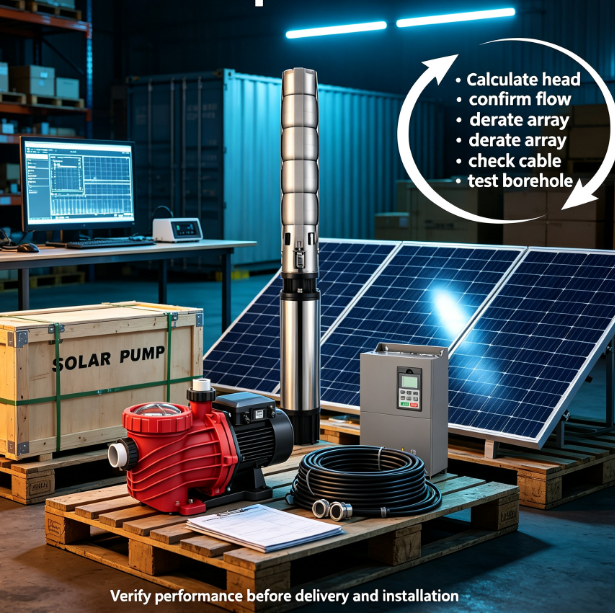
The fix for every argument is a signed commissioning sheet filled at install. It records the chosen source priority and backup order, the minimum solar start threshold, the switch-over and restart delays, and the voltage cut-out values. Add the breaker, RCD and surge ratings and the electrician licence number. A photo of the final controller menu stops disputes. The sheet lives with the warranty file and as-built drawing and is handed to the farmer. Done this way, a fault is diagnosed in minutes.
Questions a Dealer Should Ask the Manufacturer
Before stocking a hybrid, a dealer should pin down the exact controller behaviour under fault rather than trust a brochure. Ask for the switch-over time and blend capability, the minimum start power and restart delay, and the voltage and frequency tolerance. Confirm whether the default is solar only and how to change it, and get the spare relay and board price list. A clear English commissioning guide protects your desk, and a warranty covering misconfiguration beats a low price when clouds hit.
The Bottom Line
A hybrid pump is only as good as its configured controller behaviour, and the Thessaly grower proved a solar-only default idles the pump for a week. Set the source priority to blended solar-priority, know the switch-over time, restart delay and start power, and size any generator at 2.5 times the nameplate. Put the AC wiring, surge and earthing with an electrician, widen the cut-out band to stop chatter, and record every value on a signed commissioning sheet. Do that and the hybrid pump earns its backup promise instead of breaking it on the first cloudy morning.