
 DC SOLAR SUBMERSIBLE PUMP
 AC/DC Solar submersible Pump
 DC Solar Surface Pump
 AC/DC solar surface Pump
 Solar swimming Pool Pump
 Built-in Controller Solar Pump
 Solar Pump inverter
 Pump Accessories


 Mr Youkee Kong



Sizing Solar Submersible Pumps for Community Water Projects
Sizing Solar Submersible Pumps for Community Water Projects: Head, Flow, and Array Math Buyers Must Get Right
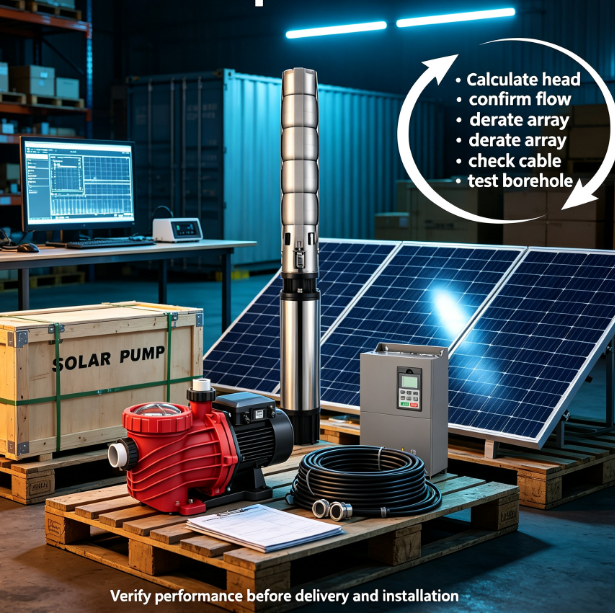
Most failed community water schemes do not fail because the pump is bad. They fail because the pump is sized wrong for the well. A 60-meter deep borehole fitted with a pump built for 30 meters will burn out within a season. A 5,000-liter daily village demand served by a pump designed for 1,500 liters leaves the storage tank empty by mid-afternoon, and the donor writes a complaint letter. Wrong sizing is the single most expensive mistake in solar water procurement, and almost every importer has paid for it at least once. This guide walks through the three numbers that decide whether a solar submersible installation succeeds or drags on a service report: total dynamic head, daily water demand, and peak solar array sizing.
Why Sizing Comes Before Brand or Price
A solar borehole pump is not a finished consumer good you can shelf and resell. It is part of a system: the well depth sets the head, the village population sets the flow, and the local solar irradiance sets the array. Skip any of those three and the system underperforms, regardless of how famous the factory is, how reasonable the unit price looks, or how nice the controller housing is.
This is also why aid organizations and procurement officers who fund these projects write specifications instead of brand names. They require bidders to demonstrate pump selection calculations against site data, not catalog claims. A distributor who can show a sizing worksheet earns trust at tender; one who can only quote capacity figures loses it. That trust translates into repeat orders worth far more than any single container.
The Three Numbers a Buyer Must Confirm Before Quoting
Before a solar borehole quotation makes any sense, three site-specific numbers need to be on the table, in writing, with sources:
- Static water level and pump setting depth, taken from a recent borehole log or pump test, not a verbal estimate
- Daily water demand in cubic meters, calculated from population and per-capita standard rather than guesswork
- Peak solar irradiance in kWh per square meter per day for the project location, sourced from PVGIS or NASA POWER, not from a salesman's memory
If any of these three is missing or fuzzy, the quotation is selling potential disappointment. A reliable supplier will refuse to price the pump until those numbers are confirmed. ZRI's engineering team, for example, treats sizing as a precondition for quoting on its DC solar submersible pump range, and a tender officer is welcome to ask for the matching calculation sheet.

Step One: Calculate Total Dynamic Head Correctly
Total dynamic head (TDH) is the number every other calculation rests on. It combines the static water level, the drawdown when the pump runs, and the friction loss through pipes, fittings, and any check valves. A common shortcut buyers take is to assume the static water level equals the required head. That assumption is exactly how 30 percent of community water projects under-deliver.
The practical rule for community boreholes in regions where ZRI pumps are deployed is to multiply the well depth by 1.3 to 1.5 to estimate total dynamic head, then cross-check against pipe run and elevation. This buffer accounts for drawdown at peak flow and 30 to 60 meters of equivalent friction loss over typical 100 to 200 meter pipe runs. For deeper schemes, the buffer shifts. A 150 meter well with a long horizontal pipe to a storage tank can easily run a TDH of 200 to 230 meters, which is where mid-power DC submersibles like ZRI's 6SC-PV150 range come into their own.
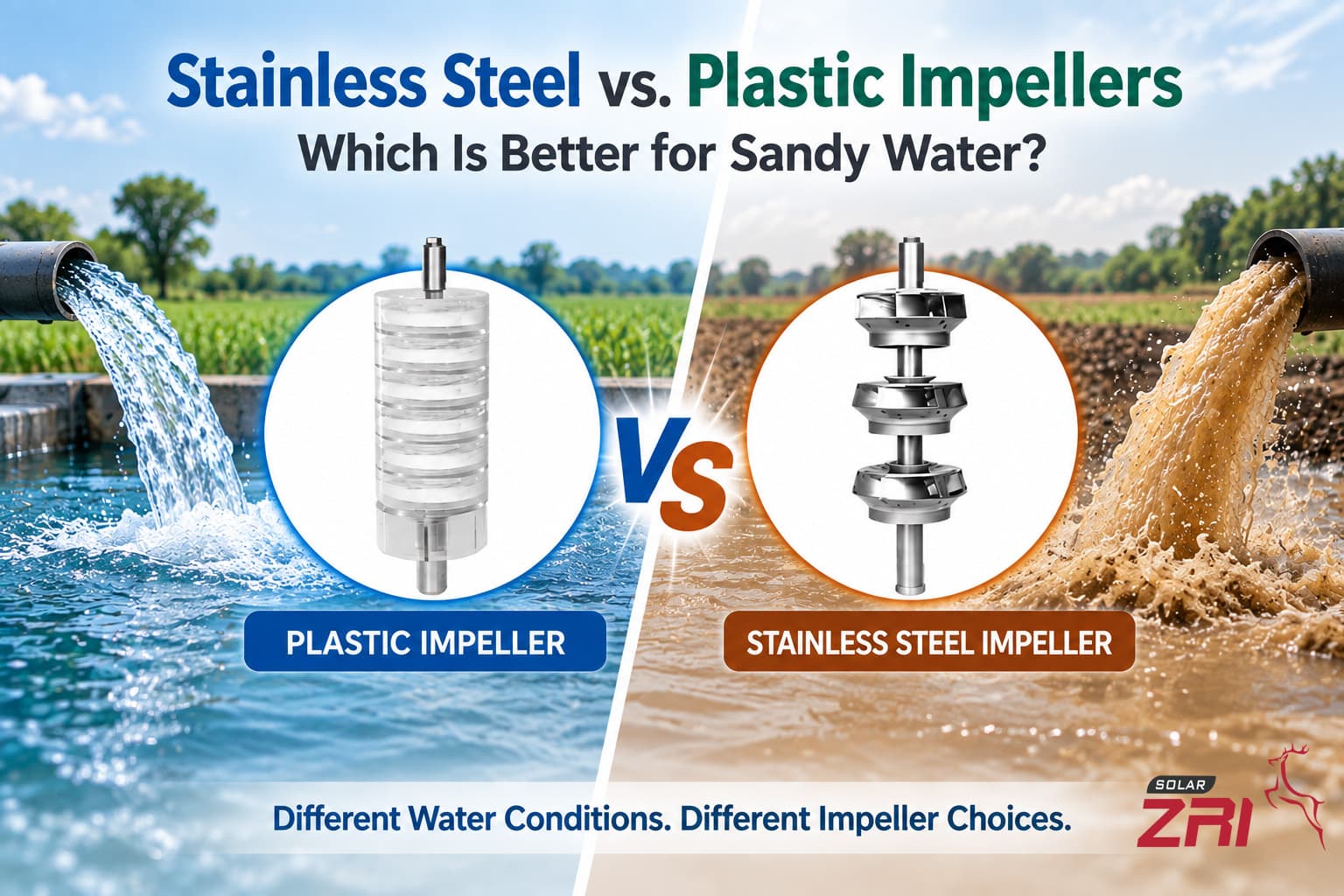
For traders sourcing from China for African, Middle Eastern, or Central Asian projects, the easy mistake is to assume a 4-inch pump covers every medium-depth well. In practice, a 4-inch unit is typically rated up to about 150 meters of head. Once a project hits 150 to 250 meters, buyers should be looking at the 6-inch or 8-inch solar pumping systems, such as ZRI's solar pump inverter and pumping system platform that pairs large-diameter stainless impeller pumps with matched MPPT inverters.
Step Two: Calculate Daily Demand from Population, Not Wishful Thinking
Daily demand is deceptively simple. Take the population served, multiply by the per-capita standard the donor or ministry uses (commonly 20 liters per person per day for rural domestic water, 50 liters for schools, 100 liters for clinics and livestock mixed use), and add a buffer. Skip the buffer and the system will fail on the hottest day of the year, which is exactly when it matters most.
A typical calculation for a community of 500 people using a mixed domestic and livestock standard looks like this. 500 people at 25 liters per day equals 12,500 liters, or 12.5 cubic meters. Add a 1.2 buffer for peak demand, evaporation losses from open tanks, and livestock clustering, and the design target climbs to 15 cubic meters per day. A pump that can deliver this daily volume across roughly 6 to 8 hours of effective sunshine is the right starting point. Pick a pump with too little daily capacity, and the project cannot scale when the village grows, which most villages do within a year of receiving reliable water.
For larger schemes serving a town of 5,000 or more, the math tilts toward higher-flow pumps with correspondingly larger arrays, often in the 11 to 22 kilowatt AC/DC hybrid class. At that scale, the manufacturer's engineering support becomes the deciding factor, not the unit price. ZRI ships projects like these regularly through municipal tender channels, with a calculator-first quotation process that lets buyers match pump, motor, inverter, and array together from day one.

Step Three: Match the Solar Array to the Pump, Not the Brochure
Once head and flow are locked, the array sizing math becomes almost mechanical. A pump drawing 1.5 kilowatts under load needs an array that can deliver that power under real-world conditions, not under laboratory STC. The standard rule for off-grid solar pumping is to oversize the PV array by 30 to 50 percent compared with the pump's nominal input, to compensate for higher temperatures, dusty modules, partial shading, and the angle losses of fixed-tilt mounting.
A 1.5 kilowatt pump therefore wants an array of approximately 2.0 to 2.2 kilowatts peak. That range is large enough to start the pump at low irradiance, run through afternoon clouds, and recover overnight tank level for the next morning's draw. Get the array too small, and the pump runs poorly whenever the sky is hazy, and villagers learn to distrust the system. Get the array too large, and the project spends donor money on unused capacity, which is its own kind of failure during financial audit.
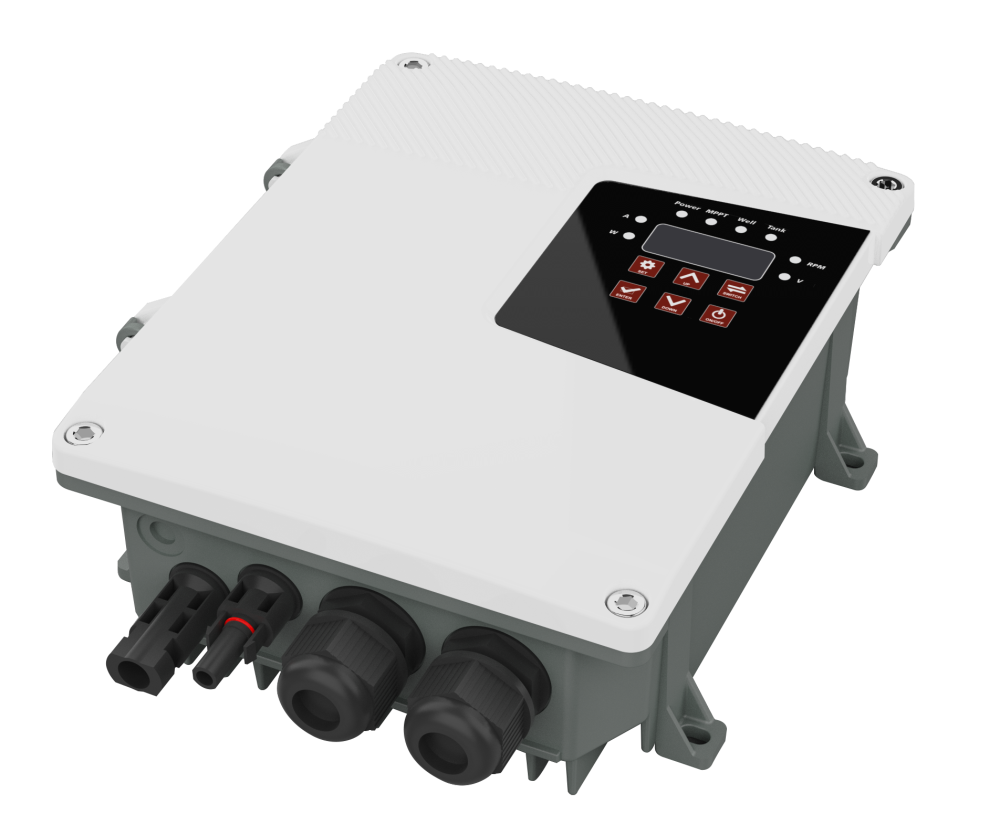
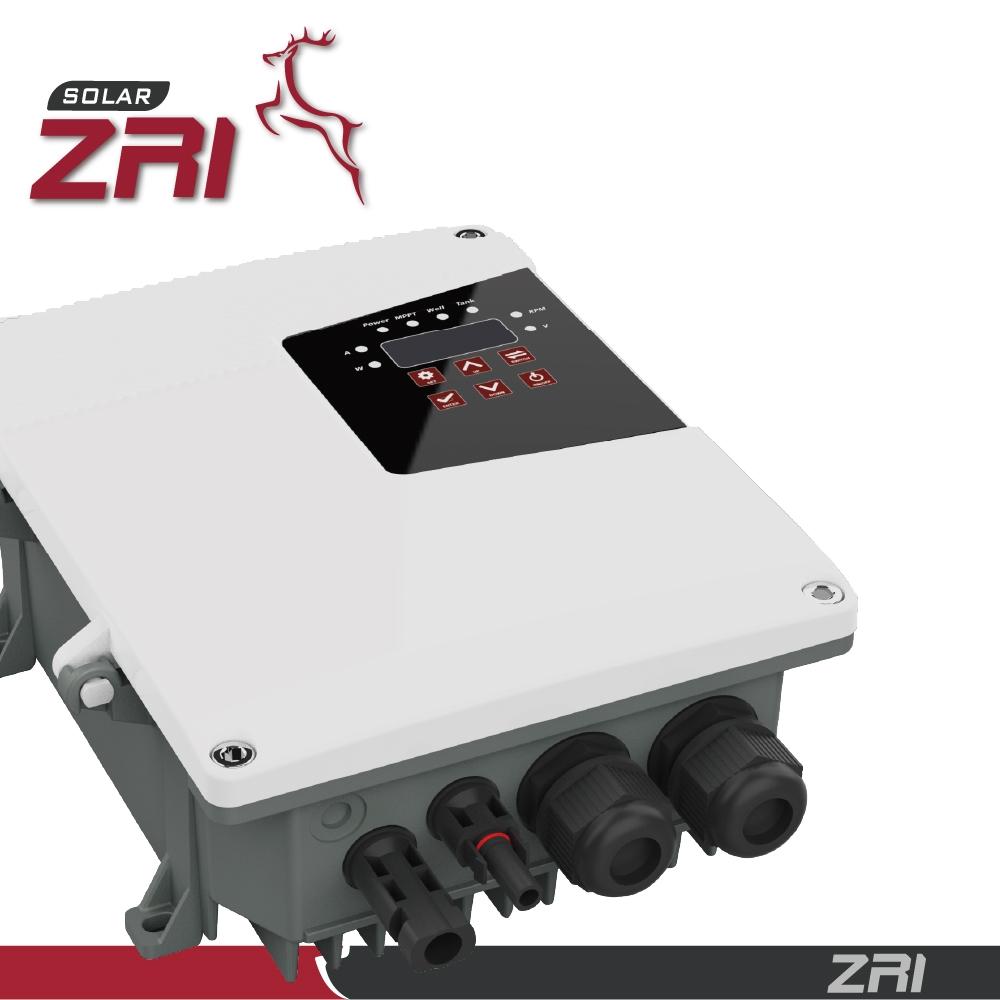
This is where built-in MPPT controllers earn their place on small to mid-range pumps. A separate inverter with full MPPT tracking handles the larger systems, and ZRI supports both ends of the spectrum, from plug-and-play built-in controller DC pumps for small community taps to the matched solar pump inverter systems that drive 4, 6, and 8 inch pumps up to 93 kilowatts.
Sizing Worksheet: A Worked Example
Consider a community of 1,000 people, livestock included, in a region with 5.5 peak sun hours per day. The borehole is 80 meters deep, static water sits at 35 meters, drawdown at peak is 8 meters, and the tank is sited 60 meters higher than the well head. Pipe run is 250 meters of 2-inch HDPE.
Static plus drawdown plus elevation plus friction: 35 plus 8 plus 60 plus approximately 8 meters equivalent friction loss gives a TDH of around 111 meters. Daily demand at 25 liters per person, with a 1.2 buffer, lands at 30 cubic meters. To deliver 30 cubic meters across 5 to 6 hours of effective pump time means a flow rate near 5 cubic meters per hour at the working head. Looking at ZRI's published curves, the 6SC-PV150 system covers exactly this operating point in the 6 inch, 5.5 to 7.5 kilowatt band.
Array sizing starts at the pump input rating. For a 5.5 kilowatt pump, that points to an 8 kilowatt peak array, more if the site has heavy dust or seasonal haze. With pumps, controllers, inverters, modules, mounting structure, cables, water-level sensors, and surge protection added up, the project budget quickly comes into focus. The point of running the math early is not to fix a number; it is to stop the buyer from fixing a number until the math supports it.
How to Read Pump Curves Without Being Misled
Manufacturers publish pump curves showing flow versus head. Read them carefully, because the quoted maximum head is almost never the operating head. A pump rated to 200 meters maximum typically delivers its best efficiency around 60 to 70 percent of that rating. Above the best-efficiency point, the flow drops sharply and power consumption climbs, which both shortens motor life and wastes solar energy on heat.
For community projects, choose a pump whose best-efficiency point sits at or near the project's TDH, with a small margin for seasonal drawdown variation. A pump operating at 120 meters when rated for 200 meters uses more electricity than necessary and barely lasts two seasons. The same model operating at 140 to 160 meters runs cool and lasts a decade. Reading the curve with this in mind separates a sustainable project from one that quietly fails.
Five Questions a Serious Buyer Asks a Solar Pump Supplier
A tender-ready supplier answers these in writing, with curves, drawings, or samples in hand:
- Can you provide a sizing calculation worksheet using the site data we provide, including head, daily demand, and local irradiance?
- Do you supply matched solar array, inverter, controller, and pump from one factory, so warranty is single-point?
- Can you provide the pump curve, not the catalog maximum, for the specific flow and head we specify?
- Do you have reference projects in similar climate and well depth, with names a donor can verify?
- What spare parts, consumables, and installation tooling do you recommend we hold in country for the first year of operation?
Suppliers who answer these confidently, with documents not promises, are usually the ones whose projects are still working five years later. Suppliers who answer with brochures are not. This is also the level of support a manufacturer like ZRI, with 28 years of pump-making history, a 12,000 square meter workshop, and shipments to over 130 countries, is built to provide. Visit the company profile page to see the production base, certifications, and application case studies that back those answers up.
Where Sourcing Gets Easier Once the Math Is Done
Once head, flow, and array are nailed down, the conversation with the supplier changes shape. Price negotiations become a comparison of like for like, with each bidder quoting the same operating point and the same array. Lead time becomes a real number, because the supplier knows exactly which pump, motor, controller, and inverter are being ordered. Installation becomes predictable, because the installer knows the cable lengths, the surge protection, and the tank sensor wiring in advance.
This is the stage where distributors who treat sizing as a competitive advantage begin to outpace distributors who treat it as a back-office chore. They win more tenders, because their bids are mathematically defensible. They keep more customers, because their installations actually deliver water. They earn the right to charge for engineering, which is the most profitable service any solar pump trader can sell.
The Final Word
Sizing is the bridge between a product on a website and water at a village tap. Take the time to do it well, send the math to the supplier before asking for a quote, and choose a partner who treats sizing calculations as a deliverable, not a favor. The pump will only do what the math allows. Make sure the math is honest, the curves are read carefully, and the array is sized for real weather, not for a brochure. Used this way, a solar submersible pump becomes exactly what communities and funders need it to be: a quiet machine that delivers reliable water for a decade or more, with the donor's money showing up as taps that never run dry.