
 DC SOLAR SUBMERSIBLE PUMP
 AC/DC Solar submersible Pump
 DC Solar Surface Pump
 AC/DC solar surface Pump
 Solar swimming Pool Pump
 Built-in Controller Solar Pump
 Solar Pump inverter
 Pump Accessories


 Mr Youkee Kong



0102030405
Solar Water Lifting Projects Based on Well Depth and Water Quality
2026-03-02
Solar Water Lifting Projects Based on Well Depth and Water Quality
Introduction
For customers who have purchased solar water pumps, the biggest headache is often not the price, but incorrect pump selection. Faced with hundreds of models, a mismatch between the pump and on-site conditions can lead to insufficient water flow and low system efficiency in mild cases, or frequent pump failures and premature failure in severe cases, resulting in failed project investment and damaged trust.
The core decision point often lies in pump type selection. Many purchasers and project planners feel confused when choosing between helical pumps and centrifugal pumps, the "golden combination". Based on frontline project experience, this article will clear up confusion for you.
You will clearly master how to accurately select either a helical pump or a centrifugal pump for solar water lifting scenarios according to hard indicators such as well depth, water quality, and daily water demand. This is not only technical but also directly determines the project’s return on investment. Below, we directly cut into the most critical selection logic.
Core Content
1. Working Principles and "Character" Profiles: Why No Single Pump Fits All Scenarios?
To choose the right pump, you must first understand their inherent "character" differences, which determine their respective "comfort zones" and "capability boundaries".
Centrifugal Pump: The "sprinter" pursuing efficiency
It works by converting water’s kinetic energy into pressure energy through a high‑speed rotating impeller to lift water, much like water droplets flying off a rapidly spinning umbrella in a park.
This structure defines its features:
- High efficiency near the rated operating point (up to 50%–70% for high‑quality products)
- Relatively low energy consumption per unit flow
It is highly sensitive to head (simply understood as vertical lifting height + pipeline loss). Once the actual head exceeds the design point, flow drops sharply or even stops, and the motor is prone to overload.
Thus, the centrifugal pump is a typical "high‑flow, medium‑low‑head" specialist, offering outstanding efficiency and flow in stable, moderate‑head conditions.
Helical Pump (also known as Progressive Cavity Pump): The "off‑road endurance king" valuing reliability
Its core component is a rotating metal screw turning inside a rubber stator, forming sealed cavities that "push" water upward like turning a screw.
This positive‑displacement principle gives it key strengths:
- Head capacity mainly depends on pump stages (screw length and stages), easily handling high and ultra‑high heads
- Insensitive to sand and impurities in water due to the elastic rubber stator
- Relatively flat flow‑head curve, providing stable output even with head fluctuations, unlike centrifugal pumps
The trade‑off is that its efficiency is generally lower than equivalent high‑performance centrifugal pumps, and mechanical friction causes some energy loss.
Industry Case Insight
In an East African rural water supply project, designers initially chose a high‑pressure centrifugal pump for a 60‑meter clear‑water well, attracted by its high efficiency. During the dry season, the water level dropped to 80 meters, and the centrifugal pump overheated and burned out after leaving its high‑efficiency zone.
The project team finally replaced it with a multi‑stage helical pump. Although its rated efficiency was slightly lower, it maintained stable water supply despite fluctuating water levels, ensuring year‑round water for the village. Overall reliability and satisfaction far exceeded the previous setup. This case vividly shows that "suitability" is far more important than "high efficiency".
Common User Question: Is a helical pump always the right choice for high‑head projects?
Not absolutely. Although helical pumps excel at high heads, a high‑efficiency multi‑stage centrifugal pump may be more economical and energy‑saving if:
- Head is within 80 meters
- Water quality is excellent (very low sand content)
- Daily water demand is very large (e.g., large‑scale farm irrigation or centralized water supply)
The key is to conduct a comprehensive "working condition – demand – cost" triangular analysis.

2. Selection Decision Triangle: Locking in the Final Answer Using Well Depth, Water Quality, and Water Demand
We now apply theory to specific project parameters. Think of this as a decision triangle with three vertices:
- Dynamic water level of the well
- Water quality
- Daily water demand and supply mode
First Vertex: Well Depth and Dynamic Water Level (Determines Head)
- Centrifugal pump comfort zone: Recommended for heads below 100 meters. Focus on dynamic water level (stable depth during pumping), not just static water level. Beyond 100 meters, multi‑staging increases cost sharply, erodes efficiency, and reduces reliability.
- Helical pump application zone: Performs stably from 50 meters up to several hundred meters. For deep wells over 200 meters, it is often the only reliable choice. Its head can be linearly extended by increasing stages with stable performance.
Second Vertex: Water Quality (Sand Content, Mineral Impurities, etc.)
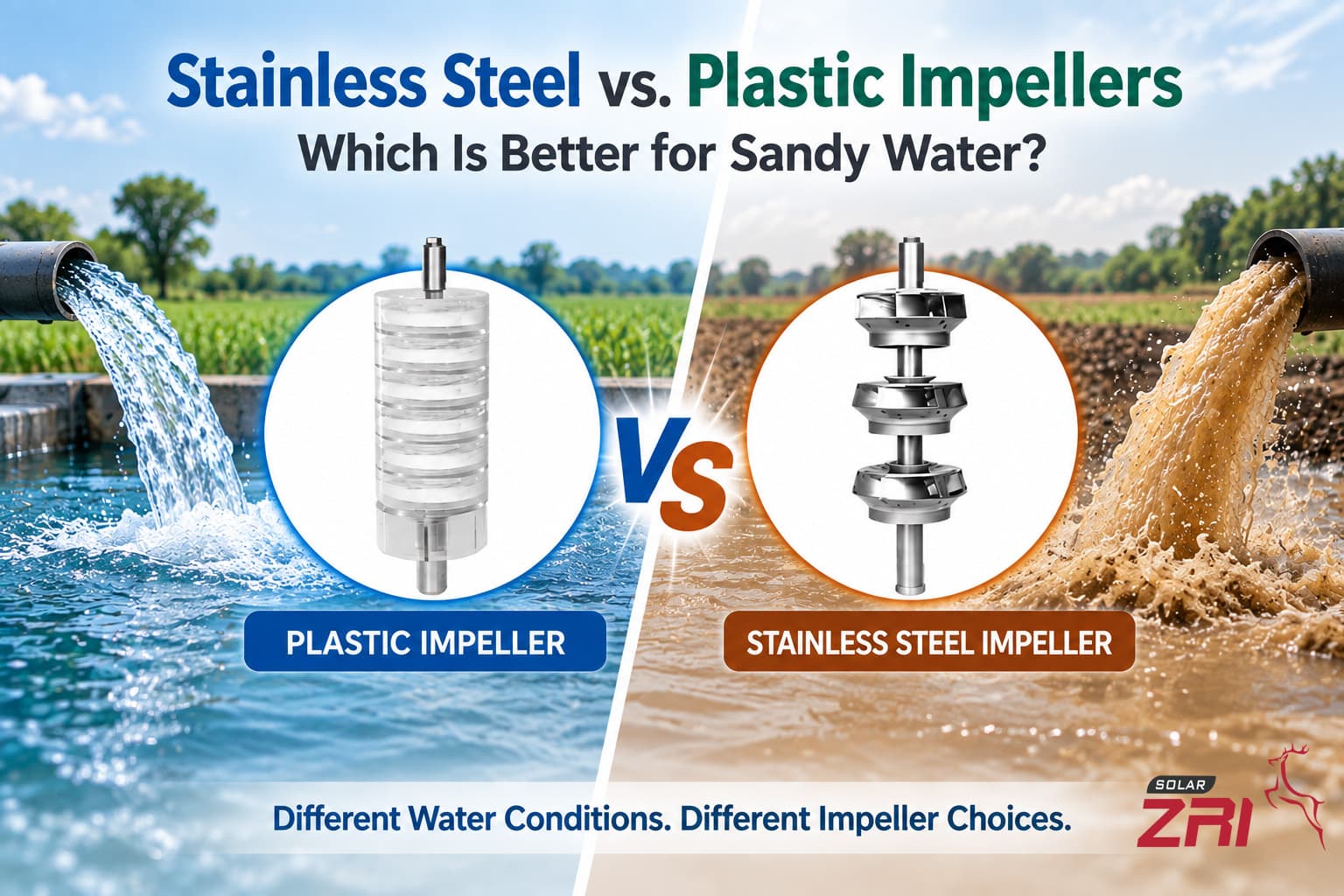
- Centrifugal pump’s "cleanliness obsession": Small clearances between impeller and casing make it highly sensitive to solid particles. Even fine sand causes severe abrasion and efficiency collapse. Suitable only for very clear water (sand content typically < 50 ppm).
- Helical pump’s "tolerance": Rubber stator allows certain particles to pass and offers better wear resistance. It greatly outperforms centrifugal pumps in sandy, brackish, or impure water — a major reason for its popularity in Northwest China, sub‑Saharan Africa, and similar regions.
Third Vertex: Daily Water Demand and Supply Mode
- Large flow demand: For high‑volume water extraction (large farm irrigation, fast filling of reservoirs), large‑flow centrifugal pumps are preferred within allowable heads for high efficiency and speed.
- Stable small‑to‑medium flow demand: For household supply, livestock drinking, or drip irrigation, helical pumps (1–10 m³/h) provide steady flow and naturally match unstable solar power — pumping slowly in low light, stopping when dark.
One‑Sentence Decision Reference:
Prioritize helical pumps for poor water quality and high head;
Prioritize high‑efficiency centrifugal pumps for good water quality, low head, and large flow demand.

3. Beyond Selection: Matching with Solar Systems and Long‑Term Operation
Choosing the right pump is only half the battle. Matching it with the solar system and ensuring stable long‑term operation is what guarantees real project success.
Matching with Photovoltaic (PV) Systems
- Centrifugal pump: Sensitive to voltage and frequency (speed). Requires a matching inverter or controller to maintain high efficiency under fluctuating PV power and avoid stalling or damage. High inrush current demands strong instantaneous output from PV arrays and batteries (if used).
- Helical pump: High torque and smooth startup. Flow is roughly proportional to speed, adapting naturally to solar power fluctuations. In battery‑free direct‑drive systems, it starts slowly and steadily at sunrise, speeding up with more sunlight — perfectly suited for solar energy’s variable nature, with a simpler and more reliable system.
Long‑Term Cost and Maintenance
- Centrifugal pump: Precision components (impeller, mechanical seal) lose efficiency significantly when worn, requiring professional diagnosis and replacement. In remote areas, this means long downtime and high maintenance costs.
- Helical pump: Main wearing part is the rubber stator, which can be replaced by locally trained staff using standard procedures. Although the stator is a consumable (service life 1–3 years, depending on water quality), maintenance is more accessible and predictable, improving overall system sustainability.
Practical Purchasing Advice:
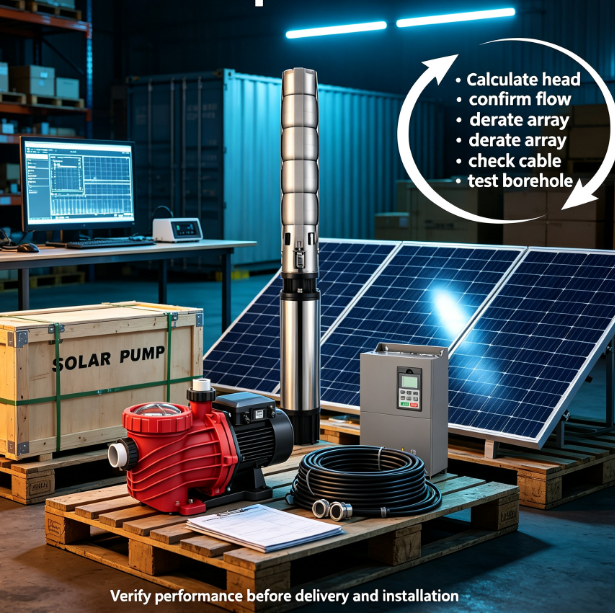
When communicating with suppliers, do not only ask for the unit price. Be sure to provide or confirm:
- Static water level and estimated dynamic water level
- Sand content or basic water quality description (water sample if possible)
- Total daily water demand and usage pattern (peak‑time use or 24‑hour storage)
A responsible supplier will perform simulation calculations and pump recommendations based on this data.
Common User Question: Does the helical pump’s rubber stator break easily? Is replacement expensive?
The rubber stator is a key consumable; its life depends on water quality, operating temperature, and daily runtime.
- 1–2 years in sandy water
- Over 3 years in clean water
A major advantage is that stator replacement usually requires only basic tools and does not require pulling the entire pump out of the well, greatly reducing maintenance difficulty and cost.
When purchasing, evaluate suppliers on stator availability, price, and technical guidance. A supplier offering clear manuals, video tutorials, and stable spare parts delivers far more long‑term value than one with only a low upfront price.
Conclusion
In solar water lifting, helical pumps and centrifugal pumps are not competitors but complementary partners with distinct roles.
Successful project planning starts with clear understanding of on‑site conditions (well depth, water quality) and end demand (water volume, pattern).
Remember this core rule:
- For harsh water quality and high heads, the robustness and reliability of helical pumps are invaluable.
- For good water quality, medium‑low heads, large flow, and optimal efficiency, centrifugal pumps shine.
Your choice defines project reliability, water security, and lifecycle return on investment. When evaluating your next solar water lifting project, return to this fundamental helical vs. centrifugal selection logic — it will be your most reliable blueprint for smart, long‑term decisions.
FAQ
Q1: Our project has acceptable water quality but a very deep well (over 150 m) and large daily water demand. Is there a balanced solution?
A: This "high head + large flow" conflict requires careful weighing. At ultra‑high heads, multi‑stage centrifugal pumps face high failure risks and efficiency loss. You can evaluate large‑flow helical pumps, which offer reliable output despite slightly lower single‑unit efficiency.
Another option is to ask professional suppliers about a combined "centrifugal + helical" multi‑stage boosting system, though this increases complexity and cost. The most practical approach is to baseline on helical pumps, compare with custom high‑head large‑flow centrifugal pumps, and focus on long‑term operating costs and risks.
Q2: How to quickly judge if water sand content is suitable for a centrifugal pump?
A: A simple on‑site method:
Fill a clean transparent bottle with water, let it settle for 24 hours. Observe sediment thickness at the bottom.
- If the sediment layer is very thin (< 1% of bottle height) with extremely fine particles, water is likely pump‑friendly.
- If a clear layer or coarse particles are visible, sand content probably exceeds the centrifugal pump’s limit.
For accuracy, use test strips or lab analysis, but the settling method provides a fast preliminary risk warning.
Q3: How do helical and centrifugal pumps differ in startup and low‑light performance in solar direct‑drive systems?
A: This is a critical difference.
- Helical pump: Thanks to positive displacement and high starting torque, it rotates and pumps slowly under low light and low voltage, achieving "light = operation" with high solar energy utilization and smooth running.
- Centrifugal pump: Has a minimum startup voltage and power threshold, below which it cannot start and may overheat. Once running, speed, head, and flow drop sharply at low power, often failing to lift water effectively.
Thus, helical pumps are usually more adaptable and reliable in battery‑free direct‑drive systems with large PV power fluctuations.
Meta Description:
Struggling with helical pump vs. centrifugal pump selection? Based on real solar water lifting projects, this article clarifies how well depth, water quality, and flow determine pump type. Master the decision triangle, avoid selection pitfalls, and keep your solar water pump project efficient and reliable. Read now for a professional selection guide.
Keywords:
solar water pump selection, difference between helical pump and centrifugal pump, deep well solar water lifting, sand‑resistant water pump, pump selection for solar irrigation system